

In this essay, based on the two projects Community Walk and Becomings, I propose that commoning design processes expand our shared understanding of co-creation by creating relational spaces where diversity, sensuousness and unpredictability can co-exist.
Commoning
Commoning is a fairly new concept that describes processes in which people co-create something new – a work of art, a practice, a space or a relationship. Unlike co-creation, commoning is not just about developing a joint product but about creating the community itself through action.
The concept is mainly used in artistic and academic contexts to challenge rationales of competition and notions of the privileged position of human beings, in part by insisting on dependence, care, play and togetherness. It is not just a method but a way of being together, where many voices, hands and perspectives become interwoven.
Expansions of the concept of co-creation
For the past two decades, co-creation has been a key concept in design research and innovation practices. Researchers, such as Liz Sanders and Pieter Jan Stappers, have defined co-creation as processes in which designers and users together develop ideas, products or solutions through dialogue and knowledge sharing (1). This approach has played an important role in democratizing the design field and acknowledging users’ experiential knowledge as a significant aspect of the design process.
However, while Sanders and Stappers’s understanding focuses mainly on human actors and communicative modes of collaboration, my research aims to expand the field towards a materially relational and site-sensitive understanding. Co-creation not only involves people; materials, places and atmospheres act as co-creating actors that shape and transform the experience of the design product and/or process.
This expansion is based on the insight that design is not just a planned activity but involves continuous intra-actions. Design emerges through what happens in between – in the encounter between maker and material, between intention and chance, between body and place. Commoning design can thus not be reduced to a tool or a strategy but must be understood as listening practices; an ethical engagement in what has not yet been given form.
Commoning processes occupy an ethical-aesthetic field where the designer must adopt the role of listening host. This receptiveness is not passive but an active sensibility to co-creative participants, the potential of materials, situated atmospheres and the unanticipated events that always occur or are present in interstitial spaces between people, materials and place.
Karen Barad – Intra-action (2007)
Karen Barad, professor of Feminist Studies and Philosophy at the University of California, Santa Cruz, distinguishes between interaction and intra-action.
- Interaction: independent entities (for example a person and an object) affect each other from outside.
- Intra-action: people and materials do not exist as separate entities but are created and shaped through relational processes.
In artistic research, this means that meanings emerge through shared becoming, as bodies, materials, places and discourses are interwoven. In the text I do not use Barad’s concept directly but instead use the terms interaction and action. My work reflects Barad’s position that we are shaped through our relational acts.
Community Walk: Body, material and relations
To me, clothing and costume design unfold in dialogues between the visual and the sensuous – between expression and impression. I have always been interested in the relationship between body and material, and a core aspect of my practice is to explore how they mutually shape and influence each other. I often use my own body as an active design tool, a way of sensing clothing from inside and experiencing the potential of a material through movement.
Community Walk emerged in natural extension of these embodied studies. With this project, I aimed to challenge my own boundaries by moving my body–clothing experiments into the public space while simultaneously exploring what relations might emerge when a piece of clothing physically connected me to another person.
The first incarnation took place during the Metropolis festival Wal(k)ing Copenhagen (2020). For the occasion, I had created a yellow two-part full-body costume that linked me to one other person through elastic connections. During a 12-hour period, I walked while connected to 12 different guests – spending one hour with each – and invited them to initiate acts. Each guest brought in new perspectives, thus becoming unique co-creators and co-hosts. With each guest I investigated how the costume, our movements/acts and the rhythms of the city shaped our acts and experiences.
The costume challenged us to stretch – towards each other, objects, surfaces and passers-by – and navigate in the unpredictability that is always present in a public space. I experienced how the colour of the costume made us visible and vulnerable, while the stretchy materiality also created a safe, playful space where the surroundings – columns, trees, benches and wind – became part of our joint choreography. Despite our physical connectedness, our perceptions of this joint choreography and our reactions to our surroundings often differed. As host, I had to listen, sense and navigate in these diverse reactions and relations while also dealing with my own bodily reactions. A common aspect of these experiences was that the colour and stretchy fabric of the costume enhanced our attention – to ourselves, to each other and to the places we moved through – in ways that were new to all of us.
The physical traces of the guests actions
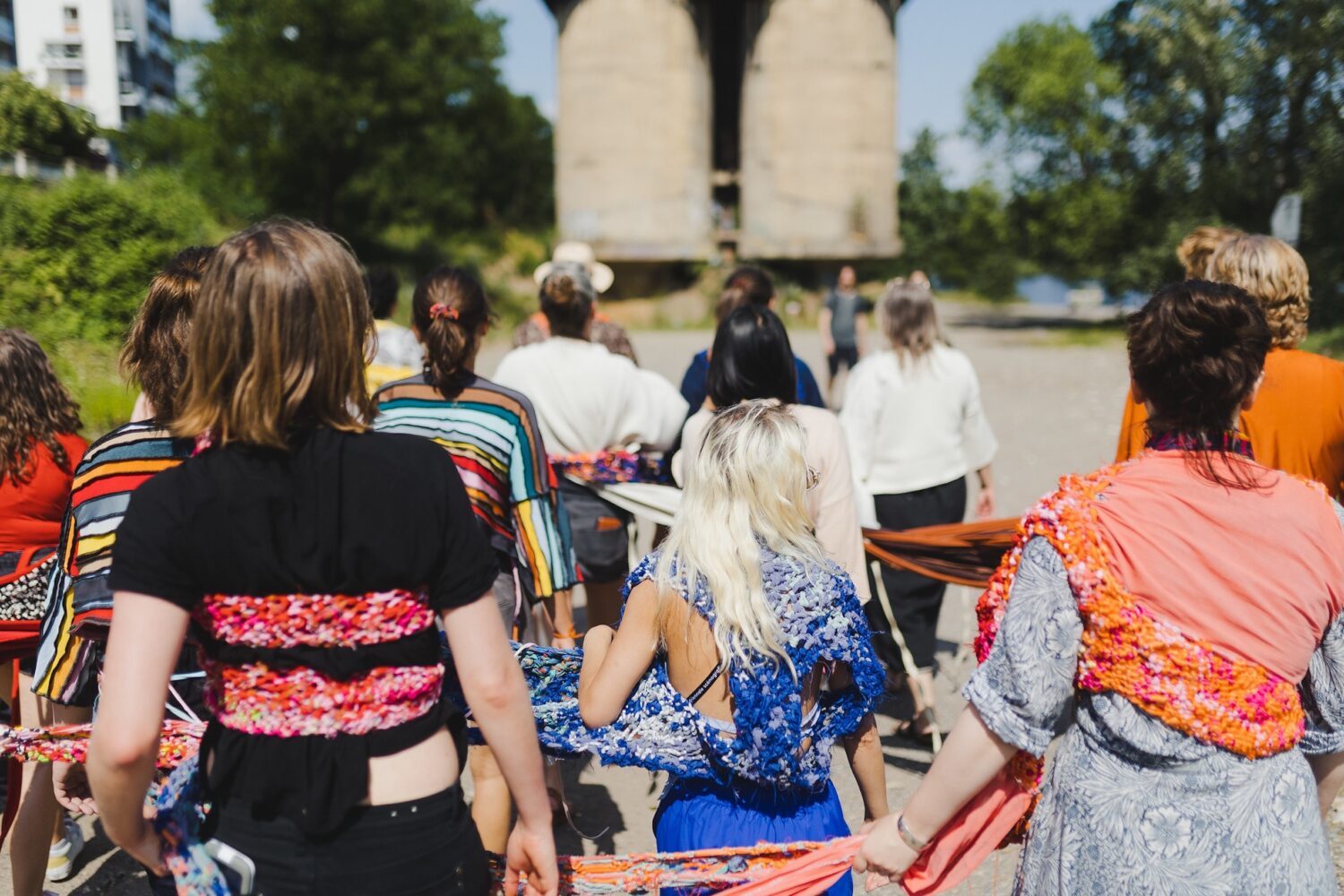
Since this first incarnation, I have further developed Community Walk into series of site-specific and commoning walks, where up to 24 guests – 12 connected pairs – can take part. For the purpose, I have created 12 unique costumes: all one-size, sewn or knotted in a wide colour palette of stretchy materials. The walks have taken place at the 15th Prague Quadrennial for Performance Space and Design (2023), SWOP Festival (2023) and Performing Landscapes (2025), among other settings, and in educational contexts.
The participants have included both children and adults. In my experience, children often intuitively explore the possibilities (and limitations) of the costumes, while adults may be more reluctant – perhaps because they want to be polite, are insecure or are afraid of overstepping my boundaries or the limitations of the costume. However, once the individual participant surrenders to the walk and the exploration of the costume, the result is often an open, playful community – not just among the interlinked pairs but in the group as whole.
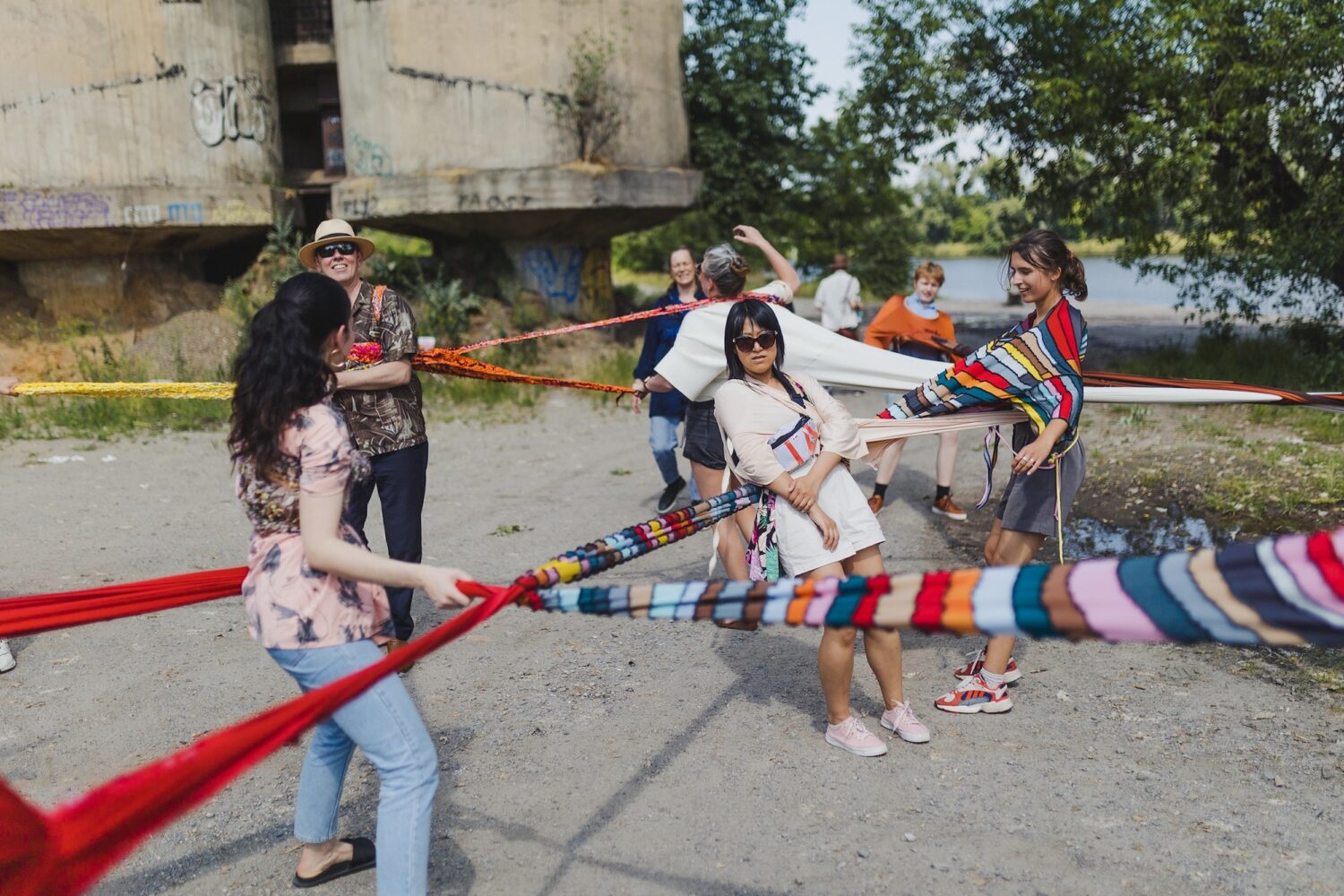
You might claim that Community Walk maintains a classic notion of design, in which I, as the designer, create the visual expression and plan the walk. On the other hand, I always invite the participants to challenge the limits of the costumes and to follow the creative impulses that arise in the encounter between material and place. In the process, the costumes are stretched, pulled, dragged and wrapped around objects and people – and after each walk, they carry the physical traces of the guests’ actions. Holes need to be mended, certain sections need reinforcing. And even though I plan a route, unforeseen situations and encounters always change the walk. Thus, the route is more loose, open framework than fixed plan.
A particular sensitivity to resources
In each version of Community Walk, playful and explorative interactions arise between costumes, participants and places. In contrast to the first experiment, this means that there are always several pairs, and thus, guests may ‘hide’ in the group, which makes the visibility and vulnerability less ‘confrontational’. Furthermore, surprisingly quickly, the pairs begin to interact; often, two or more pairs get tangled up in improvised choreographies, as the costumes turn into hammocks, trampolines, balancing points or places of rest. Each group evokes its own choreographies and relational dynamics, with some pairs leading and others following, while some remain on the periphery of the group. It is rarely clear whether the relational space is shaped by one or more of the pairs, the costumes, the place or the atmospheres – but the relational dynamics always shape the walk and act as the commoning force.
As in the first version, I always take part as an active host – listening and sensing. I try to adapt to the rhythms and dynamics of the specific group, the atmospheres of the place and unanticipated encounters that happen in the process. Listening is a way of becoming – together with the group – and of letting material, place and community shape each other. Each walk teaches me new ways of carrying, moving and connecting myself with the costume and the group. Thus, in Community Walk, play and improvisation are not just methods but ethical design approaches that open spaces for commoning relations between body, material and place. Building a community calls for a certain kind of listening or, rather, listenings. We sense in different ways, so I, as the designer and host, need to constantly attune and re-attune my sensibility in relation to the group, the place and the atmosphere. This open attentiveness is the condition for the unforeseen – what we do not yet know – to take place in our (creative) explorations of costume and walk. In Community Walk, design goes from being a method to becoming a way of being: a practice that does not seek consensus but which cultivates presence, care and diversity as creative resources.
Becomings: Textile connections and material listening
One of the key ethical questions today is how to act as hosts for the materials we use – as designers, artists and human beings. What does it mean to take responsibility for the life, movements and potential of materials – including after an artwork or a product leaves your hands? When I create something from textile materials and send it into the world, the materials continue to engage, connect and transform. This makes me not just a maker but a host – for the materials, for their previous and future lives and for the relations they set into motion.
This issue is at the root of Becomings, which explores what sorts of communities may arise between people and materials. The project also builds on my artistic PhD (2), which draws inspiration, in part, from Donna Haraway’s concept of making kin (3): the notion of generating kinship across species, materials and times. Kin-based communities where hands listen, materials speak, and dialogues arise.
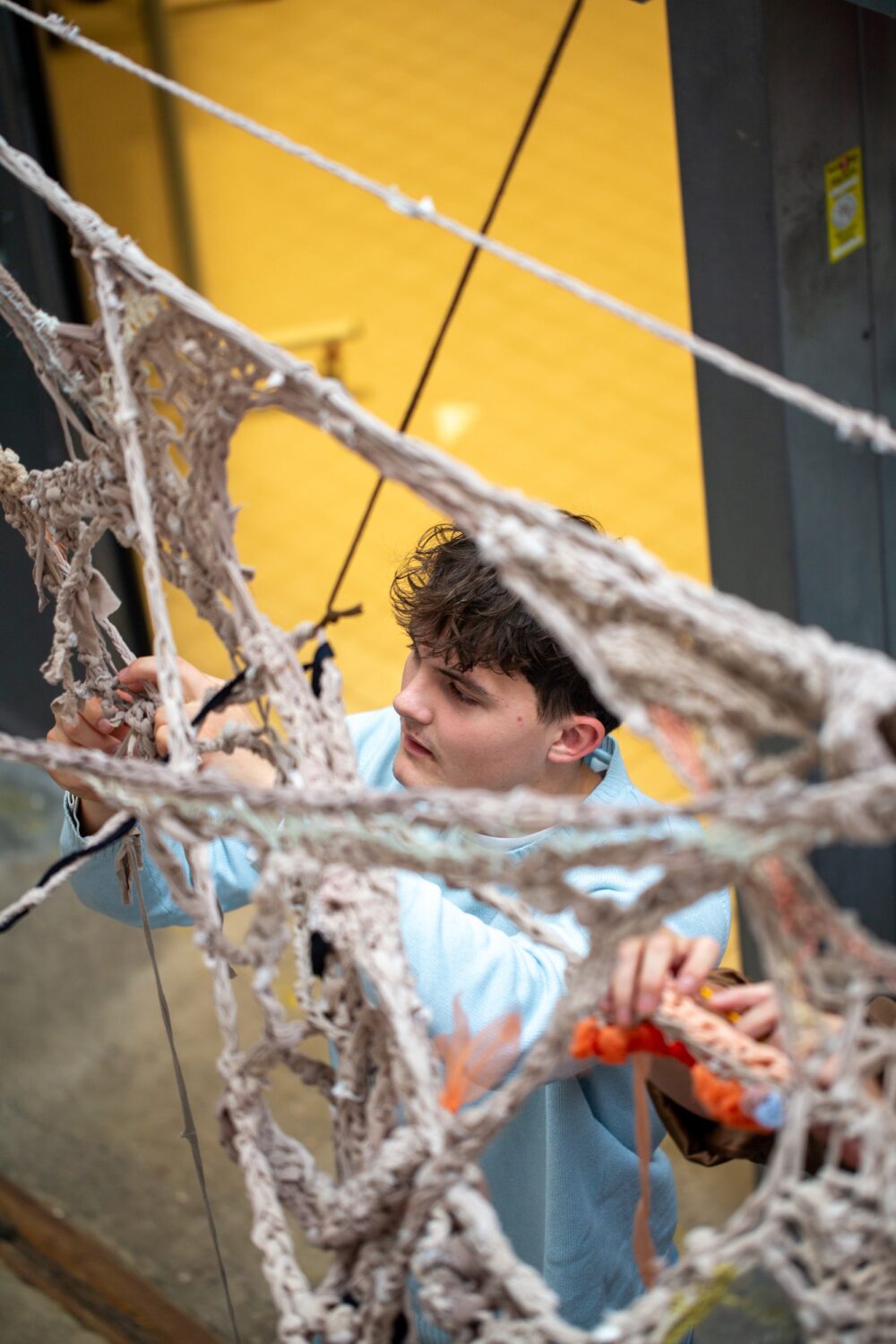
In Becomings I invite the participants into a sensuous commoning space, where they become active co-creators of a work of textile art. My intention – and hope – is that the piece will be shaped and reshaped by the participants’ hands and presence and that their engagement will make it a living, changing community(creation) of bodies, materials and movement.
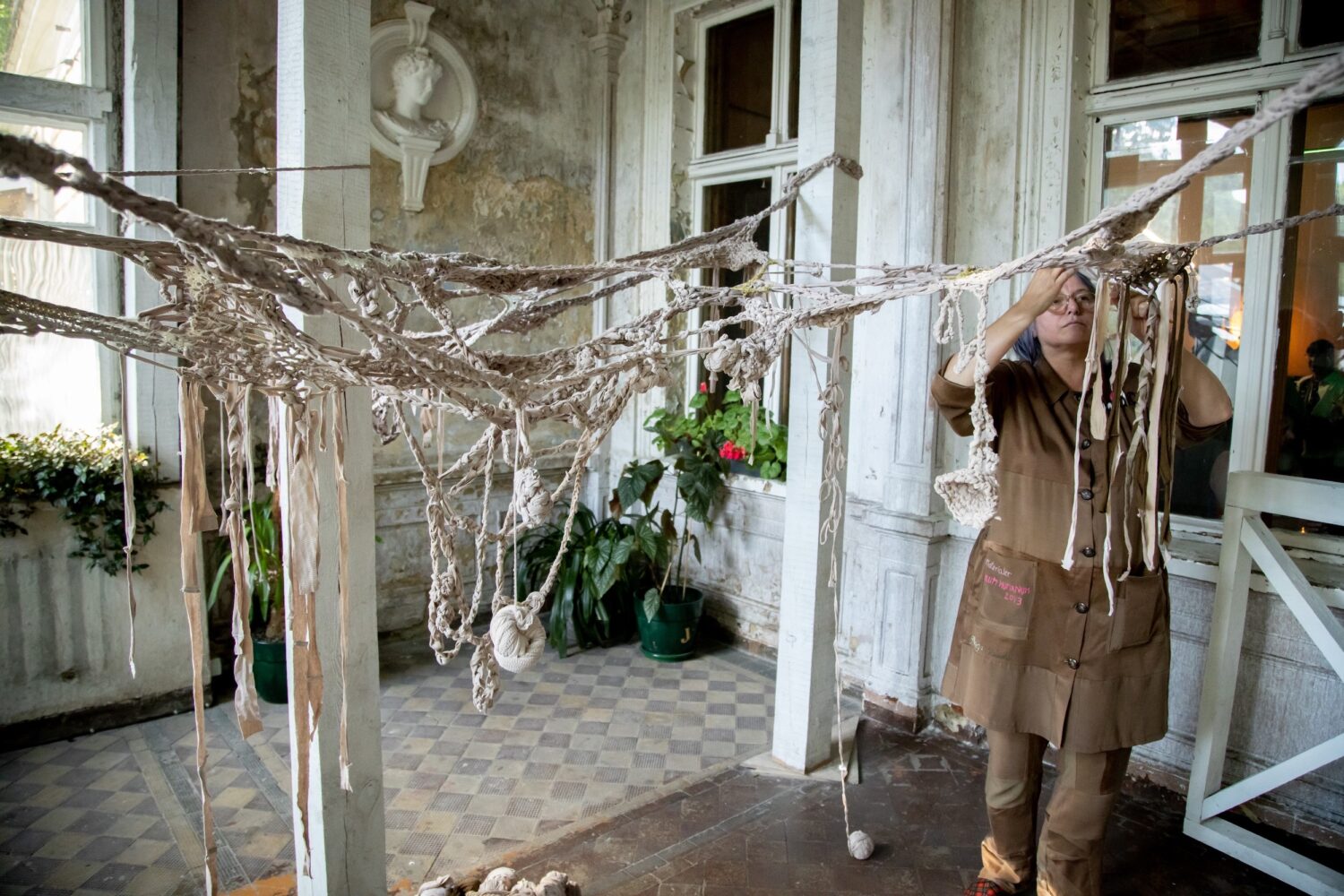
In the project, I only work with textile materials that carry traces of former life. Some come from costumes I created for the Kitt Johnson/X-act performance Forum Humanum (2013), which I cut up and transformed into balls of yarn. The traces for the materials’ former use and/or contexts may only be visible to me, but they form an experiential and sensuous foundation for the project. One key premise is to enable materials to enter into new relations and meanings in community with others while honouring their earlier relations.
The core gesture of Becomings is the knot – both as the concrete act of knotting and as a symbol of connectedness and community. The participants are invited to tie, loosen and stretch knots in a form of co-crafting, where the material is an active participant in the process. Knots tie ends together but also enable new relations between hands, bodies, textiles and places. By tying and loosening knots, the participants become part of a living textile organism in constant motion – a web of temporary and permanent connections. Even minor contributions become traces in an open process, as the piece is continually transformed by the new communities it enters into.
As designer and host, I curate the materials and the context but without directing. I do not teach the participants how to tie the knots, and I do not correct their actions. I provide an open structure, where the expression is up for negotiation. By relinquishing control over form and result, I make room for the participants’ interpretations. I position myself in the space between master and novice – a listening place where I curiously examine what each gesture, each knot, each bind, each movement can teach me.

A changing work of art
Becomings is not a work of art in the traditional sense but a walk among events and festivals – a practice in constant motion.
The project travels from place to place, collecting traces, atmospheres and stories from the communities it encounters.
It began on a small scale during a talk I gave at the annual meeting of the Danish Crafts & Design Association in March 2025. Since then, it has developed into participatory performances presented in a variety of settings, including the opening of the exhibition This Emerging World: Wowen with Textiles at Lundsgård Gods (April 2025), Riga Performance Festival Startelpa (May 2025) and the Fabrika Kbh festival (October 2025).
Each repetition documents its own encounters and transformations; the piece is constantly changing and is more process than object. The actual work of art is the creation of spaces where community, sensuousness and care can take shape in the encounter of people and materials.
To me, Becomings is a way of listening to community – not as something given but as something that continually comes into being through relations, movements and materiality. With inspiration from Sara Ahmed’s understanding of orientation towards the unknown (4) and Eva Skærbæk’s ideas about care as a relational practice (5), I aim for a design concept where creating and caring for merge into one.
In Becomings, community and commoning are not a structure but a becoming – a tactile-relational interaction where people and materials interweave. It is a slow, listening practice, where care functions as an active material, and where design is not just shaped but connects. Here differences and polyphony are not evened out but are allowed to resonate – as an open web of relations in constant motion.
Final reflections
To me, community-building through design is an ongoing negotiation between making room and taking responsibility – a form of hosting, where sharing becomes both an ethical and a poetic gesture. In commoning, the key goal is not just to invite others in but to let yourself be moved and changed by what emerges between us. Thus, the host’s role is not neutral; it calls for sensitivity to both the human and the more-than-human actors that are involved. The key is to provide conditions for different voices – human, material, site-specific – to co-exist side by side without being homogenized but instead being allowed to resonate.
This understanding of commoning design thus departs from the notion of design as giving shape to a product and moves towards a practice that is shaped through relations. The common focus is not a goal but a continuous becoming – a tactile-relational interaction and a temporal field where care, attention and play are interwoven. Listening becomes a way of being: a sensuous and ethical position that requires a willingness to be touched, to give into the voices of the material and the situation.
In this context, hosting becomes a tool for cultivating open and polyphonic spaces where diversity is not perceived as a rupture but as a necessary condition for commoning. Play and improvisation act as catalysts to unanticipated meetings – places where mistakes and hesitation take on value and where the designer has to relinquish control in order to enable something new.
Sharing without homogenizing thus means insisting on the porous and ever-changing character that defines any community. The common must be kept open to allow materials, people and atmospheres to shift and become anew. In this movement lies a hope: that design can not just shape the world but can also help keep the world open and receptive – to change, to care and to not-yet-known ways of being together.
About the author
Charlotte Østergaard (PhD): artistic researcher, textile artist, clothing and costume designer. www.charlotteostergaard.dk
References
- Liz Sanders & Pieter Jan Stappers, Convivial Toolbox: Generative Research for the Front End of Design, BIS Publishers, 2012.
- Charlotte Østergaard. 2024. Crafting Material Bodies – exploring co-creative costume processes. PhD dissertation. Lund University. https://www.researchcatalogue.net/view/3184425/3184426
- Donna Haraway. 2016. Staying with the Trouble – making kin in the Chthulucene. Durham and London: Duke University Press.
- Sara Ahmed, Queer Phenomenology – Orientations, Objects, Others, Duke University Press, 2006.
- Eva Skærbæk, Leaving Home? The ‘Worlds’ of Knowledge, Love and Power, Athena, 2009.
- Karen Barad, Meeting the Universe Halfway: Quantum Physics and the Entanglement of Matter and Meaning, Duke University Press, 2007.
Theme:Various bodies
Crafts and design are closely linked to materiality, sensuousness and the physical – both in the inherent qualities of the works and through the hands that shape them.