
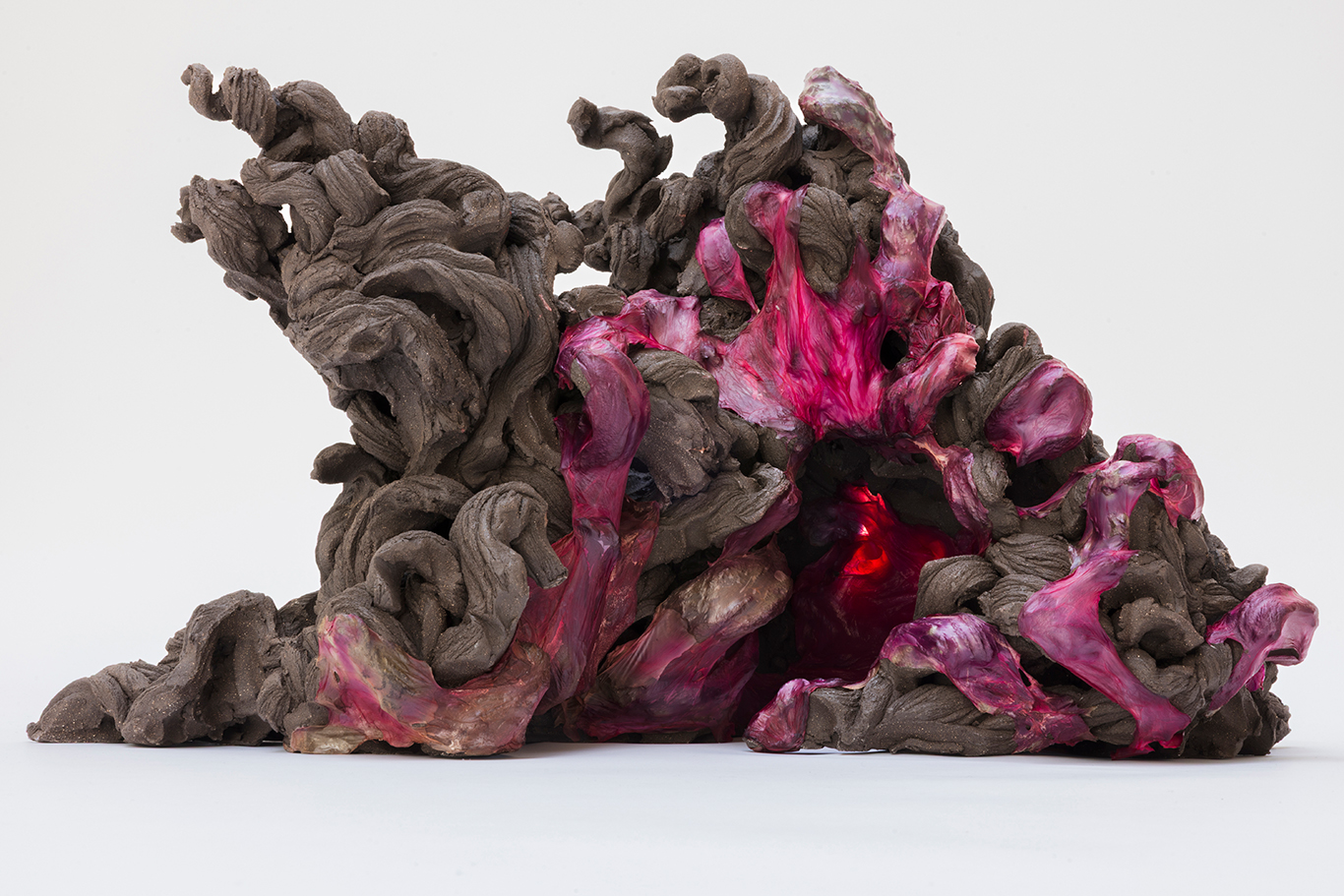
When we encounter art, we do so as living bodies that feel, react and interpret. The encounter between body and art creates a field where creation, expression and experience merge. Understanding the body as the foundation of art is crucial to understanding the essence of art. The body is not merely a medium for art, but an inevitable and active co-creator of both artistic expression and the way in which the work is experienced. At the same time, materiality plays a central role in this interaction between body and art. Materials are not neutral – they have texture, weight, temperature and history. They influence how the body moves, how the artist shapes their expression and how the viewer encounters the work. In this space – between body and material – something sensual and changeable arises, where the form of art becomes a physical imprint of both the inner and outer human being and the world around it.
Artists Marie Breyen, Anne Søgaard Frandsen and Magdalena Köb each work with the body in their own way in their art of glass and ceramics, respectively. For them, the body and materiality have always been crucial factors in their work and intuitive approach to creation and design. Formkraft spoke with the three artists to learn more about how they work with the body in art through craftsmanship and materials.
Bodily intuition and intention
Bodily intuition, natural intention and process are something that all three artists emphasise as essential to their work. This includes both the physical body and its movements, but not least the inherent nature and experience that the body possesses. They all describe how the creation of works becomes gentle and fluid, meditative and intuitive.
Glass artist Magdalena Köb explains:
“The body is really important as part of the process when I create works of art. As a glassblower, the body is always in motion, and you have to be careful not to think too much about the movements, but to be in a place where they come naturally.
For me, it is best to be in a place where the movements and creation come from an intuitive place.”

Marie Breyen, who is also a glass artist, agrees with this point and elaborates:
‘For me, creating works of art is a meditative process. When working with glass, you use your lips, breath and hands. It is a very delicate and quiet craft, where the body works together with the material. The craft is not only noisy and rough, as is often believed, but also has a quiet and profound side.’
It is precisely this meditative character that ceramicist Anne Søgaard Frandsen also experiences in her work with clay:
‘For me, it is also a meditative experience. Time disappears, and you are rather in a strong flow. The craft becomes a form of language first and foremost,’ she says.
The process, in which the body leads the way, is a central part of their approach to and work with both ideas and materiality. Breyen explains:
‘For me, the final work is just as much the process as the physical object that is created. I don’t have a process and then a product – my product is always also my process.’

Søgaard Frandsen also emphasises the process and the physical anchoring in her work and describes how she consciously creates opportunity and space for what arises spontaneously:
‘Part of my process is that I give space and room to what comes naturally from my body. The spontaneity or whatever comes to mind at that moment is important for me to encounter and explore. The process is therefore crucial to how the work develops and becomes.’
Köb’s process largely incorporates the life she lives, the relationships and interactions she encounters in her everyday life:
‘I am very inspired by nature, my surroundings, people and the encounters I have. These often happen very naturally and intuitively. I listen closely to my body and try to be myself, trust myself and my gut feeling. That is a big part of my process. In combination with working with the material, where you shape the work, but also look at it afterwards and make decisions about how to proceed. You can learn a lot technically about a craft, but if you don’t understand the material, it won’t work.’
Together, their perspectives show how the work stems not only from technique and form, but from a deep, physical dialogue, understanding and process between body and material.
Finding oneself
The deep physical anchoring also becomes a space for personal discovery. For practitioners, it has been evident that they have found themselves through their art and work with materials.
‘I have never been good with words, and it has previously been difficult for me to express myself. It was a bit of a coincidence that I got into working with glass, but when I did, it was like finding myself again. In a way, I found the child inside me through the material – I could allow myself to play with the material and use my acquired skills. I gained a language,’ says Breyen, continuing:
‘But the experience of finding myself in the material only dawned on me afterwards, so it was an unconscious process for me. I am still realising how important it was and still is in my process.’
Søgaard Frandsen agrees, pointing out:
‘I feel a strong connection with the material. In a way, it feels like coming home when I have my hands in the clay.
That’s where I feel my body takes over and my subconscious speaks through my body. It’s a place where I can explore questions that I may not even be aware that I’m searching for yet.’

The body as a theme
The body as a focal point is not only a condition of the craft itself, but also directly enters into the themes of the works. Breyen describes how her practice revolves around precisely this:
‘My art often moves towards the subject of the body. It can be very literal, but mostly it is in a psychological sense – for example, emotions, phenomena or processes that take place in the body or in the mind. My works are a mix, but with the body as the focal point,’ she says, before clarifying:
‘Today, my works are both a representation of the body, where you can recognise the body in them, but also in a more figurative sense.’
Köb focuses on the big questions, human existence and the mind in a broader perspective:
‘I always come back to questions about who we are and where we come from. Why are we here? Why do we do the things we do?
I want to explore our life here on earth and the part of us that is greater than ourselves. Also where we want to go – what the future looks like. I find that very interesting.’

The inner life of the body and a spiritual presence are often what preoccupy Søgaard Frandsen. She describes the artistic quest as a personal space where, for her, the works open up encounters and new understandings:
‘For me, it is important to create personal works – it creates a space to meet people, the unknown or everything we do not see or understand. My passion is to bring out nuances about the inner life that are otherwise hidden – to give the fleeting and spiritual a focus; to honour what is physical through the material.’
The dualism of the material
Working with glass and ceramics often revolves around the transparency and fragility of the material, and for the artists, these qualities become both a visual and a sensory language. Breyen describes how transparency is central to her practice and work with glass:
‘Transparency is important in my work, both because the material provides it and because it is in my consciousness when I work on projects. It becomes a kind of lens to another world.
Sometimes I wish people could see through me, or that I could see through others, so that we could connect directly. We have created a lot of barriers on and for our bodies. For example, how we look, how we are told we should look. For me, it becomes a language where transparency becomes a way of understanding.’
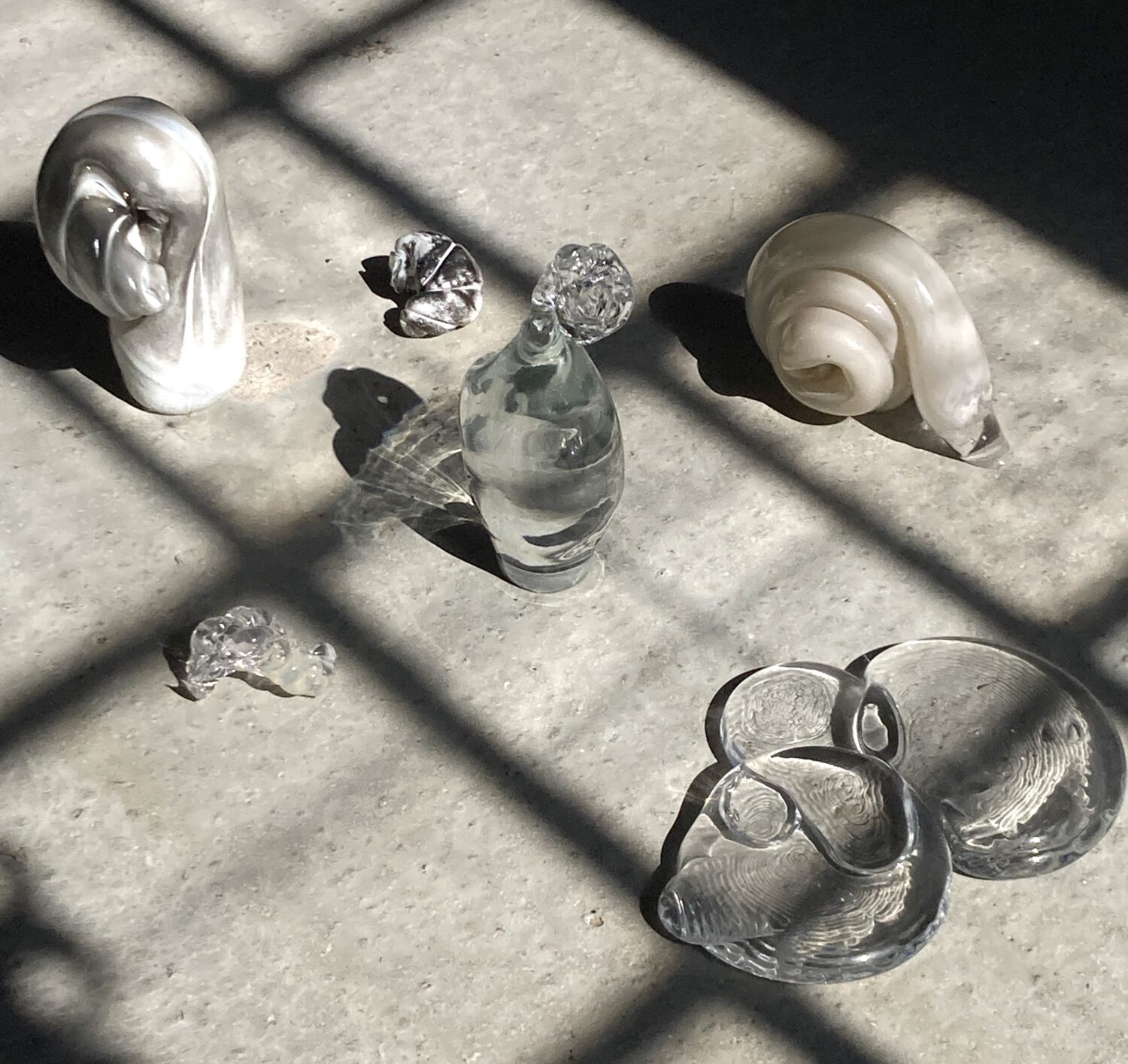
She elaborates on how she intertwines transparency and narrative in her works.
‘It’s like having a story in the work itself, but also a story around it. In this way, it becomes a story about the space in between – what happens between the two narratives – as well as the work and the world around it.’
For Köb, glass also holds a special sensitivity and an opportunity to explore boundaries:
‘I love working with the fragility of glass. I challenge the limits of what glass can do. I really enjoy the moment with the material. Seeing what happens and trying to engage in dialogue with it. And also bringing external and internal themes into play in relation to how I shape the glass.’
Søgaard Frandsen also associates the porosity of clay with human vulnerability and strength:
‘Fragility is a big part of being human, and the same is true of fired clay,’ she says. She also experiments with combining different materials and describes how new expressions arise in the dialogue between two different techniques she uses – namely clay and kombucha fermentation:
‘I have experimented with bringing the clay into contact with the biofilm. The clay is heavy and solid when fired, and when combined with the wet and soft biofilm, something happens. Together, they create a whole new expression. As the moist biofilm dries, it becomes increasingly transparent and fragile over time. It slowly takes shape and impressions from the clay. Over time, they become part of each other.’

Connection and dialogue
The role of art as a meeting place – between people, emotions, and between us and the world – is clearly evident in the artists’ descriptions of their work. Breyen points out how art creates space for connections:
‘Art is a way for us to share stories, feelings and experiences. And that’s the beauty of visiting exhibitions or creating exhibitions. Here is a space where we have the opportunity to connect. It’s about how we respond to what we see. I get a feeling of being more connected – both with those who are present with the artist, the earth and our surroundings in general.‘ At the same time, she emphasises the quiet but profound effect of art: ’Art can reach the individual on a deep level, without you really being aware of it.’
Köb also sees art as a relational field in which encounters and conversations are central:
‘For me, art – both my own and that of others – is very much about meeting people, creating relationships and dialogue, bringing people together, while being mindful of how it affects me.’ She also highlights the emotional resonance that art can carry:
‘I completely agree that the beauty and wonder of art is that it can reach you on a deep level.’
Together, their perspectives show how art is not just an object or an experience, but a living exchange that creates connections – both visible and invisible – between people, materials and the world we share.
About
Marie Breyen, trained glassblower from The National School of Glass, Riksglasskolan in Sweden 2019. The Royal Danish Academy, BA Glass & Ceramics 2023.
Magdalena Køb, The Royal Danish Academy, BA Glass & Ceramics 2025.
Anne Søgaard Frandsen, The Royal Danish Academy, BA Glass & Ceramics 2025.
Colophon
Writer: Johanna Nyborg
Managing editor: Helle Dyrlund Severinsen
Editorial Board: Lars Dybdahl, Annette Svaneklink Jakobsen, Ane Fabricius Christiansen, Peter Moëll Dammand, Anne Louise Bang, Pernille Anker Kristensen.
Translation: This article has been translated using AI. The original text is written in Danish.
Publisher: Danish Crafts & Design Association
You may also want to read these articles:
Theme: Various bodies
Crafts and design are closely linked to materiality, sensuousness and the physical – both in the inherent qualities of the works and through the hands that shape them. As a counter-movement to digital technologies, which are developing at the same speed as a Japanese high-speed train, we are seeing a growing interest in crafts, materials and techniques.
