
Sissel: How did your interest in working with local clay begin?
Silje: I discovered an interest in ancient pottery whilst I was a student. We had a seminar and a guided tour at the Museum of Cultural History in Oslo, where one of the artefacts was a bucket-shaped vessel made from Norwegian blue clay. I also had Sigrid Espelien (b. 1984, Norway)[1] as my supervisor during my first year in the ceramics department; she works with local blue clay.
Both my introduction to ancient pottery and having Sigrid as my supervisor sparked my interest in the specific characteristics of the clay and its site-specific history. Blue clay has not been in continuous use in Norway, and I have wondered why not. Through Sigrid, I came into contact with genuine blue clay from Oslo, as she was at that time working with blue clay sourced from the excavation at Bjørvika during the construction of the new Munch Museum.
I have thought a great deal about the clay – the clay that lies in the ground beneath us at all times. The ambiguity of this material, which supports our lives, yet at the same time possesses unstable and changeable qualities. I see a connection between the way we seek to stabilise and control the clay and our desire for the same qualities in our own lives.
Working with my own blue clay is interesting because it opens up the possibility of relating to the clay and the place it comes from. Whilst I was a student, I once found some clay at my family’s summer cottage in Bohuslän in Sweden, which was completely different from the blue clay in Oslo. I found the clay in an idyllic spot; it was green and very malleable.
Sissel: How did you start working with performance art centred on clay and the body?
Silje: I worked with clay as an art student at Einar Granum Art School, but it wasn’t possible to fire clay at Granum because we didn’t have access to kilns. I was actually most interested in working with casting – how to cast with concrete, plastic and porcelain.
After art college, I applied to several art academies in Norway and Sweden, and was accepted at the Oslo National Academy of the Arts (KHiO). I applied to study metalwork so I could work with concrete casting, but ended up studying ceramics.
I had to try to find my own way at KHiO and with ceramics, and gradually I began to explore how the body might relate to the works I was creating. It started, in a way, because the workbenches at KHiO are a standard size – that is, a size designed for a typical man’s body.
I’m under 160 cm tall, and it was challenging for me to work at workbenches designed for a completely different body size. One of my tutors had made a platform the size of half a pallet to stand on whilst she worked, but I found that it restricted my movement.
It made me think things like ‘is this the space I’m allowed?’ and ‘do I need a different body?’. In my bachelor’s project, Charlotte’s Turn (2022), I built seven containers out of blue clay, all of which were based on my own body weight. I feel as though the material sees me, and that there is something within it that is recognisable.
Sissel: You have worked with local clay on several occasions. In what ways does clay from different locations require processing?
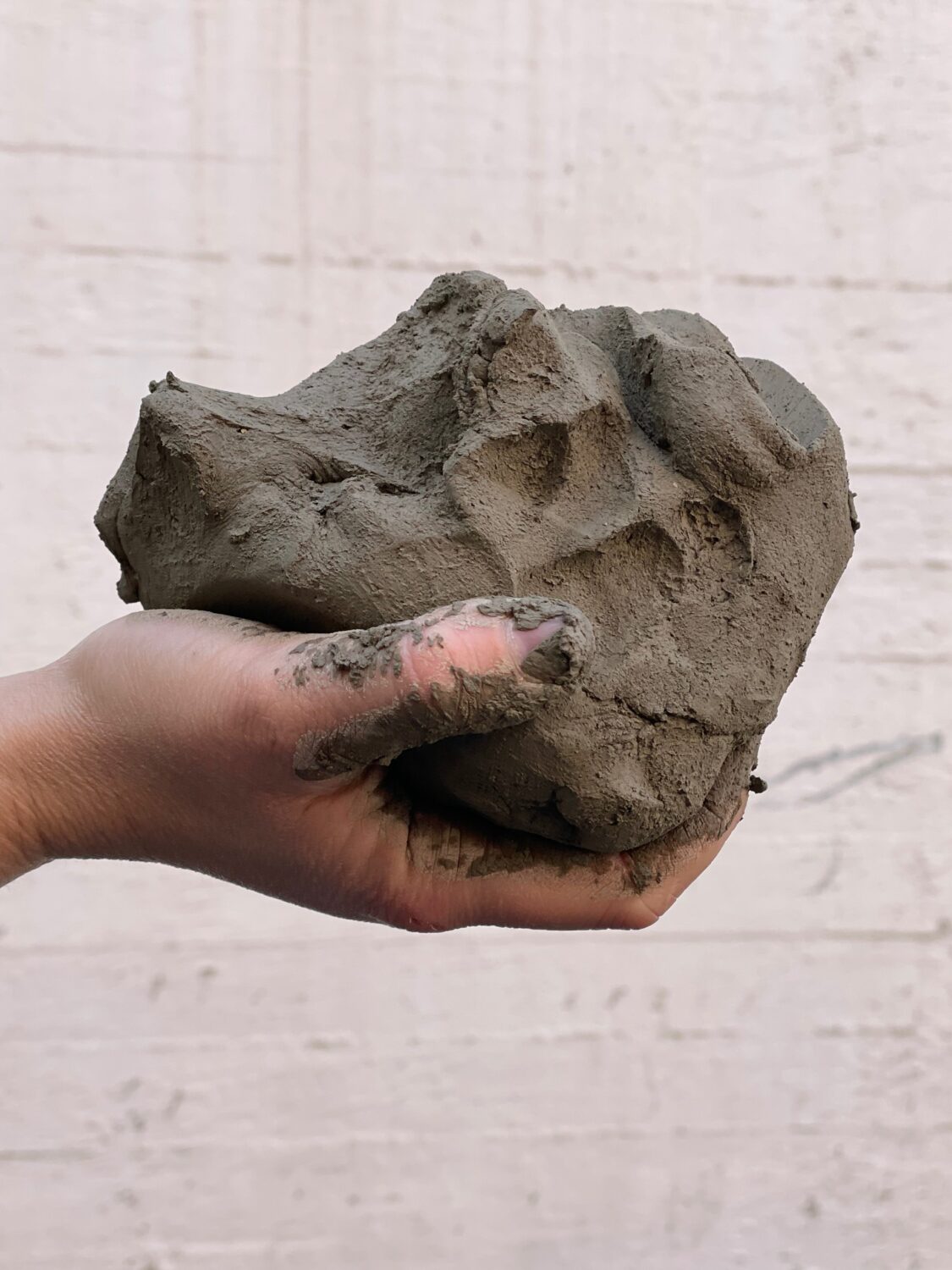
Silje: I’ve mainly worked with blue clay from the Oslo area and from Romerike. The clay from Romerike didn’t need cleaning as it was fine and clean. The Oslo clay and the Aarhus clay needed a lot of cleaning. During my training, I worked with clay from Bohuslän in Sweden which contained lots of sharp shells that also needed quite a bit of processing.
I often keep the pieces that have been removed, and sometimes I mix the leftover material from the same clay back in, or fire it to create other objects. I prefer to mix in the leftover material rather than chamotte if I can. I process the clay to achieve a consistency where I feel a connection with the material.
Sissel: Tell us about the project and the performance you’re going to do in Aarhus as part of the RARIORUM exhibition. How have you been preparing for the project?
Silje: I started by driving down to Aarhus from Lørenskog, which is a 12-hour drive. Beforehand, I’d spoken to Danish potters about the blue clay found in Denmark, and the differences between Danish and Norwegian blue clay. The blue clay in Denmark is very malleable, whilst the Norwegian blue clay has more ‘gravity’ and is more reminiscent of a body.
It’s difficult to build anything with the Norwegian blue clay. It sort of sags when you try. One of the Danish potters I’ve spoken to has said that Danish blue clay is the best potter’s clay there is. In Aarhus, I collected clay from a building site at Sydhavnen, which is an area with a lot of construction activity and where there is plenty of waste material – blue clay.
Sissel: You’ve mentioned that the clay from Aarhus and the blue clay from the Oslo area have different qualities. Could you describe the feel of the clay from these different locations?
Silje: I have a studio with high humidity, and right now the Aarhus clay is on a plasterboard table in my living room because it takes so long to dry. The clay from Aarhus is firm and malleable, and greenish in colour. It has a tough texture that’s good for rolling out and kneading.
The Oslo clay feels more substantial and heavy. Perhaps it’s down to how the water is distributed within the clay. The Oslo clay actually weighs more than the Danish clay when measured by volume. The Aarhus clay is fascinating, and I’m a bit worried about what it will be like to work with it in a performance, but it’s also going to be really exciting! The colours of the Oslo clay and the Aarhus clay are also completely different.
Sissel: How do the colours differ from one another? And have you noticed any other characteristics that distinguish the Oslo clay from the Aarhus clay?
Silje: The clay from Oslo, and Norwegian blue clay in general, is grey-blue. It has a bluish tinge and is grey when dry. The Aarhus clay was grey-blue when I collected it, and through washing it has become greener. This is probably due to the different minerals in the clay. The Aarhus clay also doesn’t yield in the same way as the Oslo clay. There is more resistance and resilience in the clay. Norwegian blue clay lacks the plasticity of the Aarhus clay. It is more unstable. It is short, thick and dense – and cracks easily! The Aarhus clay is unlikely to do so.
It is harder work to shape the Aarhus clay than the Norwegian blue clay. It will be exciting to see how differently I’ll have to use my body and how I’ll have to adapt to the material. I’ve also collected some clay from Denmark, and have, amongst other things, received extra clay from a Danish potter I’ve been in contact with. The clay from Aarhus is lighter, and I need larger quantities of it to ensure it’s heavy enough.
I haven’t tried throwing with Norwegian blue clay. In my opinion, Norwegian blue clay is the best clay, but for purposes other than throwing.
Sissel: Do you usually work with local clay during your performances?
Silje: Yes, it’s important to me to work with clay that has a connection to the place, and preferably local clay. Sometimes it isn’t possible to use local clay, and then it’s an interesting process to create a site-specific context, as I had to do in Ringebu (a town in Norway) during the opening weekend of the exhibition *Kraftoverføringer* at the Centre for Ceramic Art.[2]
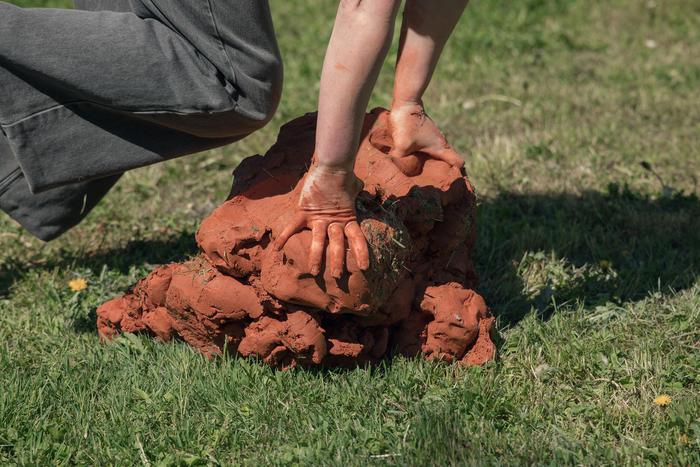
In ‘Lover, låver’ (2025), I investigated early on whether it was possible to use local clay, but when it gradually became clear that it was not possible to find and use clay from Ringebu, it was necessary to find a different direction for the performance. The solution was to use purchased moulding clay and mix in red iron oxide to achieve a red colour in the clay that resembled the paint on the church spire and the barn wall at Ringebu Stave Church and Vicarage.
The red colour was very important for creating a link to the church and the farm, and for creating a contrast to the green grass. There is such a strong history associated with the church and the farm, and so it was important for me to bring out the red tones from these in the clay to emphasise the connection and the history.
The performance ‘Lover, Låver’ is an exception, as it was not possible to use local clay, but it is nevertheless important to me that the clay relates to the place.
Sissel: Could you tell us more about how you relate to a place and its architecture when you’re preparing for a performance, or perhaps during a performance?
Silje: I go to the venue where the performance is to take place, and I try to connect with the history of the place. I use my body to find my bearings and to relate to the place. I walk around the area a great deal, taking notes and sketching. Among other things, I sketch the buildings and the site. I pay attention to how it feels in my body as I walk around. Afterwards, I read up on the history of the place. Ringebu was very special with its dramatic buildings. There, I became particularly interested in the church wall, for example. Ringebu has farm work on one side and the sacred on the other.
In places such as the Cathedral at KHiO and the National Museum, where I have staged the performance KJ KN KA, the architecture is very austere. I wonder if there are other ways to use the space. When you stage a performance involving clay, you become very aware of the major constraints on the ordinary use of the space. I also think about what I can bring to light from unseen history and try to express something that lies latent within the space – as I interpret it – and bring it to life.
It’s a really enjoyable part of the whole process leading up to a performance. Afterwards, I’m in the studio, where I build and test things, and think a lot.
Sissel: What happens in the studio, and how does the work on the performance continue there?
Silje: In the studio, I piece together fragments to form a choreography and test it out with the group. For example, I draw lines from the spot where the performance is to take place. If it’s a straight line, how can it be made more dynamic? I think through the physicality and rhythm of the performance. How high should my heart rate be, and where or when in the piece should that happen? And what action or movement will make that happen?
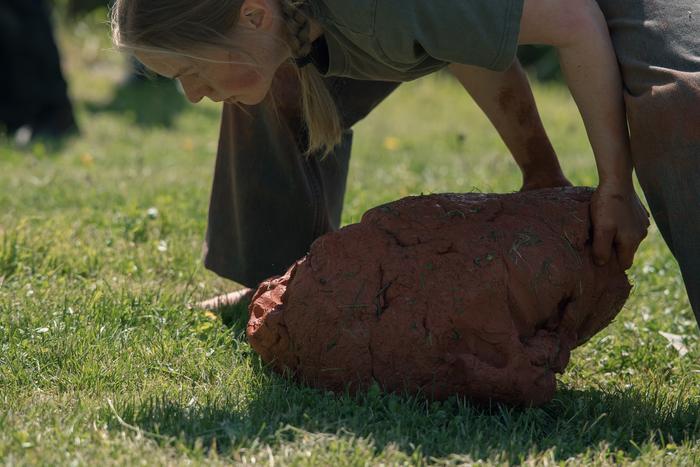
It does happen that I lose a bit of control over the material, and there’s always some improvisation along the way. The intention is important. There has to be a driving force behind the performance and a sense of where we’re heading. That’s why it’s also important to test the material. I prepare the clay in advance, partly by sifting out impurities.
Sissel: There’s a really lovely section in your Master’s thesis about your Master’s project ‘På felles grunn’ (2024) which describes what it’s like to work with others on the clay:
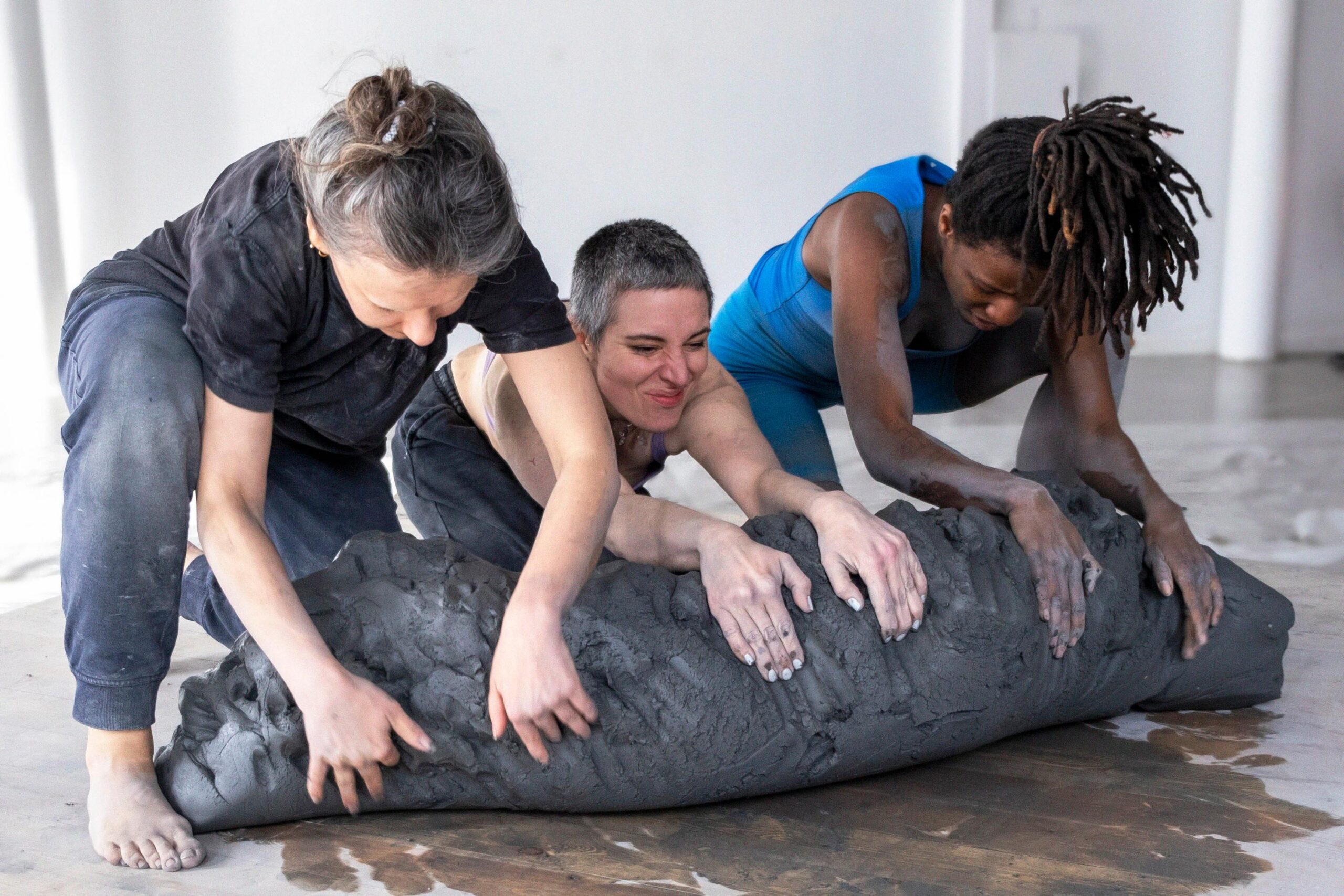
Because I have always been the one working alone with the clay, I haven’t seen how the body behaves or the changes that occur in the artist during a session. In the physical collaboration with the clay, one must listen with the body and see with the hands. It is an intimate contact where the clay clings to the pores and the smell of iron and earth fills the nose.[3]
Sissel: Can you tell me more about how you listen with your body and see with your hands when you’re working with the clay, before and during a performance?
Silje: There’s something about that sensory experience and the fact that the clay becomes another body. I’m very firmly rooted in the idea that the clay body is my own body. And so I treat the clay body accordingly. I have to gather my own body in order to gather the clay body and to keep it still.
Then I have to feel my way with the material. It’s very physical and sensory, intuitive and instinctive. When the clay body becomes large, I can’t shape it so easily or the way I want to. Then I have to try to listen and sense what’s possible with it.
What movements are possible? What happens when you break up the clay body, or destroy it? And perhaps that is a point in itself – to see what happens.
Sissel: What role do your subjective experiences play in your encounter with the clay before, during and after a performance?
Silje: I believe that the body is also a place, and a lot happens when the body is connected to a place or architecture. The body is my fundamental experience and the body is always with me. It belongs only to me. With clay, I have always experienced a tenderness when engaging with the material.
What is tender can be both pleasant and painful. The feeling of tenderness when engaging with clay is ambiguous, or perhaps two-sided. There is a charge or a tension between the clay, the body and the place when these come together. It is an ambiguous tenderness that is expressed.
One has points within oneself that are tender. When one touches the clay and it yields, perhaps it is as if one is touching one’s own tender points that yield. In a performance, I wander through an inner landscape that is rooted in the material and the space – or the history of the space I am in. Body, clay and place are like a trinity.
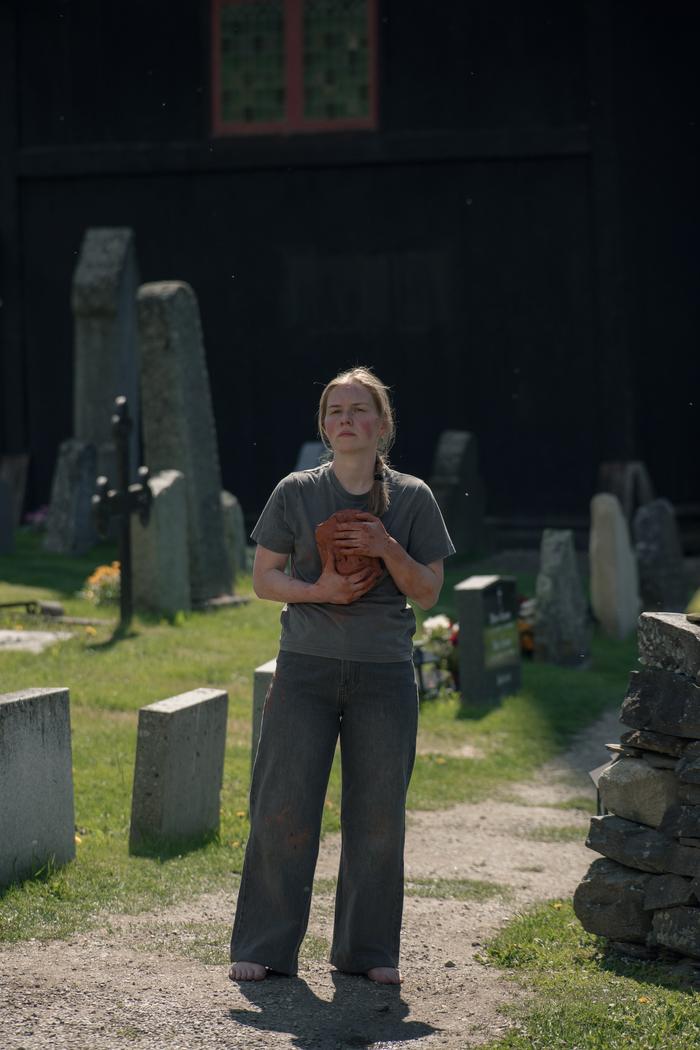
Silje Kjørholt (b. 1990, Norway) was invited to take part in the exhibition RARIORUM with a site-specific performance to be staged at RERUM and the Institute for X in Aarhus. Unfortunately, her performance has been cancelled, but there is still an educational programme focusing on performative practice and material hierarchies.
PROGRAMME
Friday 9 October, 4.00–5.00 pm
Ole Worm and unusual objects
Lecture by Lisbet Tarp, Senior Lecturer at Aarhus University.
Vogn 2, Godsbanen, Karen Wegeners Gade 8, 8000 Aarhus C.
Friday 9 October, 5.00–6.00 pm
Behind RERUM: How we are building a new exhibition space for craft and design
A conversation between Karina Præstegård, Helle Dyrlund Severinsen and Ingrid Halland. Moderated by Anna Lena Raab.
Vogn 2, Godsbanen, Karen Wegeners Gade 8, 8000 Aarhus C.
Sunday 11 October, 1.00–2.00 pm
Conversation: Body and clay
On craft and performative practices. Art critic Sissel Leknes in conversation with Ingrid Halland, taking Silje Kjærholt’s performative practice as a starting point.
Vogn 2, Godsbanen, Karen Wegeners Gade 8, 8000 Aarhus C.
Sunday 11 October, 2.00–3.00 pm
Conversation: On Nordic collaborations and peculiar objects
Nynne Hoe and Ingrid Halland in conversation.
Carriage 2, Godsbanen, Karen Wegeners Gade 8, 8000 Aarhus C.
Admission is free – places are allocated on a first-come, first-served basis.
Please note:
Silje Kjærholt’s performance has unfortunately been cancelled due to illness.
Talks and debates will be held in Norwegian and Danish.
Notes
[1] Sigrid Espelien, https://www.sigridespelien.com/
[2] Kraftoverføringer (2025) ved Senter for keramisk kunst, https://www.senterforkeramiskkunst.no/utstilling/kraftoverforing
[3] Silje Kjørholt. På felles grunn: Erfaringer fra en performativ og kollektiv praksis med blåleire, våren 2024. MFA i medium- og materialbasert kunst.
Theme: Places and the Agency of Materials
In this theme, Formkraft explores how craft and design can help shape our environments: from materials and architectural details to landscapes, raw materials and global power structures. What unites them is an interest in how materials, design and craft can forge connections between people and their surroundings.