
Clothes are often referred to as a second skin, an extension of our body both intimate and highly public. Clothes are considered a visual narrative that we project to the world as well as a tactile, sensory experience determined by fabric, function and fit.
But clothes are also emotional. When we put on that special dress for a party, that shirt for an interview or those sweatpants we sink into after a busy day. Clothes make us feel.
This article presents early findings of a research project conducted at the Royal Danish Academy, Center for Visibility Design and explores the hypothesis that clothing holds potential for making us feel better and attempts to explore how this may be measured physiologically using sensors.
What is Comfort?
Comfort here is considered both as a noun, meaning “the pleasant feeling of being relaxed,” and as a verb, “to make someone feel better when they are sad or worried” (Cambridge Dictionary). The Britannica Dictionary expands on this, defining comfort as something that makes life easier or more pleasant, a state of being less worried, upset, or frightened during emotional distress, and the act of helping someone feel less troubled.
This dual understanding of comfort as both a physical and an emotional experience forms the foundation of this paper’s exploration of clothing and well-being. The aim is to examine how everyday practices, such as dressing and being dressed, contribute not just to physical ease but also to psychological and emotional resilience.
Anthropologist Daniel Miller’s The Comfort of Things (2008) supports this perspective through an ethnographic study of thirty households on a single London street, illustrating how people use everyday objects to construct meaning, maintain a sense of stability, and cope with life’s challenges. This notion of comfort extends beyond the material to encompass emotional security and existential grounding.
The concept also has deep roots in design and architecture. In his 1898 essay Principle of Cladding, Adolf Loos argues that the origin of architecture lies in clothing or cladding, originally intended to provide “protection and warmth” (66).
He describes the act of covering the body with animal skins and textiles as “the oldest architectural detail” (66) highlighting the architect’s role in creating warm, livable spaces. In this sense, clothing can be seen as an ancient form of shelter offering not only physical comfort but also a symbolic return to a space of emotional safety and familiarity.
State of the Art
Some research has been done to further research on how we feel fashion physically, physiologically and emotionally (Ruggerone 2016; Woodbard 2017). Karen Cross (2019) explores how psychological comfort through dress can support identity formation, highlighting a qualitative focus in fashion studies on how clothing relates to subjective wellbeing.
Similarly, Smelik and van Tienhoven (2021) use affect theory to analyze emotional and sensory responses to clothing, emphasizing that fashion affects the body through non-rational and embodied processes. Their study critiques the lack of attention to what they call the “bio-neurological response” in much fashion research.
The theory of “enclothed cognition” (Adam and Galinsky, 2012) adds that the symbolic meaning of clothes can influence cognitive performance and psychological states. Lucia Ruggerone (2020) builds on affect studies to describe dressing as an embodied experience, advocating a shift away from mind-body dualism.
She focuses on how clothes shape feelings of comfort, pleasure, or discomfort. Together, these scholars point to a growing recognition of fashion’s role not just in social signaling but in shaping how we feel in and about our bodies.
Comfort in popular culture
In recent years, there has been a growing trend in popular culture toward viewing neurotransmitters as something that can be actively managed to improve wellbeing. Media and lifestyle trends such as “dopamine dressing” connect mood-boosting effects to choices in fashion, reflecting a broader interest in the brains’ role in happiness.
Self-help books like Habits of a Happy Brain (2018) by Loretta Breuning advocate for stimulating key brain chemicals such as dopamine, serotonin, oxytocin, and endorphins through simple, repeatable actions.
Together, these narratives suggest that wellbeing isn’t just emotional or psychological, it’s chemical, and potentially within our control through mindful lifestyle choices.
Narratives and emotions
Included in these early findings were indications that the narratives associated with specific items of clothing are carriers of the emotions we attach to them in additions to materials, color, fit, price or brand.
One example was the strong feeling one participant had about a sweater that was the last present she received from her parents before they divorced. She described mixed emotions about how the item carried both a sense of safety and a reminder of loss. Other items include narratives of connection and resistance.
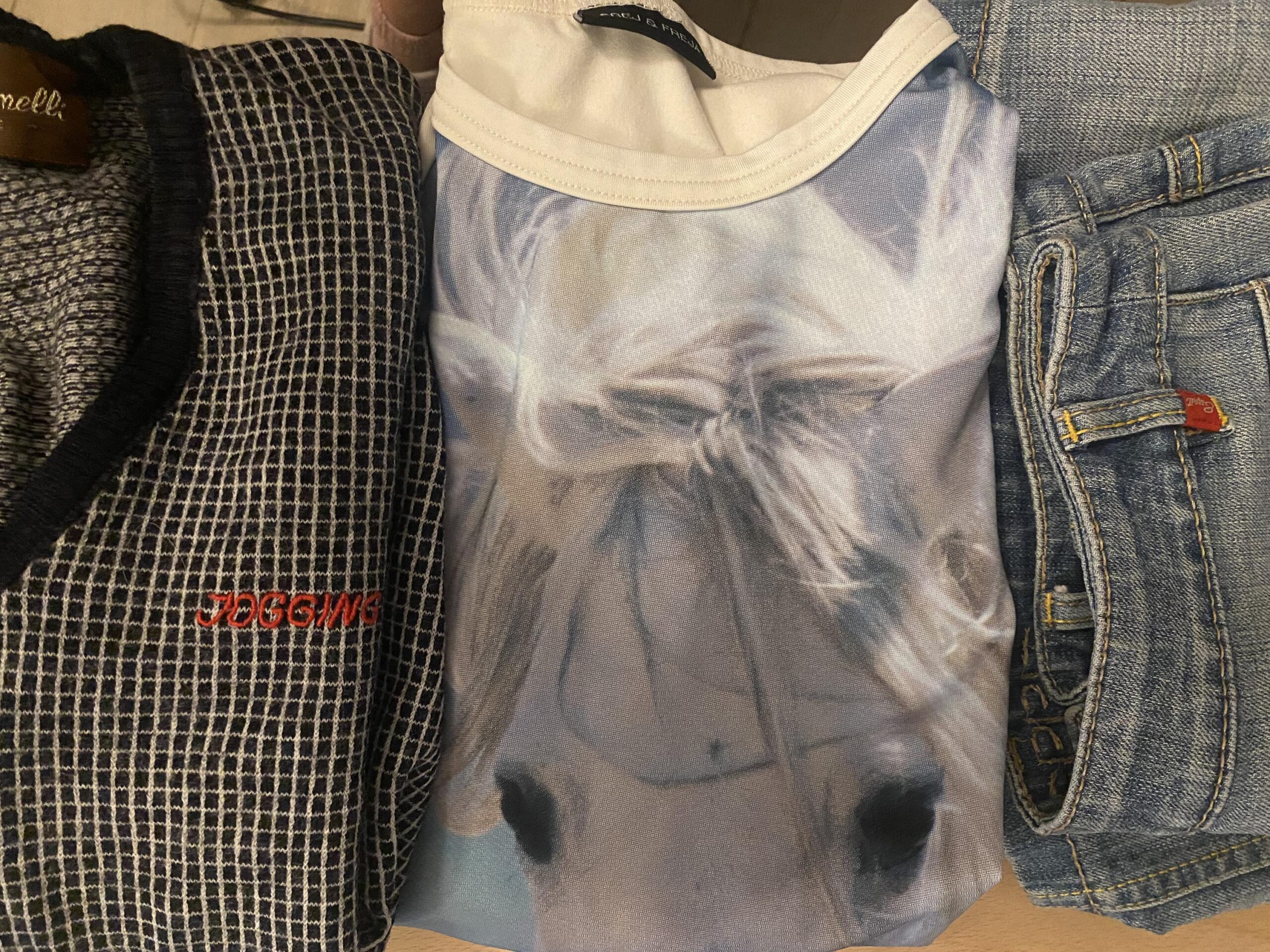
A T-shirt with a horse on the front was worn on Christmas Eve that generally requires a formal dress code even in a family setting. Another example was a pair of jeans made by a participant as part of a school project.
The evoke a sense of joy in part because they were worn by a band for a concert at Roskilde Festival which she described infused the pants with “a lot of energy”. She describes how they helped make her feel that she belongs at the Academy. There is a white top made from a wedding dress. The narrative of connection and the honor of being gifted such a special item from her mother’s best friend is described as the reason the top brings her joy.
From the wardrobe to the laboratory
Everything in our wardrobe has been sanctioned by us. Our clothes have been purchased or made by our ourselves or they have been gifted us, and we have chosen to keep them. All items in our wardrobes can therefore be assumed to have emotional value, but we are more emotionally attached to some items than to others.
In this preliminary study, we invited two participants to a semi-structured interview, to talk about eight clothing items selected from their own wardrobes. The study aimed to explore how differences in emotional attachment come to expression when participants talked about them, by measuring the physiological responses while talking using biosensors such as electrodermal activity (EDA; also known as Galvanic Skin Response, GSR), facial expression analysis (FEA) and voice analysis (VOICE).
We wondered whether differences in emotional attachment affected the verbal and non-verbal communication about the items; not only in what participants chose to say about these items during the interview, but also in the emotions subconsciously expressed by the participants while talking.
This framework drew on wardrobe studies (Woodward 2007) using observation and interviews regarding the informants’ personal belongings and the narratives they attach to them, but we added biosensor measurements. Woodward describes clothing as mediating between the social and intimate self through ethnographic studies of the wardrobe.
Wardrobes are often conducted in a private setting of the physical wardrobe often a bedroom. This was not possible here due to technical requirements. However, we argue that the wardrobe and the lab share the properties of being private spaces where the clothing items are removed from the performative, social spaces allowing for a focus on the emotional attachment between owner and object.
Method: The specific framework for the experiment
Participants
Two participants (1 male, 1 female, both in their 20s) were volunteering in this semi-structured ethnographic interview; both participants were students at the Royal Danish Academy.
They were asked to bring eight clothing items to the interview from their own wardrobes, including four items which had a special affective meaning to them (affect condition) and four items without such special meaning (no-affect condition).
In advance, the interviewer did not know which clothing items belonged to which of these conditions.
The Setup
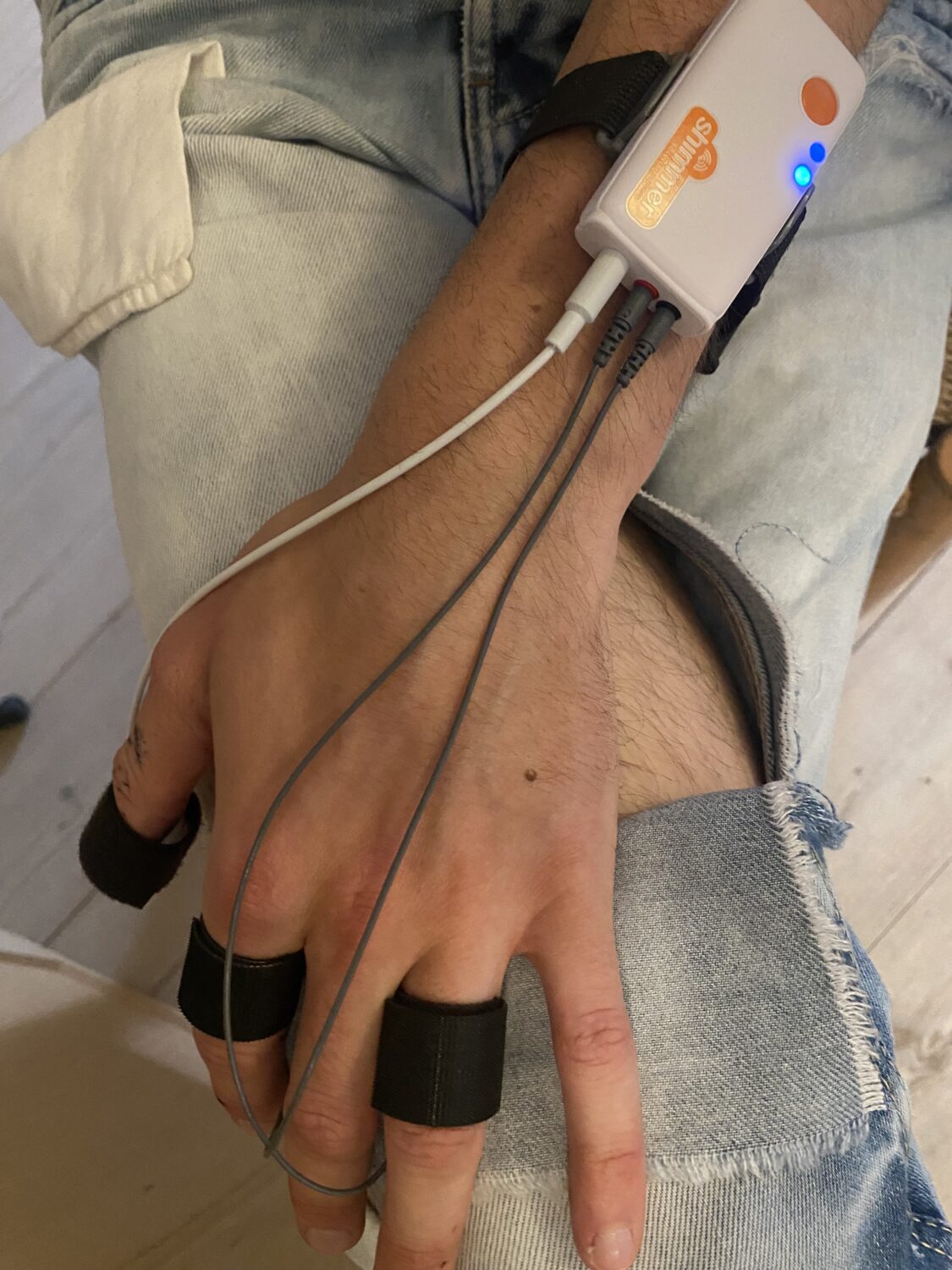
The interviewer and interviewee were seated face-to-face with a little table in between them. The interviewee was wearing a Shimmer device on the left hand for measuring electrodermal activity (EDA). For ensuring good data quality, participants were asked to rest their hand on their lap and not move it too much (figure 1). Additionally, a video camera was positioned behind the interviewer, recording the participant’s face (for FEA) and audio from the interview (for VOICE). All recordings were analyzed using iMotions software (v.10), powering Affectiva AFFDEX and AudEERING devAIce.
Procedure
The interview started with a brief, introductory talk about the participants (who they are, where they grew up, what they are studying, etc.), after which the interviewer pulled the first of eight items from the clothing bag and put it on the table. For each of the items, the conversation then proceeded in three phases.
First, participants were asked to describe the clothing items in a material way – what is it, what are the materials used, what is the brand (Phase 1).
Hereafter, participants were asked to reveal why they brought it to the interview, hence, revealing whether it concerned an item that they were emotionally attached to (affect condition) or not so much (no-affect condition) (Phase 2).
Finally, in the last part, the interviewer and interviewee engaged in a more free, in-depth ethnographic interview about the clothing item (Phase 3) until the conversation naturally ended, and the interviewer moved on to the next item.
Analysis
In addition to an ethnographic analysis of the interview, we measured how long the participants talked about each of the items and the emotional responses expressed while talking about the items, thereby focusing on two core values.
(1) Emotional arousal: the intensity of the emotions expressed.
(2) Valence: whether the emotions expressed were positive (e.g., joyful) or negative (e.g., sad).
Specifically, emotional arousal was measured using EDA (“Peaks-per-minute”; i.e., the number of peaks per minute, obtained through iMotions’ Peak Detection R-Notebook), FEA (“Engagement” score) and VOICE (“Activation” score); valence was measured using FEA (“Valence” score) and VOICE (“Valence” score).
Results
Each clothing item was talked about for, on average, 131 seconds. But the conversations were longer for clothing items that participants were emotionally attached to than for clothing items with less affective value.
Moreover, while talking about items with stronger affective value, participants were showing measurably more positive emotions. All ‘valence’ scores were higher for clothing items in the affect condition as compared to clothing items in the no-affect condition; and all ‘arousal’ scores were higher for clothing items in the affect condition as compared to the no-affect condition.
Because these values could have been biased by the interviewer’s interactions, we additionally measured the same scores for Phase 1 alone; this is the time before the interviewer’s first question. During this time, participants merely described the clothing items in a material way without interruptions by the interviewer. Already here, we observed that participants talked longer about items in the affect condition than items in the no-affect condition.
All ‘valence’ scores were higher for clothing items in the affect condition as compared to clothing items in the no-affect condition; and all ‘arousal’ scores were higher for clothing items in the affect condition as compared to the no-affect condition, regardless of whether these scores were obtained through electrodermal activity, facial expression analysis, or voice analysis.
Although the findings in this study are tentative, the consistency of the findings suggests that, indeed, clothing items can have an emotional component that is expressed while talking about these items and that is measurable through biosensor measurements, offering a first proof of concept for this new type of studies.
Conclusion: Clothing can have measurable emotional value
The notion of comfort clothing is complex involving as it does a range of motivations including sensory experience, symbolic association, emotional attachment and the commodified function of situational items of dress. The aim was to argue for a development of new methodologies in fashion as part of proposing a sensory turn in fashion studies.
Based on how fashion makes us feel, the paper operated with a hypothesis that clothes hold the ability to make us feel comfortable.
A key finding is that we talk more and express more emotions when describing clothing to which we have a special attachment. Using biosensors, it is possible to gain new insights into how clothing can contribute to a sense of security and well-being.
By measuring the body’s reactions, we gain unique insight into how materials, fit and design affect our experience of comfort. The study thus contributes to increased awareness of what clothing does to us emotionally and points to clothing as a possible tool for enhancing well-being. It opens up new ways of thinking about clothing in everyday life and in contexts where human well-being is central.
Facts
Maria Mackinney holds a Master of Arts degree, a PhD and is an associate professor at the Department of Design and Visual Interaction, Royal Danish Academy of Fine Arts, School of Architecture, Design and Conservation. Read more
Bart Cooreman is an assistant professor at the Department of Design and Visual Interaction, The Royal Danish Academy of Fine Arts, School of Architecture, Design and Conservation. Read more
References
Adam, H. & Galinsky, A.D., 2012. Enclothed Cognition. Journal of Experimental
Social Psychology, 48(4), s. 918-925.
Breuning, L. (2016). Habits of a Happy Brain: Retrain Your Brain to Boost Your Serotonin, Dopamine, Oxytocin, & Endorphin Levels. Avon, Storbritannien: Adams Media.
Entwistle, J., 2003. The Dressed Body. I: L. Welters & A. Lillethun (red.), The
Fashion Reader. Oxford, Storbritannien: Berg. s. 139-149.
Kamalha, E., Zeng, Y., Mwasiagi, J., & Kyatuheire, S., 2013. The Comfort Dimension; a review of perception in clothing. Journal of Sensory Studies, 28, s. 423-444.
Loos, A. (1982). The Principle of Cladding. Spoken into the Void: Collected Essays, 1897-1900. Cambridge, Storbritannien: Graham Foundation, s.66-69.
Miller, D., 2009. The Comfort of Things. Cambridge, , Storbritannien: Polity.
Pineau, C., 2008. The Psychological Meaning of Comfort. Applied Psychology, 31(2),
s. 271-282.
Ruggerone, L., 2016. The Feeling of Being Dressed: Affect Studies and the Clothed
Body. Fashion Theory, 21(5), s. 573-593.
Smelik, A., & van Tienhoven, S., (2021). The Affect of Fashion: An Exploration of Affective Method. Critical Studies in Fashion and Beauty, 12(2), s. 163-183.
Woodward, S. (2007). Why Women Wear What They Wear. London, Storbritannien: Berg Publishers.

Theme: Various Bodies
Crafts and design are closely linked to materiality, sensuousness and the physical – both in the inherent qualities of the works and through the hands that shape them. In this issue, Formkraft explores corporeality with multiple perspectives on bodies and materiality.