

‘We actually agree on most things. Perhaps this is due to a shared approach to design language and materiality that transcends the changing trends of the times.’ These are the words of Maria Bruun, and the person with whom she agrees is Lærke Ryom. Both are furniture designers and graduates of the Royal Danish Academy, Maria Bruun in 2012 and Lærke Ryom in 2022.
The two designers met at the Royal Danish Academy where Maria Bruun served as Lærke Ryom’s supervisor for a period. The three of us meet on Zoom for a conversation that quickly turns to materials, craftsmanship and lived experience; to the relationship between the digital and the physical; and to what happens when ideas are transformed into tangible objects.
The fact that we are discussing precisely these topics whilst each of us is on our own screen seems almost like an ironic reminder of just how much of our lives today takes place at a distance from the physical world. Perhaps that is also why the conversation keeps returning to the importance of materiality.
The tangible as a common ground
Although Maria Bruun and Lærke Ryom studied at the same institution just ten years apart, they describe two different educational cultures. Maria Bruun refers to her time as a student as a period marked by change. She recalls a programme with strong roots in craft, characterised by workshops, close contact between different disciplines and a free flow between design and craft disciplines. At the same time, she observed a gradual shift towards a more academic direction. For her, the move to Holmen and the introduction of the concept of Design Thinking stand out as milestones in this development, during which the theoretical and methodological dimensions took on an increasingly prominent role.
When Lærke Ryom began her studies on the furniture design course at the Royal Academy, the academicisation of the programme was already an integral part of the course. Although she sees it as a strength that designers learn to articulate their work – and has herself benefited greatly from this skill – she also witnessed an ongoing debate about the implications of this development for the programme.
Time spent on theory and reflection was often taken away from workshop work, and she emphasises that it is precisely the engagement with materials and the physical process that constitutes a special form of learning, where ideas are transformed into concrete experience. At the same time, the programme was under political pressure to prepare students for the labour market as quickly as possible, which contributed to a shift away from specialised streams and towards a more generalist profile.
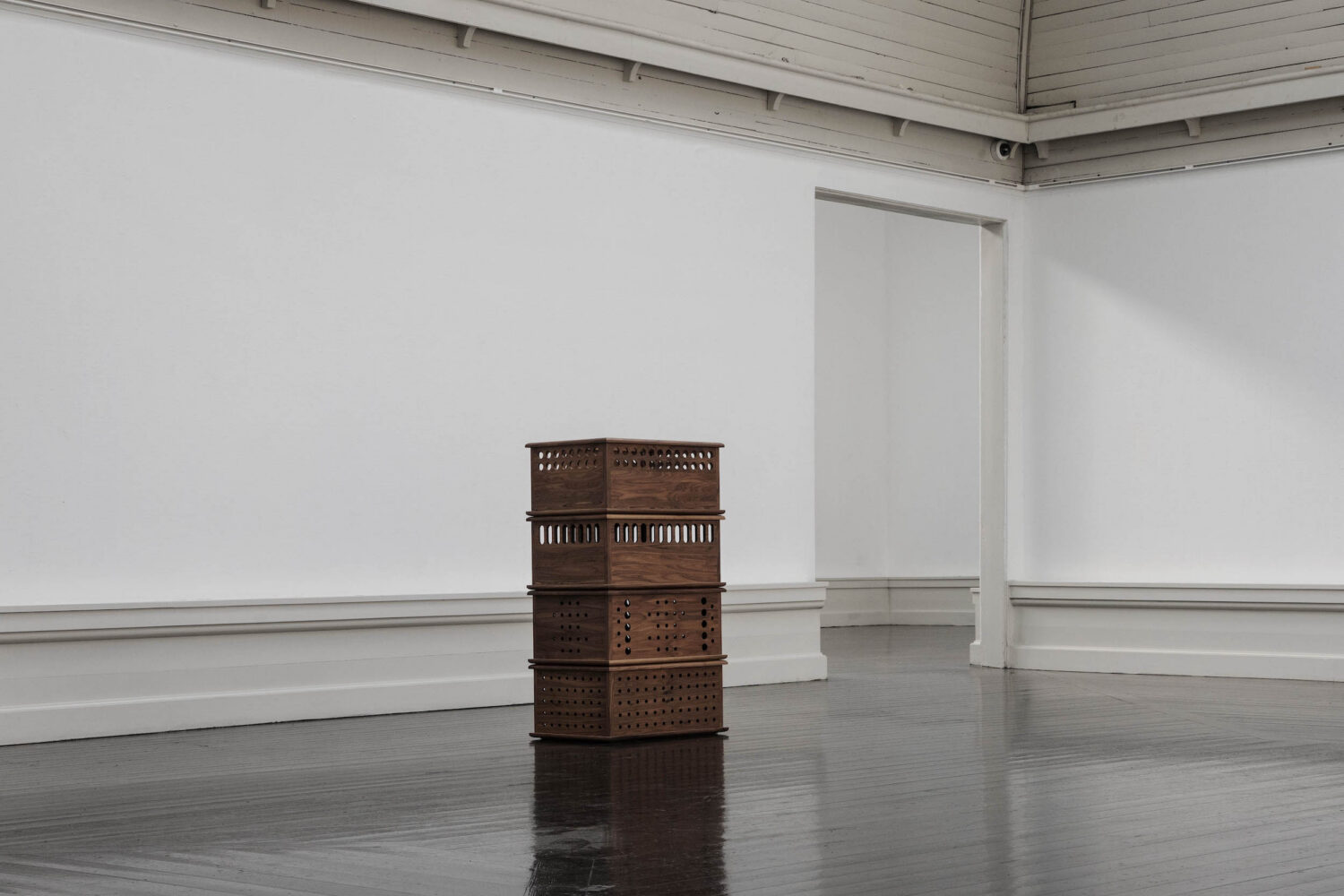
Both highlight the tension between specialisation and breadth. Ryom points out that she had the opportunity to immerse herself in furniture design, and emphasises that the programme offered great freedom to shape her academic profile through the self-directed semester projects.
At the same time, she points to a difference between the two educational cultures: during Bruun’s time as a student, there was greater scope to move between different workshops and disciplines. When Bruun later returned to the academy as a lecturer, she observed a clear division among the students: some focused on form and the physical object, whilst others gravitated towards more strategic and conceptual design practices.
According to her, this development reflects a broader shift within the field of design. The world does not necessarily need more products, but rather new ways of applying design skills. This raises the question of how educational programmes can continue to make room for those who wish to immerse themselves in furniture and object design as a craft and a design discipline. ( Read also: Rethinking education – and craft – an interview with Tim Ingold)
When I ask the two designers what traces of the present day they see in their own work, their answers revolve around a shared longing for the physical in an increasingly digital world.
For Lærke Ryom, this longing is expressed through a sustained interest in the surfaces, textures and tactile qualities of materials. She sees her work as a way of maintaining a connection to the physical world at a time when more and more of life is unfolding on screens.
It’s not that she’s opposed to digital tools as such. She herself uses both 3D programmes and other digital tools, but her creative process is rooted elsewhere.
As she puts it, it’s a matter of ‘a saturation with the digital and with screens’ and a corresponding increased desire for the sensory. She creates best when she has the materials in her hands.
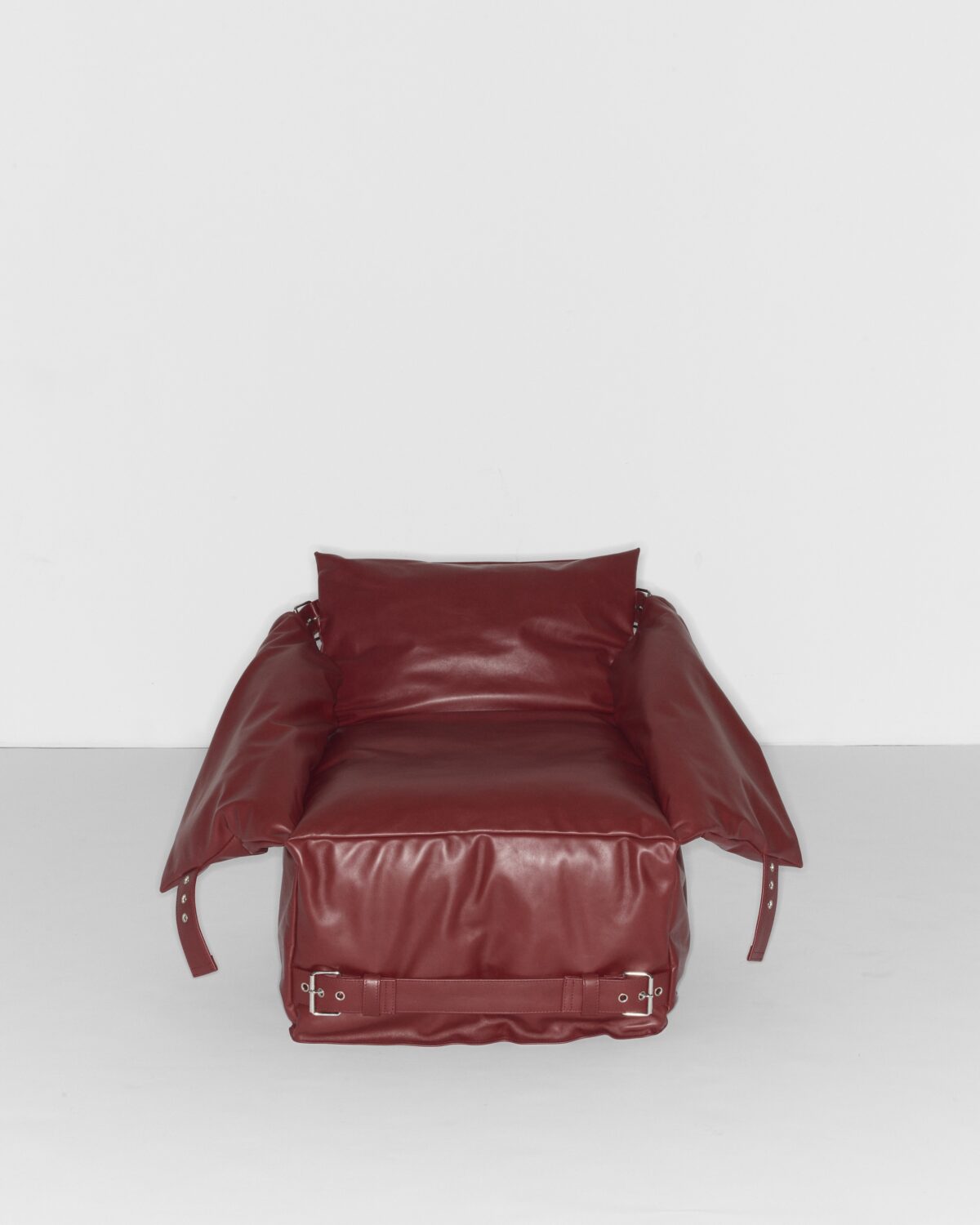
Maria Bruun points to a similar starting point in her own work. She regards Ryom as a designer who remains true to her intuition, and highlights a clear affinity between their practices. “Some of the similarities between our work lie precisely in the physical aspect. We share a common standpoint,” she says. She also highlights how Ryom’s practice delves into the material to uncover its possibilities.
But whilst Ryom primarily explores the potential of materials, Bruun is concerned with how design can influence the way objects are used and consumed. How can design help to sharpen our awareness of materials and the care that goes into an object?
For Bruun, furniture design is closely linked to the rhythms and rituals that make up everyday life.
She is fascinated by how a piece of furniture can support particular ways of being in the world, and by how design can heighten our awareness of the actions we otherwise carry out without giving them a second thought.
In this sense, design also holds the potential to foster a sense of presence and make room for a much-needed slowness.

‘You bring the ritual and the lived experience with you when you design and create,’ Ryom tells Bruun. It is precisely this lived experience and the passage of time, which shape both objects and materials, that form a key focal point in both designers’ practices.
Whilst Bruun often highlights the actions and rituals in which objects are involved, Ryom pays particular attention to the changes that use brings about in the materials. She is interested in the tactility and aesthetic value that arise when materials age, wear and gradually develop their own character. For her, tactility does not stem solely from the properties of the material, but also develops through use and the passage of time. Design objects should not exist in isolation from life, but should support it.
In Bruun’s work, this interest in the life of objects over time is expressed in a different way. Among other things, she explains how, over the years, she has worked with the same objects, which have gradually taken on new materials, functions and meanings. The aim is not merely to create things, but to influence our perception. The object must give something back, challenge the user and sharpen the senses in a way that ensures it holds more than it reveals at first glance.

Sustainability and longevity
As the conversation turns to sustainability, it becomes clearer that the two designers belong to different generations within the design education system. Maria Bruun was not, in fact, taught sustainability as a separate subject. The focus was rather on materials, craftsmanship and direct interaction with the material itself.
Nevertheless, she does not see sustainability as something new. On the contrary, she regards it as a natural part of a craft tradition in which respect for materials and resources has long been a given. ‘Sustainable design’ has now become an ubiquitous concept in the design world, but for that very reason, she points out, it risks being reduced to a requirement that can be documented and ticked off a list. For Bruun, however, sustainability is not a box to be ticked, but a fundamental way of thinking and working.
For Lærke Ryom, sustainability was an integral part of her education and a fundamental principle underpinning every design process. In her own work, she has, amongst other things, explored upholstered furniture and ways of ‘dressing’ furniture so that it can be more easily repaired, dismantled and maintained.
She works with replaceable components and with offcuts that can be incorporated into new cycles. At the same time, she emphasises that sustainable solutions must also create aesthetic value.
‘It’s not enough for it to be sustainable,’ as she puts it. On the contrary, the constraints should become an active part of the design process and can even help to open up new aesthetic possibilities and give direction to the work.
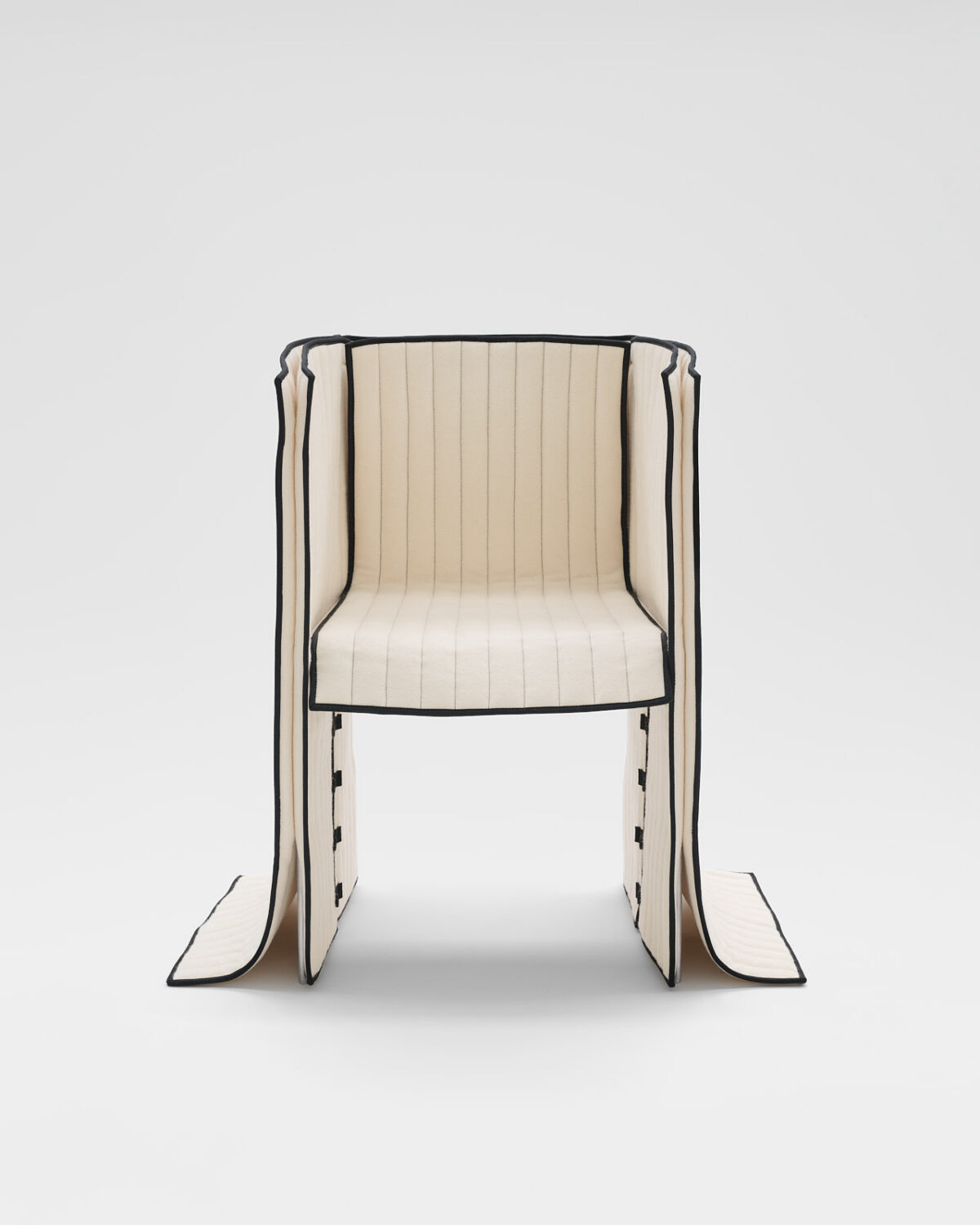
The conversation turns once again to time. To what happens when people live with objects over a prolonged period. What makes us look after a chair, repair it and let it accompany us through life, rather than simply replacing it? How does the attachment arise that means some things stay with us, whilst others quickly lose their significance?
For Maria Bruun, the answer to these questions lies, amongst other things, in an object’s ability to change alongside its user. She describes her approach as an attempt to decode sustainability on a smaller scale: through flexible functionality, use over time, and furniture that can evolve in step with its users. Lifestyles change, families change, needs change, and objects should be able to keep pace with these changes. At the same time, she sees it as her task to introduce users to new materials and recycled materials, thereby broadening their concept of value.
If a piece of furniture is to accompany us through life, it must be capable of more than simply functioning. Some objects fulfil a specific need and provide immediate sensory satisfaction; others continue to offer something in return; they challenge our habits, sharpen our awareness and gradually reveal new layers of meaning.
Whilst functional flexibility broadens an object’s range of uses, aesthetic flexibility broadens its range of meanings. This is precisely why an object’s aesthetic value is not merely a complement to its function, but a prerequisite for it to accompany us throughout our lives.
If a design object is not ‘finished’ when it is new, but can continue to evolve through use, experience and the passage of time, it makes room for lived experience and for the traces left by time.
When a product continues to reveal new layers of meaning, it becomes harder to replace – not merely because it works, but because it continues to be experienced as meaningful.
Time thus becomes not something the object must withstand, but something with which it evolves.

At Ryom, this philosophy is reflected, amongst other things, in a design approach where the rich detail of the materials plays a central role. Repetitions in patterns, textures and surfaces ensure that the object continues to offer new experiences and new layers of meaning through use and over time. In Bruun’s work, it is evident in her furniture designs, which can change function, meaning and use throughout their lifespan.
What they have in common is an approach to design in which materials and form are inseparable, and where sustainability arises from the interplay between material choice, design and use. Materials form the foundation of both designers’ practices, but their work primarily explores what form can bring to the materials, rather than how new materials are developed as part of an independent field of design.
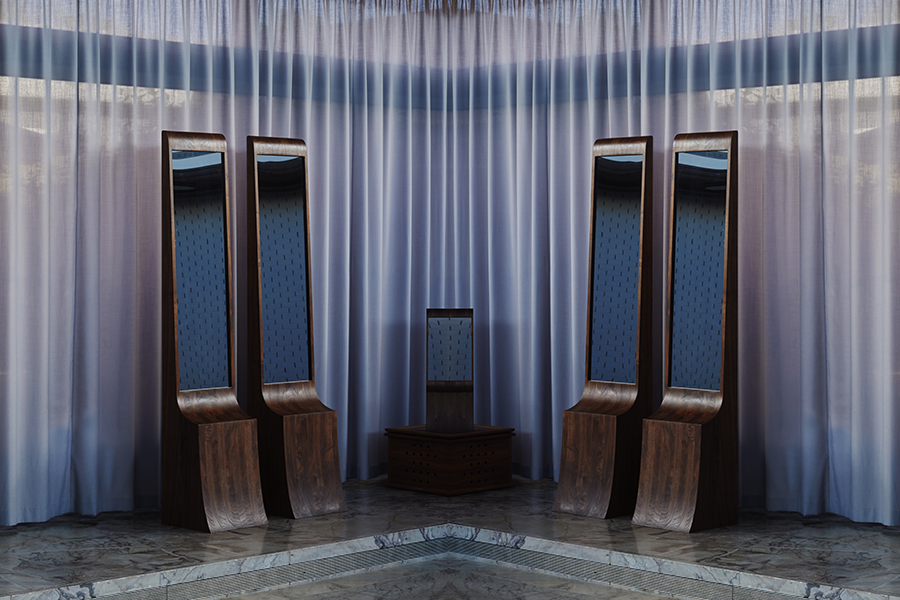
What should design preserve?
Towards the end of the conversation, I ask the two designers what they hope future generations of designers will carry forward. Once again, their answers revolve around the physical, the sensory and lived experience.
For Maria Bruun, her approach to working with materials and design is not a trend or a reaction to contemporary movements. After fifteen years in the field, she sees it rather as a professional discipline and a form of practice stemming from a more fundamental mission.
For, as she says, the values associated today with material awareness, craftsmanship and slowness are not new. They have always been present in the design discipline, although at times they have been more prominent than at others. That is precisely why she is delighted to see younger generations rediscovering and further developing these perspectives.
For Lærke Ryom, it is crucial that the connection to the physical world is not lost. She hopes that working with materials will continue to form a central part of both design education and the design discipline, and that the design process will not be entirely transferred to the screen. When an idea is transformed into something physical, a special kind of learning and realisation takes place, which she does not wish to lose. At the same time, she sees potential in design that challenges our expectations of the objects we surround ourselves with and encourages us to view our surroundings in new ways.
Maria Bruun highlights a related, yet more fundamental issue. For her, it is not the technology itself that poses the challenge, but a world that is gradually becoming more two-dimensional, more streamlined and more abstract.
As more and more of our activities move onto screens, we risk losing some of the rituals and ways of being present in the world that were once a natural part of everyday life.
For her, this raises a question about the designer’s responsibility. Should design always make everyday life faster, easier and more efficient? Or can design also create space for slowness, immersion and presence?
If more and more aspects of life are characterised by speed and efficiency, the designer’s role may be more than simply optimising. The designer can help to slow things down – by insisting on slowness and on the experiences that arise when things are allowed to take their time.
Both Bruun and Ryom emphasise the importance of materials and the physical experience. Not as a resistance to progress, but as a reminder that there are forms of knowledge and insight that arise only through the body and the encounter with materials. For Ryom, it is about maintaining a sense of curiosity towards the physical. For Bruun, the value lies in creating space for rhythms, rituals and immersion in an age where innovation and efficiency often appear to be objectives in themselves.
And perhaps this is precisely what they hope to pass on to future generations of designers: an understanding that new solutions are not the sole purpose of design.
That design can also enrich our relationship with the things that surround us. That design can help to preserve the rituals and ways of being in the world that give depth to everyday life, but which are easily at risk of disappearing in the name of efficiency.
Lærke Ryom
Graduated as a furniture designer from the Royal Danish Academy in 2022. That same year, she received the Talent Award at the Design Awards.
Lærke works in furniture design, exhibition design and curation, focusing on the tactile, sculptural and narrative qualities of design objects. Her work spans a wide range of materials, from wood and metal to textiles, as she seeks to create new aesthetic experiences from familiar materials.
She is also a co-founder and curator of the award-winning exhibition platform and creative community, Ukurant.
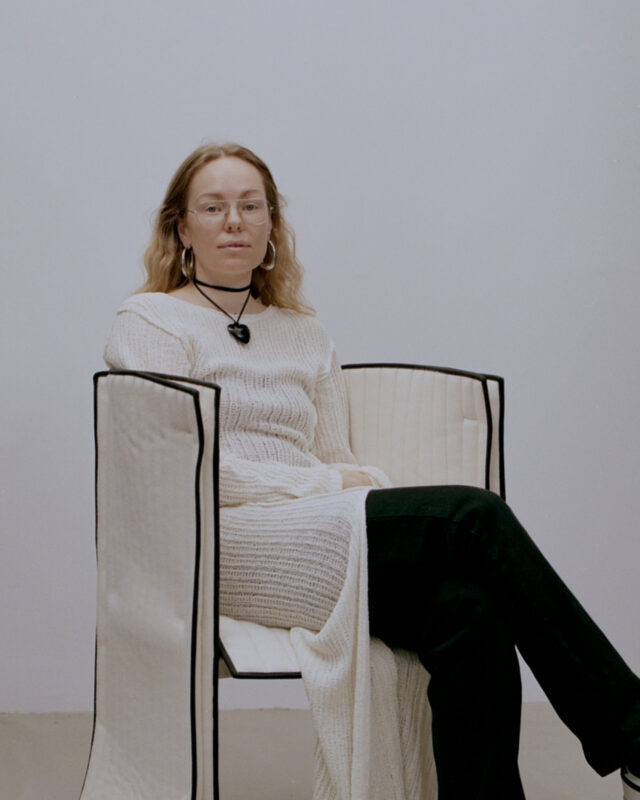
Lærke Ryom. Photo: Alexander Hollsberg
Maria Bruun
Maria Bruun is a Danish furniture and interior designer based in Copenhagen and the founder of Maria Bruun Design.
She is a graduate of the Royal Danish Academy and works at the intersection of art and functional design.
Her work has been recognised with several prestigious awards, including the Finn Juhl Prize and the Wegner Prize.
She has also exhibited her work at international museums and design platforms such as the Design Museum London and Design Miami Basel.

Maria Bruun. Photo: Maya Matsuura.
Legacy Reimagined
What defines contemporary craft and design? How is a practice shaped by the era in which it emerges? How does it endure as times change?
Every generation of designers and craft artists works at the intersection of heritage and innovation. They inherit techniques, ideals and institutions from those who came before, yet must simultaneously engage with their own era: its values, crises, technologies and visions of the future.
In this issue of Formkraft, we explore how crafts moves through generations, , and how the times leave their mark on methods, materials and mindset.