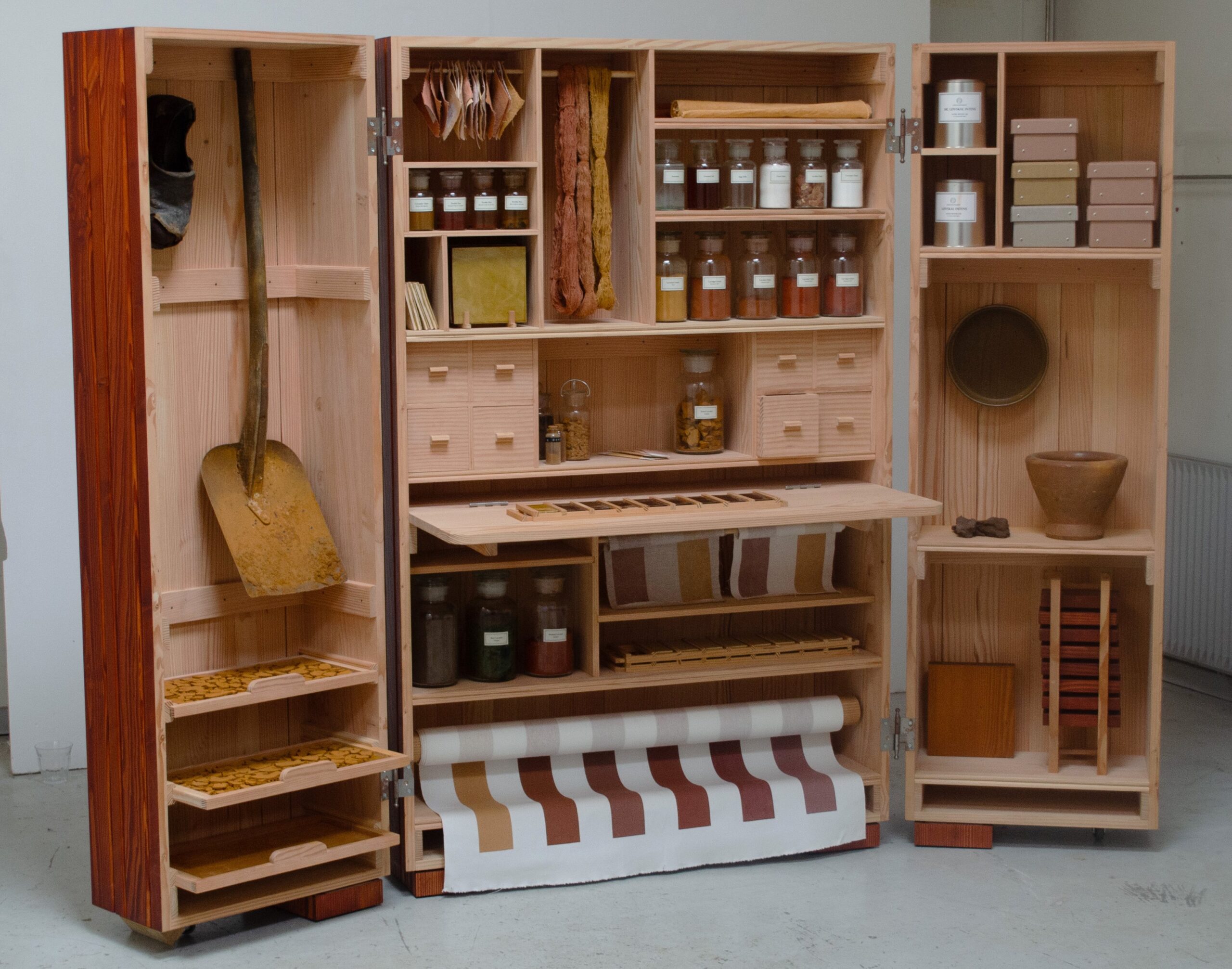
‘I want to prove that it is possible to have a relationship with our surroundings, to maintain and communicate it in an industrial context. There are seven billion people on Earth, so we have to have industries. They are a prerequisite for how we live. But we can get better at using the local nature and resources that we have a relationship with,‘ says Thomas Woltmann. Because, as he says, ’The world is industrial.’
Thomas Woltmann is a trained furniture designer. In 2025, he received the Danish Design Award in the “Young Ideas” category for the Løvskal Ochre project. Since his bachelor’s project, he has been working with the pigment ochre, which runs like a reddish-brown vein through his artistic practice and commercial adventures. He wants to restore the production of ochre pigments in Denmark. He dreams of his own factory. Somewhere in the countryside. Close to nature.
The relationship with nature
‘I work with the least innovative material you can imagine. Ochre is the oldest industry, the oldest extraction of a material that can be documented. The use of the material dates back to the first cave paintings. It is fascinating that ochre is part of a 300,000-year-long story. It connects us to the past, a cultural past.
It has been used more in some periods and less in others, but it has always been present all over the world. Ochre has always been here. People on every continent except Antarctica have used ochre. It is something we have in common,’ says Thomas Woltmann.
The choice of ochre allows Thomas Woltmann to explore his interests: cultural history, industrial history, raw materials and local nature.
Ochre
Ochre is a naturally occurring soil type that can have yellow, red and brownish hues. The world’s oldest ochre mine is located in the small country of Eswatini (formerly Swaziland) in southern Africa and is 48,000 years old.
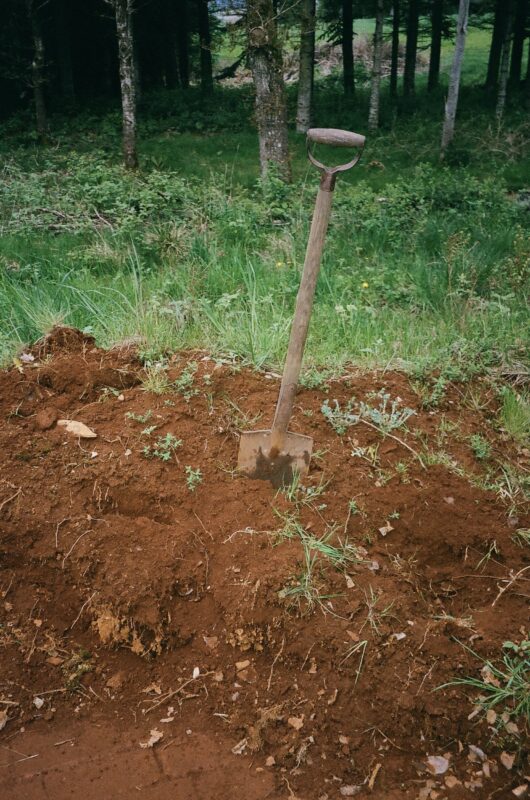
In Denmark, ochre is found particularly in the Jutland soil as sediment deposits from the Ice Age. In some places, it lies in layers 5-7 km below the ground, in others it is mixed into the soil.
Here, the iron-rich compound can remain unchanged for thousands of years, but when it comes into contact with oxygen, the mineral pyrite splits into ferrous iron and sulphur – and red ochre is formed.
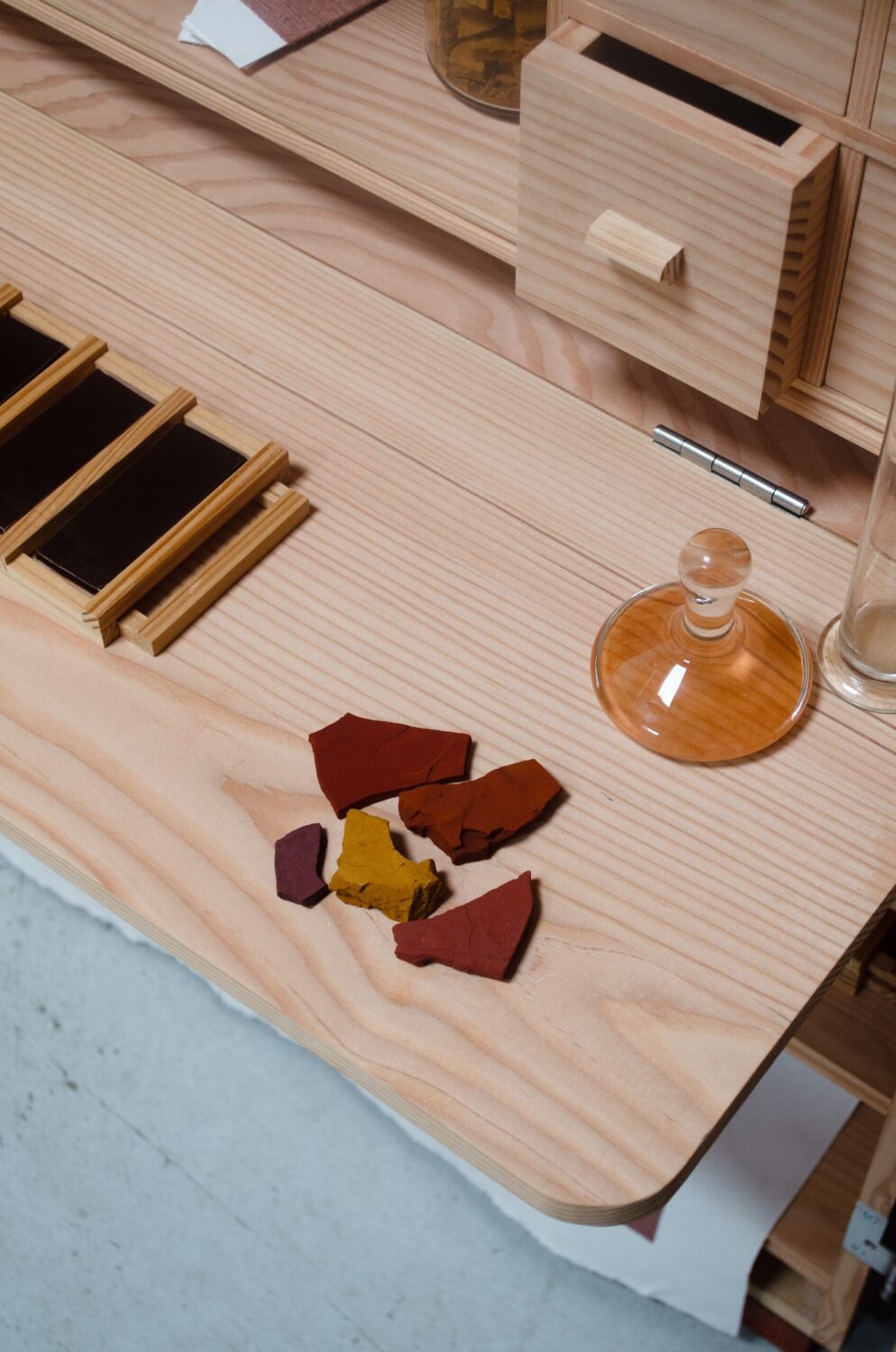
If water is added, the ochre turns yellow. If the ochre is burned at between 400 and 1100 degrees, the yellow colour can be changed to red and violet tones.
Colours are also materials
‘Colour is not just a colour. It is also a place, a natural product and a story. There are people who extracted it 100 years ago. I find the storytelling inherent in the material exciting, for example that ochre was used for DSB’s freight trains or half-timbered houses in the 1700s. It is so much more than just the colour. A red paint from Flügger is just a red paint. The materiality is not relatable, and we do not understand the chemical components in the paint,’ he says.
Thomas Woltmann has a studio in a former factory on Amager, which once housed the city’s production. The view through the window behind him is anything but natural, but inside he has decorated with textiles dyed with ochre, tiles glazed with ochre pigments and cardboard in grey-brown, yellowish and reddish shades.
His interest in surfaces, materials and old traditions arose when he was an apprentice at a furniture restoration workshop. Here, it was necessary to understand the materials, not just the product. He recognised that surface products and colours have a materiality in themselves, which, in his opinion, designers and consumers today are not particularly aware of.
‘Most products, most colours, are extremely synthetic. This has been the case since the Industrial Revolution. We have other natural materials that we use industrially and commercially, such as marble, granite, wood and wool, but this does not apply to colours. There is a big movement within natural dyeing, but it has not cemented itself industrially or commercially. Ochre is still produced, but only in a small share of the market,’ he says.
Contemporary production
In 2025, Thomas Woltmann founded Pigmenta, a company that supplies pigments to other businesses. Its main purpose is to revive the production and use of Danish earth pigments in a contemporary way. He is particularly interested in water-based ochre pigments.
For years, streams in Jutland have been plagued by ochre pollution. Ochre is not toxic in itself, but due to drained agricultural land, it is washed out in large quantities, settling at the edges of and on top of watercourses, suffocating plants and wildlife. The municipalities are left with the task of slurrying it up and typically have several tonnes of ochre to dispose of.
‘This discovery led me to waterworks, which have the same problem because there is also pyrite in the groundwater. When they pump up water, the pyrite oxidises and precipitates as ochre, which they sort out.
And the waterworks are even better because the water becomes extremely clean when it has been through their systems. So that’s a source I’m looking at right now. The advantage of waterworks is also that they produce such extreme quantities. Today, I collaborate with waterworks in Helsingør and Fredensborg, which produce 130 tonnes of ochre sludge per year,’ he explains.
Pigmenta’s first product on the market will be two variants of the linseed oil paint Løvskal Intens for indoor woodwork – an opaque paint for woodwork and walls and a semi-transparent paint for furniture.
Løvskal Intens was developed in collaboration with the manufacturer Linolie & Pigment as an offshoot of his artistic project Løvskal Ochre.

In his material-based research, Thomas Woltmann is investigating the contexts in which ochre can be applied, and he sees ‘industrialisation as a prerequisite.’
‘It would be a shame if the product remained confined to restoration and arts and crafts. It needs to be more widely used, which is why I am more interested in the next step, in product development. If I industrialise it, there is a chance that it will be continued. If it is solely tied to my artistic interest, the effect is more indirect. It can inspire people, which is also something. But I like that design can have a direct effect. It can only do that if you organise it. So it becomes a real alternative,’ he explains.
The dream of a factory
Thomas Woltmann is passionate about all things Danish – and he dreams of having his own factory here at home.
‘My project is about establishing a more natural relationship with the place we live and the things we use. In Denmark, we don’t produce very much anymore. I think that’s tragic. We also have a sanctified relationship with nature. It has become something we look at from the outside, behind a fence. But we are also nature. And we also use nature. Maybe we don’t use Danish nature, but then we use Chinese, Indian or American nature. Why not use Danish nature? And why not use local colours when they are available here? Especially when it is a waste product or by-product,’ says Thomas Woltmann.
He points to scaling up as the major challenge. 100 kilograms of pigment is sufficient for 30-40 litres of paint. Manufacturers need to use 100 kilograms, 200 kilograms, perhaps a tonne, for ochre pigment to be commercially viable.
The difficult part is obtaining the necessary quantities and making the logistics work. And it takes time and resources to set up the business. It’s a different game, where you have to deal with legislation, limit values, certificates – and then you are liable for the quality of the products.
‘It takes up a lot of my time. It will probably be relevant to look at the international market, but there is a lot to navigate. I have to be an expert on all sorts of things that I haven’t dealt with in my design career,’ explains Thomas Woltmann.
The dream seems to be coming true. The Innovation Fund has decided to support Pigmenta, and Thomas Woltmann has a plan:
‘Within a year, I should be able to produce 5 tonnes and have more space outside the city, which is a little closer to some of my sources. It’s also a personal ambition to move out to the countryside.’

Bio
(Born in 1993 in Vejle) Danish furniture designer based in Copenhagen, Denmark. Educated with a master’s degree in furniture design from the Royal Academy in 2024 and a BA from Design Academy Eindhoven in 2018.
Colophon
Writer: Tyra Dokkedahl
Managing editor: Helle Dyrlund Severinsen
Editorial Board: Lars Dybdahl, Annette Svaneklink Jakobsen, Ane Fabricius Christiansen, Peter Moëll Dammand, Anne Louise Bang, Pernille Anker Kristensen.
Translation: This article has been translated using AI. The original text is written in Danish.
Publisher: Danish Crafts & Design Association
You may also be interested in reading these articles:
The Weaver as Artist and Material Researcher
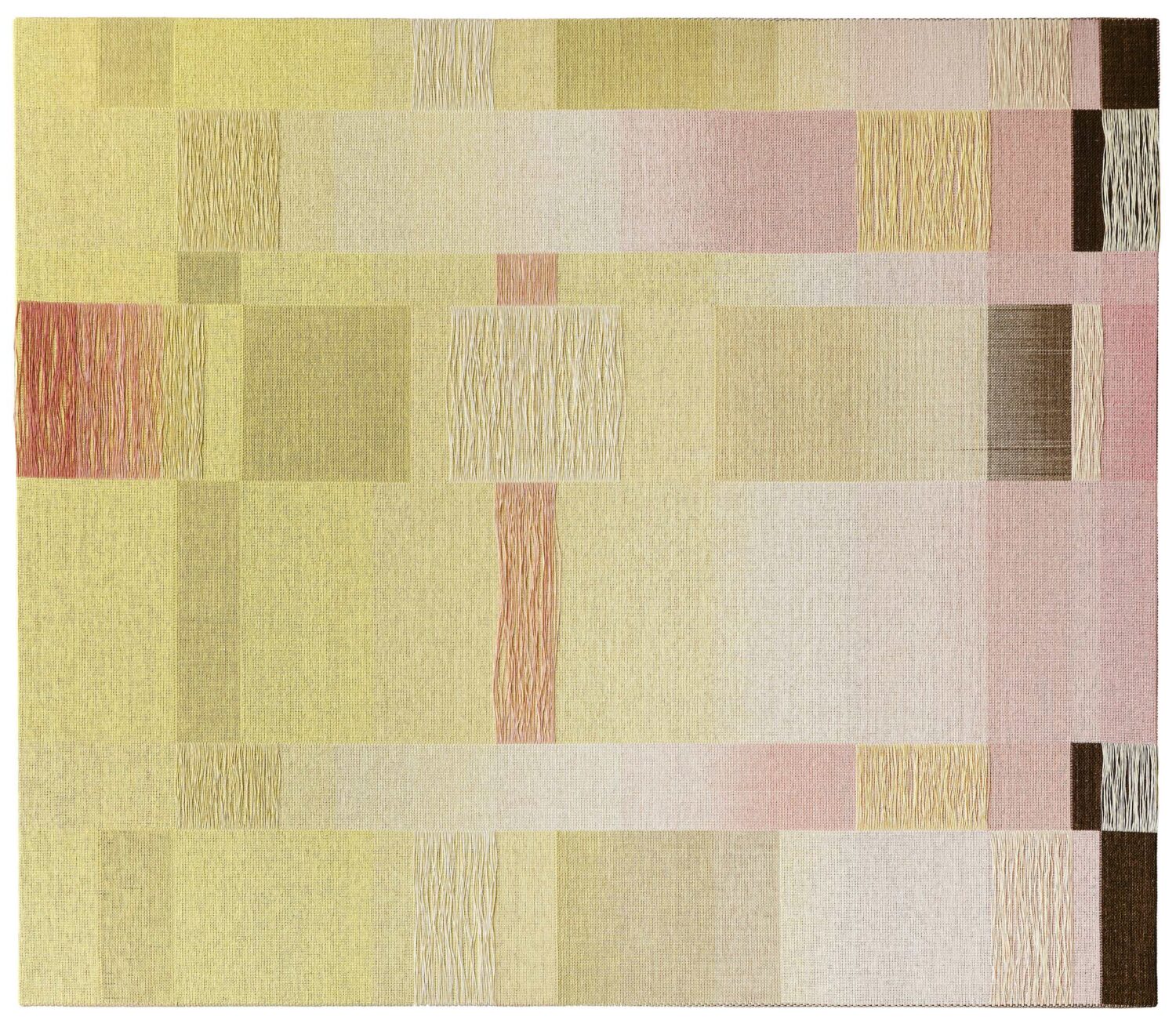
Weaver Anne Mette Larsen effortlessly moves between the art world’s exhibition spaces and the design production’s color and material laboratory. She currently has an exhibition at Galleri Kant in Copenhagen and is simultaneously working on a new production of rugs with Kjellerup Væveri.
Vibeke Rohland: You can’t argue in symbols and colours
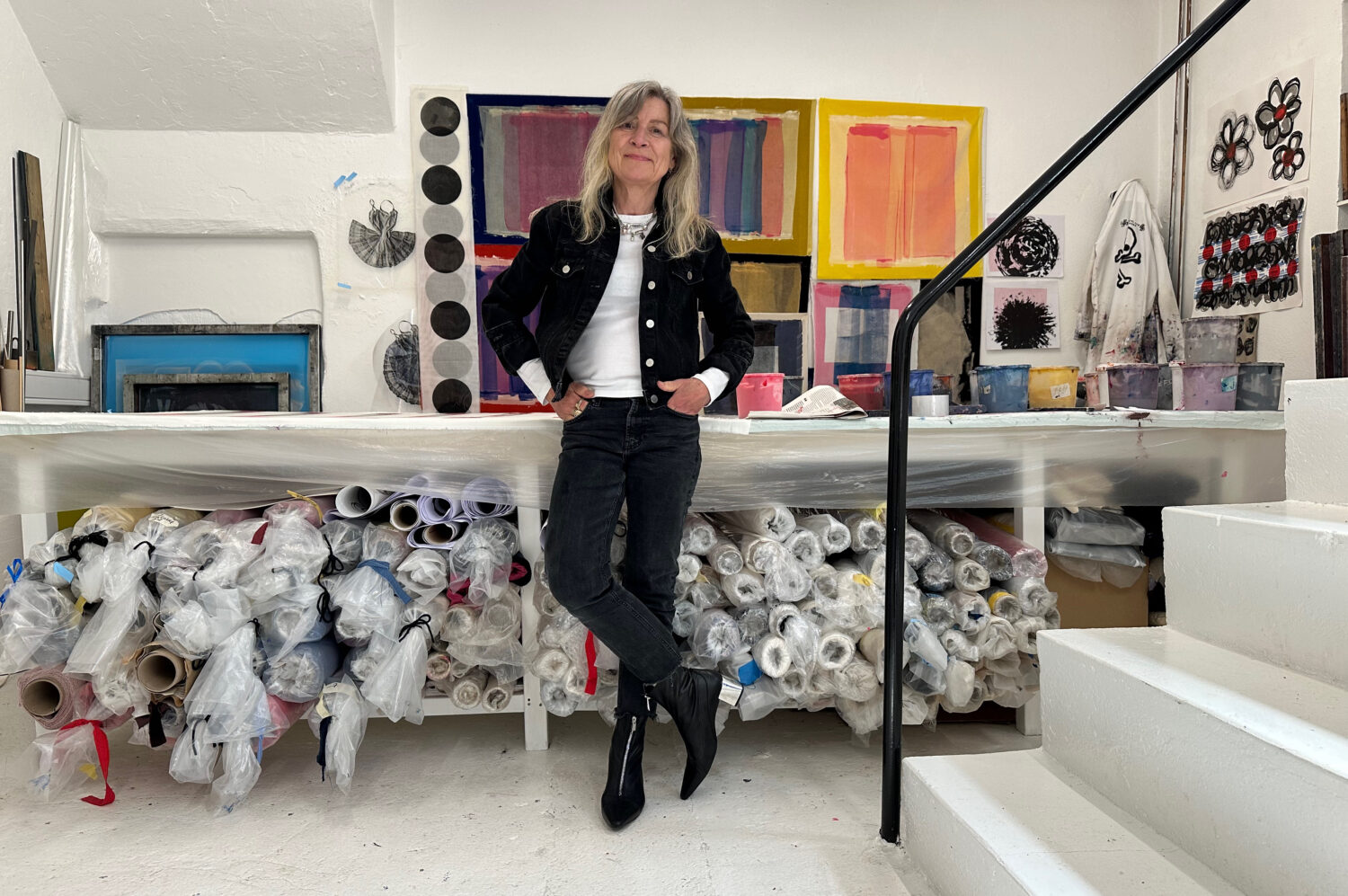
Two trips to Mexico have had a crucial impact on the textile artist’s expression. In this interview, she talks about her fascination with Mexican visual culture.
Verner Panton – The Good Taste of Well-being
Verner Panton’s visionary thoughts and methods speak into a time of Covid 19 crisis, where the recovered collective consciousness pushes society in a new direction.
Can we use Panton’s unconventional approach to design and draw inspiration when rethinking our social lives? Can we learn something from the colorful designer’s thoughts on the sentient body and the unconscious mind? And does Panton have the answer to what so-called good taste is?