I had a dream where I was inside an intestine. It was a bright and airy space. I cleaned it and checked that everything was okay. It was. It was a strong and beautiful intestine I was inside.
The distance between myself and my material sometimes dissolves. The material helps me to see through layers and understand sensations that are otherwise bound in the body. As a Danish textile artist, I have been preoccupied with the magic of gut skin in recent years.
My first physical encounter with gut skin was in 2019 in Northern Norway during an Artist-in-Residence stay at the Arctic Culture Lab. Before that, I had only viewed the material from a distance at the National Museum in Nuuk and in Copenhagen, wondering what a beautiful material it was.
A material that breathes
In October 2025, together with the Greenland National Museum and furrier Sofie Amondsen (GL), I opened the exhibition Puggut Anernerat / Breathing Membranes, focusing on the innovation and tradition of gut membrane. Workshops, lectures and the publication of a freely available online booklet on the subject support the project’s aim of inspiring and anchoring knowledge in society.
Intestine skin as a material
Intestine skin is part of Greenland’s intangible cultural heritage, as it was traditionally used to sew objects and clothing. Kapiseq, a Greenlandic raincoat, was sewn from intestine skin, as the material is breathable, windproof and waterproof. It was also used for windows in turf houses and curtains in summer tents, as light can penetrate it.
The processing of gut skin fell out of use about 100 years ago in Greenland. It is believed to originate from the Thule culture and thus dates back over 1000 years. The oldest finds to date are 600-year-old kapisit (raincoats) from Nuulliit, North Greenland. In modern Greenland, intestines are used almost exclusively as a delicacy. The intestines are cleaned, boiled and eaten as a kind of spaghetti or stuffed with mattak (whale blubber) or other fillings.
Source: Randi Sørensen Johansen has a Master’s degree in cultural and social history.
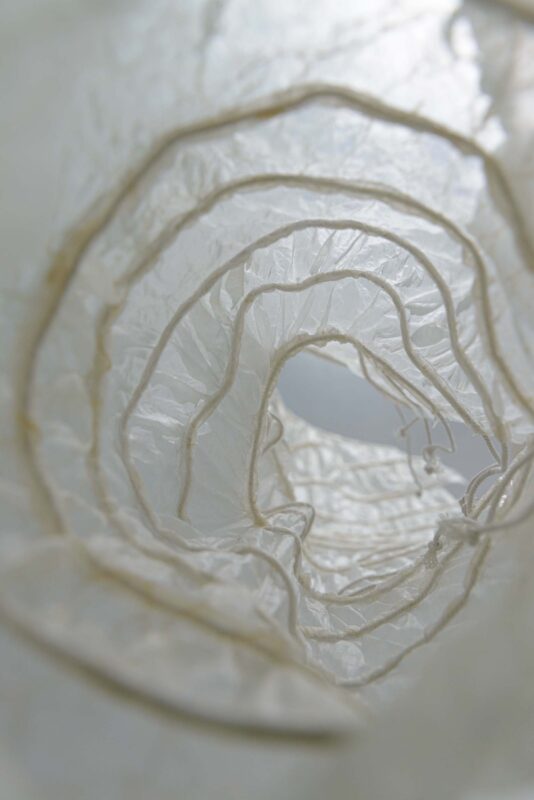
Min Mors hænder (My Mother’s Hands) by Julie Bach, textile artist. Photo Soffi Chanchira Larsen.
It is a completely new development that intestines are now once again being used as a material for crafts and artistic expression. The project has helped to revive knowledge that would otherwise have been lost to history.
Forgotten knowledge
My role in the project is as exhibitor, project manager and initiator. I have been conducting research in Greenland for several years, and in that connection I have seen the beautiful sheepskin anoraks and wondered how they are made. I have inquired in the various sewing circles I have visited in Nuuk (Skindsystuen Kittat), Sisimiut (National Costume School) and Ilulissat (Women’s Association). But I found no answers.
It was only during an Artist-in-Residence stay in Northern Norway that the opportunity arose when a seal was shot and I asked for its intestines. Then I started researching the material. First using the best “learning by doing” method and later based on “Sewing Gut” videos on YouTube from the Smithsonian Arctic Studies Centre Alaska.
The tradition of cleaning, scraping, drying and sewing gut skin has been practised throughout the Arctic region, and here on YouTube there was evidence that the tradition was still alive in Alaska. I later found out that Anne Mette Olsvig, museum director in Qasigiannguit, Greenland, had also studied gut skin, so I travelled there to exchange knowledge.
Light and darkness
The way I work with my pieces is rooted in both craftsmanship and ideas. I studied fashion design at Design School Kolding, and I’m really into creating spatial forms using soft materials. To do this, I usually use leather and fabric, which I sew into sculptures or installations. With my works, I want to invite viewers into an intimate space, close to the body and into the personal narrative – in the form of a larger theme of connectedness, memories embedded in the body and sewing craftsmanship, as a gateway to healing and creating community. My contribution to the exhibition Puggut Anernerat / Breathing Membranes consists of the following works:
My Mother’s Hands
I Have My Father’s Legs
Pendant of Memories
The Connection Through Time
Where It All Began
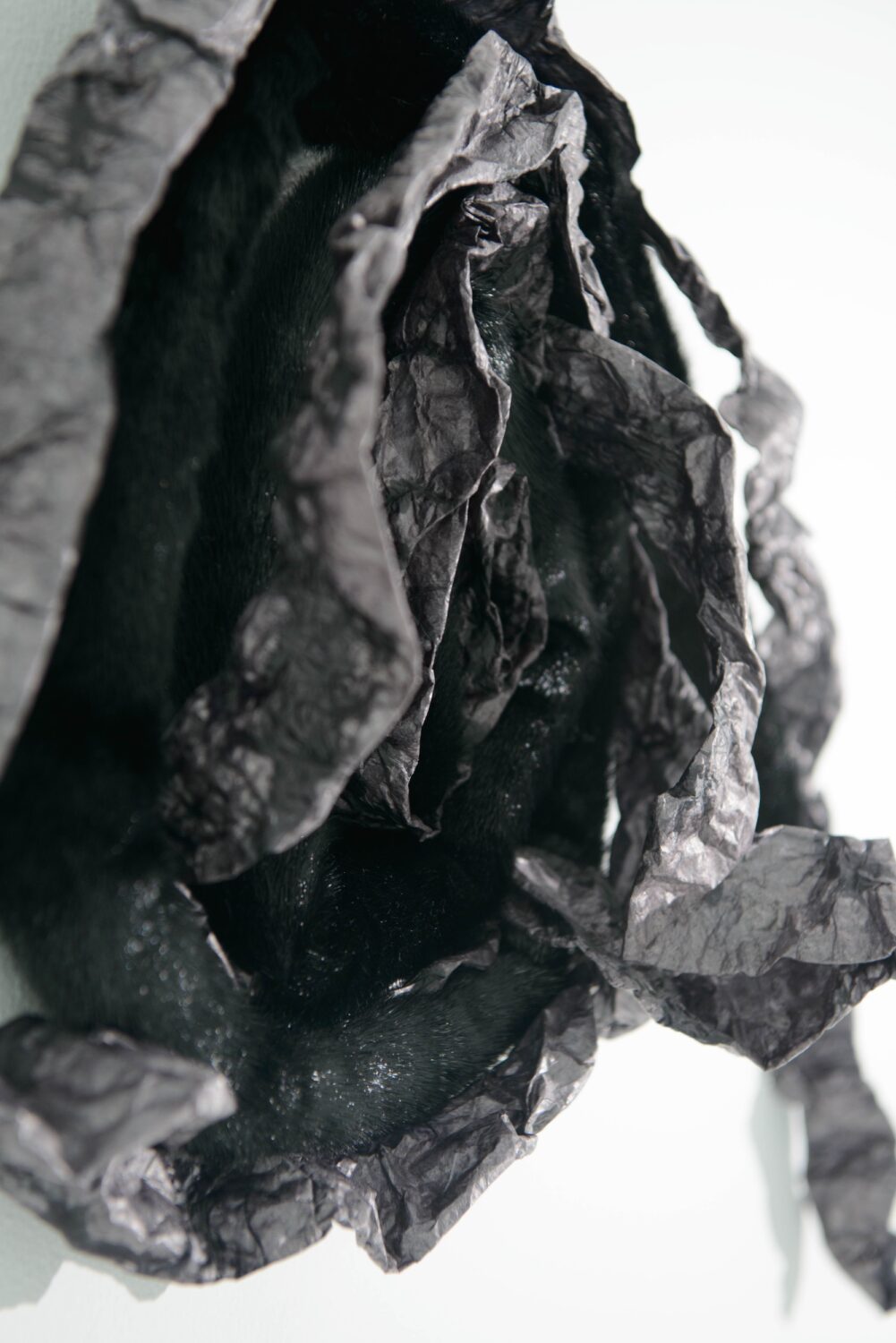
The materials are pig intestines, seal fur, recycled textiles, aluminium and silver. The theme of light and darkness preoccupies me as aspects of myself and as the basis of all life. In my choice of materials and lighting in the exhibition, I play with the relationship between light and darkness, heaviness and lightness: the shiny, black, full heaviness of the seal fur and the light openness of the intestine in its form. The heaviness of the earth and the glow of light.
The very special sensuality of intestine skin fascinates me. That it has both a moist, slightly clammy wet aspect before drying – and a crisp, light and poetic aspect after drying. It transforms! It embodies the very essence of what I am interested in exploring in my works: the corporeal and the spherical. Energy and carnality. Perhaps that is why the material continues to fascinate me!
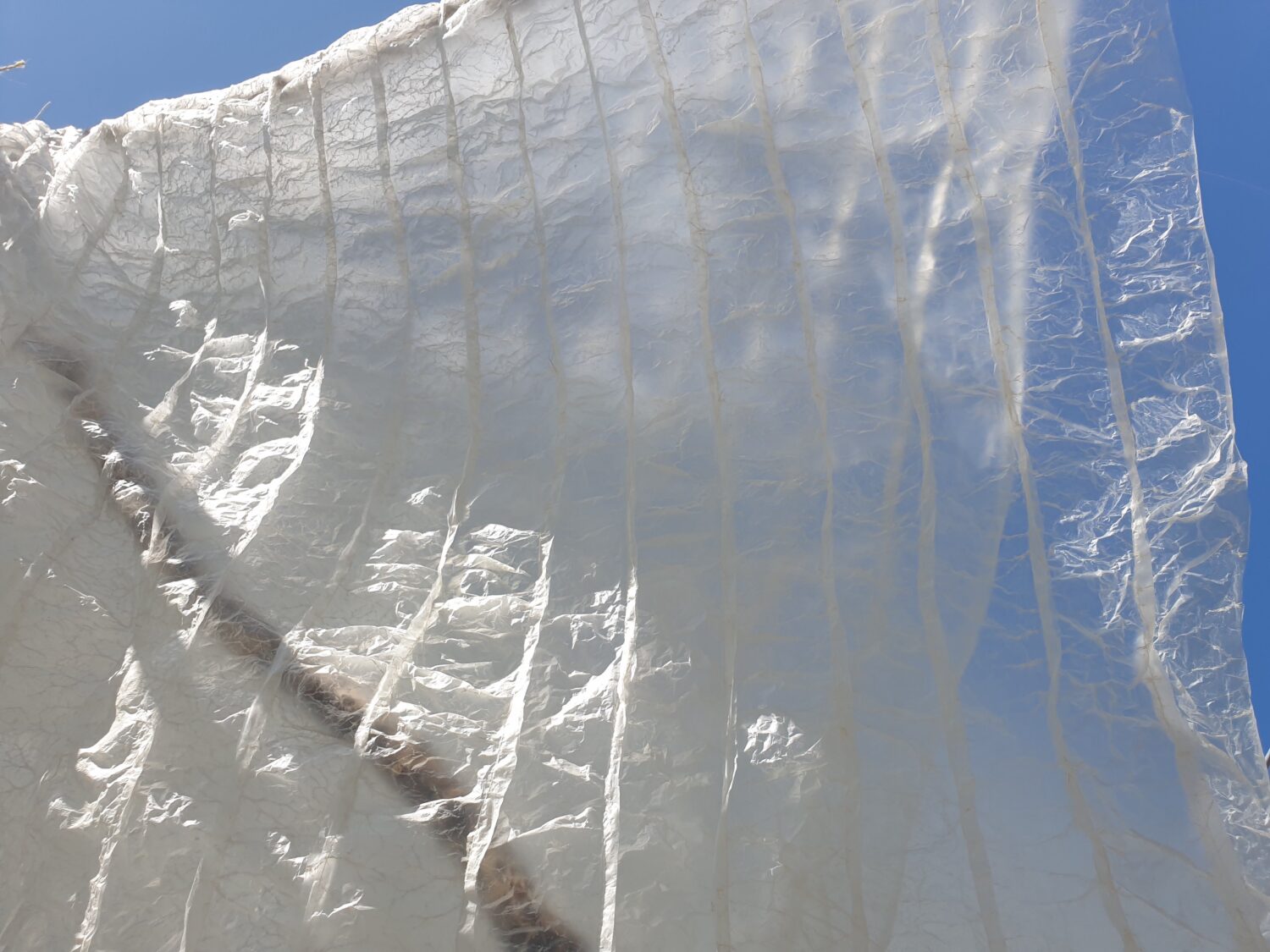
Intestinal skin is, quite literally, a membrane through which the substances the body needs for nourishment can pass. When dried, when light shines through, beautiful structures and branches are revealed, which can be seen everywhere where there is life. For me, intestinal skin embodies the story of the vibrant space of energy that can arise between people.

My Mother’s Hands
The thematic focus of my series of works is my connection to Greenland and my family. I am interested in how we shape each other, and I use intestines as my primary material to describe an experience that is both energetic and physical. The installation My Mother’s Hands consists of sculpture, text and sound. It represents both a wet and a dry trace. The physical work of dried intestines takes the form of a wave, a body, a suit, a skin that carries memory in its skin. When caught in the light, it reveals its lines and markings of the traces of time. Shadows resembling creatures are cast on the wall. They grow out of the darkness, balanced in the light.
The soundtrack contains the crackling, almost roaring sound of dried intestines – like an auditory landscape between poetry, documentary and dream. Documentary elements of the wet, slightly clammy process of emptying seal intestines are included, giving the audience a glimpse into several aspects of the intestines’ story. The poem is about being a daughter and seeing your mother age, and about being connected to a country and a people, and seeking that connection through the active act of sewing.
I was born in Nuuk in 1979, the year Greenland gained home rule. Eighteen days after I was born at Rigshospitalet in Denmark and christened in my mother’s home region in Central Jutland, we travelled back to Nuuk as a family, where my father worked as a nurse at Sana (Queen Ingrid’s Hospital). My parents are both Danish, but my first experiences in life were in Nuuk and later in my childhood home in Denmark, where I grew up surrounded by beautiful Greenlandic handicrafts. My time in Greenland has had a profound impact on my family, and when my father passed away in 2014, it became clear to me that it was time to travel to Greenland and experience it as an adult.
I Have My Father’s Legs
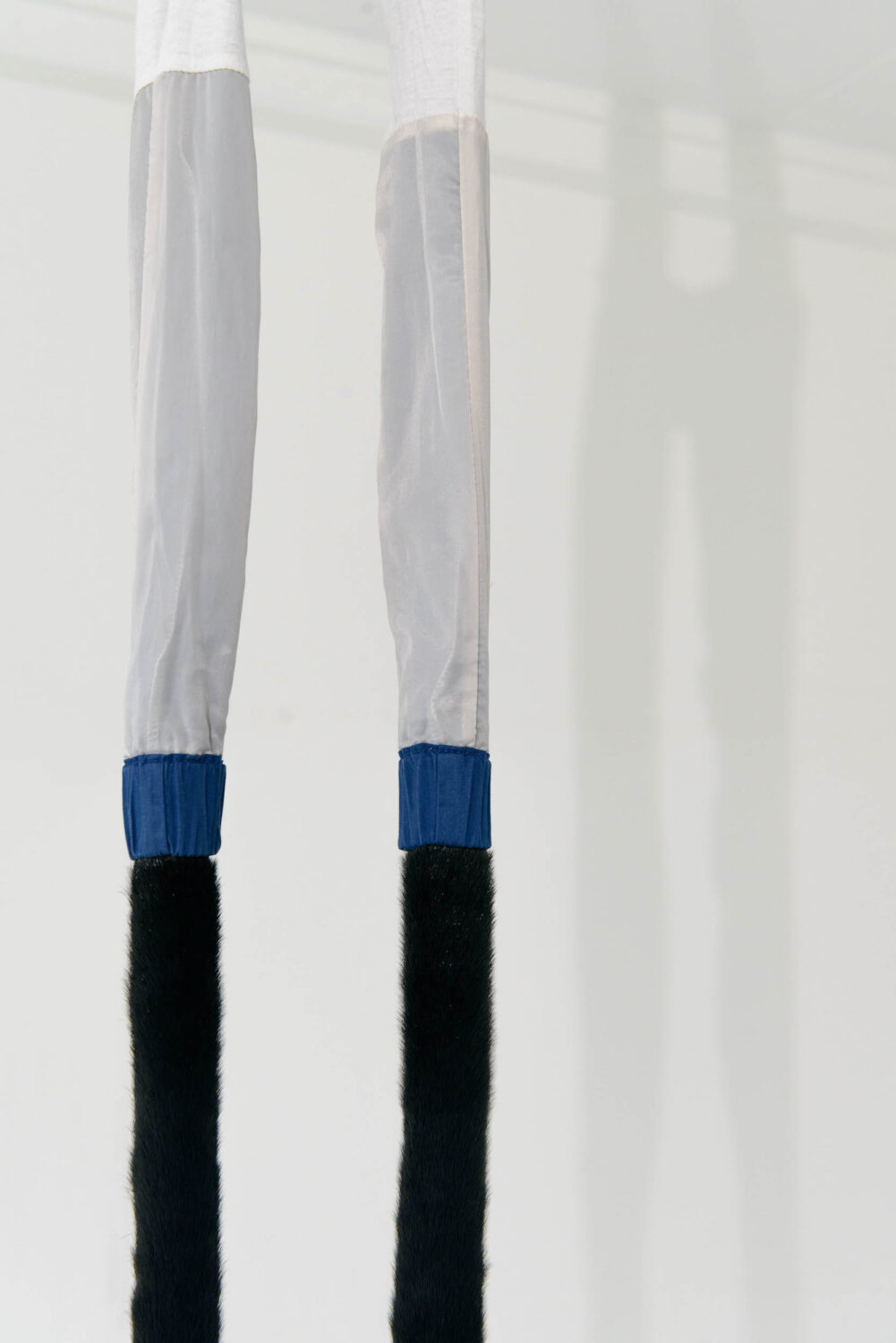
When I develop my works, there are many surprises. In the art work I Have My Father’s Legs, the surprise was the almost tarantula-like legs that revealed themselves in the process. The furry, dark, animalistic, aggressive, something that shows its teeth! It grows out of a remade handball shorts from the 1990s. This is something I see.
Out of the mainstream camping outfit grow long, black, shiny tarantula legs. Is this something I should be afraid of? The feminine? The dark power? The power that comes from the earth?
The tarantula is beautiful, its fur is beautiful, and I accept its form and the associations it gives me. For me, the work is about being a woman and standing by my power. As well as honouring my origins, where I come from.
A genuine collaboration
I made the agreement to exhibit at the Greenland National Museum with Randi Sørensen Johansen (GL), curator of intangible cultural heritage, and she has been my close collaborator throughout the nearly three years we have worked together on the project. I approached her with the idea of creating an exhibition focusing on gut skin, and to my great surprise, she said, ‘We can do that.’ I had envisioned it: an exhibition where the audience is offered many ways to experience the material and the work.
Randi Sørensen Johansen has a Master’s degree in cultural and social history, and in her role as museum curator, she brings a deep understanding of ethnological, anthropological and historical research. It is precisely the different disciplines and cultures that each of the participants has contributed that have given the project strength, anchoring and breadth of perspective.
Objects made of gut skin have long been part of the Greenland National Museum, but the knowledge of the craftsmanship behind them was no longer alive in Greenlandic society. We therefore wanted to revive the traditional knowledge and at the same time inspire its use in a modern context.

Ripples in the water
With a strong desire to anchor knowledge in society, we have collaborated with local actors who have helped shape the project and who can help share knowledge after the exhibition. Leatherworker Sofie Amondsen (GL), museum curator for costume history and ethnology Aviâja Rosing Jakobsen (GL) and the leather workshop Kittat (GL) have all left their mark on the project.
Sofie Amondsen is contributing works to the exhibition. She has sewn the everyday objects Pooq (basket) and Qaamasortaq (lampshade) from processed seal intestine using thread made from seal throat. At a knowledge-sharing workshop in February 2025, all parties met to share knowledge about the processing of intestine skins. With a hands-on approach, we tested materials, methods and tools described in historical sources and studied the museum’s objects to understand stitching and materiality. This knowledge has helped shape the exhibition and formed the basis for the workshop held in connection with it.
In a four-day workshop, participants processed narwhal gut and sewed their own creations from pig and narwhal gut. We are proud to see participants from the workshop using gut in their everyday crafts. By focusing on an overlooked material, the project has created ripples in the water that are now spreading.
About the project
Puggut Anernerat / Breathing Membranes can be seen at Nunatta Katersugaasivia Allagaateqarfialu (Greenland National Museum) until 22 February 2026.
Would you like to try working with gut membranes and learn more?
‘Breathing Membranes – Gut Processing Methods and Innovation’ by Sofie Amondsen and Randi Sørensen Johansen provides an introduction to the subject in words and pictures.
Hear the project participants talk about their work with gut membranes in an online lecture on 21 February 2026.
Watch live or on replay
Source
Schmidt, Anne Lisbeth: An Analysis of 600-Year-Old Gut-Skin Parkas of the Early Thule Period from the Nuulliit Site,
Avanersuaq, Greenland’ (2022), ARCTIC ANTHROPOLOGY, Vol. 59, No. 2, pp. 107–130
Læs også:
Breathing Membranes – meeting the beautiful and the disturbing
Textile artist Julie Bach is in Greenland working on the exhibition Breathing Membranes. Here she talks about gutskins, the healing properties of sewing, physicality and presence: ‘An important part of the project is to meet and stand together and have our hands in the materials, and hopefully influence and learn from each other.’ Julie Bach talks about the preparations for the project.
Karen Fly is a Greenlandic jewellery designer: “I’m honoured by that and I try to live up to it.”
Once upon a time, she held Greenland “outstretched”. But then Karen Fly visited her mother’s homeland for the first time. It was a life-changing journey that changed her view of Greenland – and of herself.