

Sitting on the bus that is wending its way through the landscape, I feel that I have travelled both into the future and back to the past. Outside, it is pitch dark, and I feel that I could be anywhere in the world. My mind is filled with memories of a past when my life revolved entirely around weaving, as I think about how it will affect me to be confronted with the profession I had to give up almost ten years ago.
The next morning, when I wake up and open the curtains, I am greeted by a panoramic view: the beautiful, slightly hazy valley embracing the Norwegian town of Hønefoss. I am visiting Vibeke Vestby and her husband, Ola Tronrud, who have put me up in a guest section of their house. Both Vibeke and Ola are the kind of people who might be easily overlooked in passing: gentle, polite, friendly people, who might not match the stereotype of hard-hitting, dominant business executives. Nevertheless, they both run groundbreaking companies.
I have come to Norway for prepare an episode of the podcast Fabric of Society, which I create in cooperation with Rosa Tolnov Clausen, who holds a PhD in Crafts. Thanks to support from the Danish Arts Foundation, Rosa and I have come here to learn more about the loom that shapes the weaver’s possibilities.
Vibeke Vestby is the key figure in this story. She had the idea for the Thread Controller (TC) loom and is the founder of the company Digital Weaving Norway. During the three days I spend with her, it becomes clear that Vibeke would much rather talk about the TC loom and about how everybody else helped make it what it is today than talk about herself. I am sure this is in part a reflection of her humility, but even more so, it reflects her passion for weaving.

A multifaceted loom, a many-sided person
In many ways, the TC loom opens the field anew. It is sold to leading textile departments at design, art and craft universities around the world and to innovative technological research institutions. To many others, these two areas might seem to belong in separate worlds, but the more I get to know Vibeke Vestby and her way of thinking, the more sense it makes. As a talented weaver and a pioneer of digital production, she combines the two perspectives. Meeting Vibeke in person, I have no doubt that the success of the TC loom was made possible by her obvious people skills and pleasant demeanour. Her commitment and genuine passion are infectious.
Back in the 1970s, a young Vibeke is training to become a weaver at the OsloMet university, but she is frustrated and bewildered by her courses. She knows that elsewhere around the world, weavers are making intricate floral patterns and animal motifs in colourful silks, but on the floor looms she is introduced to, they mostly weave woollen textiles in a single colour or, at most, with stripes. She is told that id she wants to make more complex designs, she can use the tapestry loom; a hugely time-consuming process. But that is not what she wants. She wants to weave imaginative and reproducible fabrics by the yard or, as Vibeke puts it, ‘What I wanted was the freedom to weave a photograph or a text or a naturalistic drawing.’
The TC loom
The Thread Controller 2 is now generally known as the TC2. In this article, it is referred to as the TC loom, as the article also deals with the first number of years, when it was called the TC1.
The loom is made in Moss, Norway, and exclusively sold through Digital Weaving Norway, which is part of Tronrud Engineering. In the summer of 2025, the company celebrated its 30th anniversary. The loom is sold to clients all over the world, two thirds of them being institutions of education.
From fixed form to creative freedom
In essence, weaving consists of threads that cross each other at right angles in an organised manner to create a rectangular textile. All the threads going in one direction are mounted on a loom; in weaving terminology, they are known as the warp. When weaving, the weaver lifts some of the warp threads to insert threads between them, at right angles. These threads are called the weft and are passed between the warp threads using a so-called shuttle. The key feature is the weaver’s options for raising individual warp threads. On the simplest looms, stripes are the only possible pattern, created by varying the colour of the yarn. The more sophisticated the loom, the greater the weaver’s creative freedom. The unique quality of the TC loom is that it lets the weaver raise each of the warp threads independently of the others. This provides the ultimate degree of freedom in weaving, which is generally viewed as a craft that cannot escape certain basic restrictions.
During her studies, Vibeke gradually realizes that Jacquard weaving will allow her to create more complicated patterns. In 1801, Joseph Marie Jacquard invented the Jacquard loom, which could create sophisticated patterns based on a system of punched cards. The method that he developed for this purpose was the first step in the development of the computer as we know it today. The earliest form of computer programming was the binary system, which consists of zeros and ones. This relates directly to the logic of weaving: the warp thread is either raised or not; those are the only options.
The Jacquard loom was developed to do control the threads automatically using punched cards, which functioned as early form of pattern programming.
As the technology for Jacquard weaving developed, the punched-card system was replaced by computerized control. Instead of controlling each individual thread, the weavers now repeated the same pattern to make piece goods.

In her development of the TC loom, Vibeke worked more like an artist, seeking the freedom to create an image on a canvas, than a furniture upholsterer looking to produce a hardwearing fabric for a sofa. Thus, the TC loom is based on a further development of the original Jacquard method. As a thread-controller loom, where all the threads can be controlled individually, it affords the weaver greater freedom.
One key difference between the industrial Jacquard loom and the TC loom is that the former is mechanical, while the latter is a hand loom that can be used with a wide range of materials because the weaver inserts them by hand. Meanwhile, the weaver can control every single thread by programming the design into a computer connected to the loom.
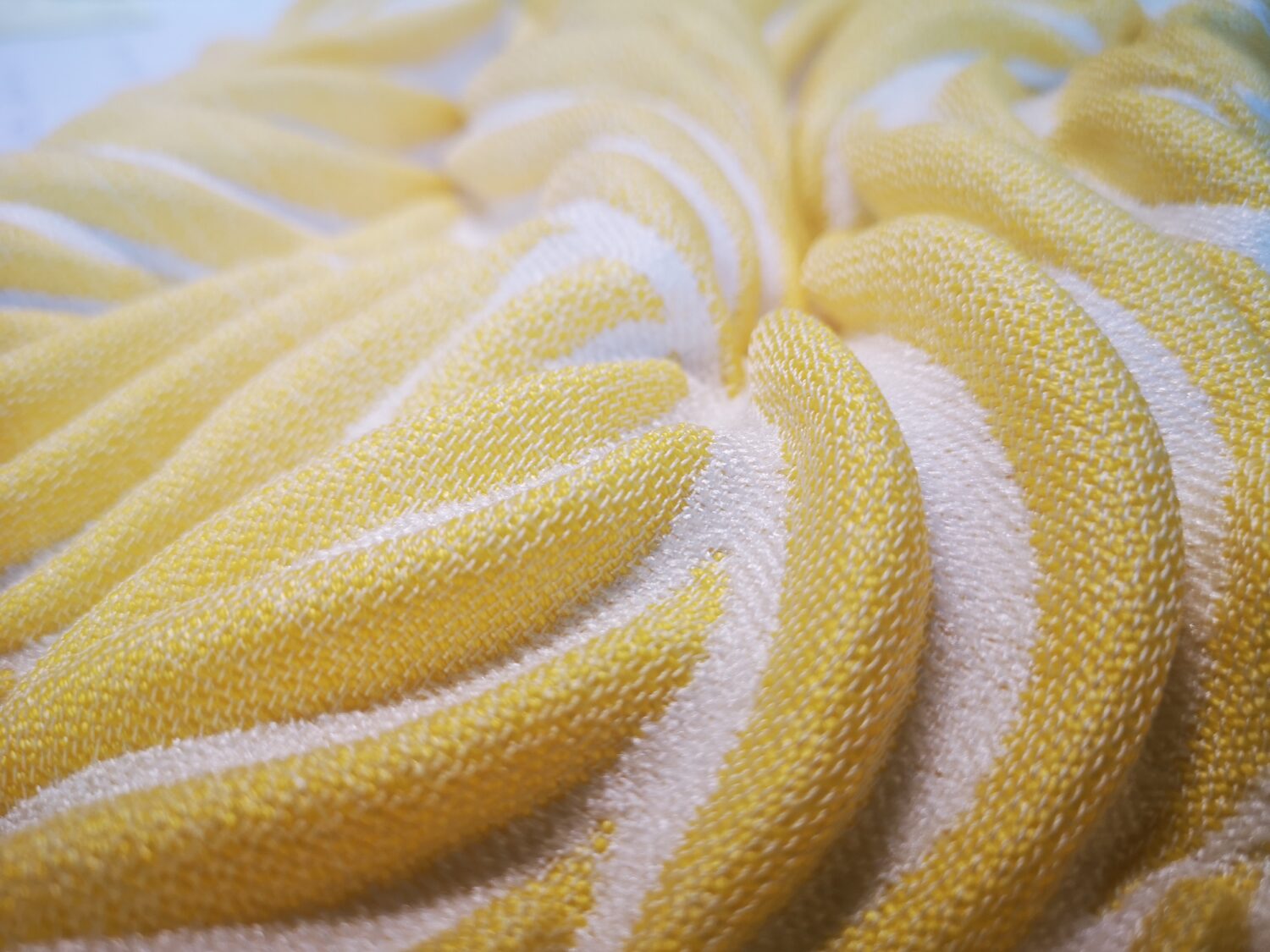
A key moment
One key moment in the development of the TC loom occurs almost by chance during the early 1990s. At this point, Vibeke teaches at the Oslo National Academy of the Arts (KHiO). One day, she happens to see a memo announcing the Norwegian government’s decision to invest in new research to develop traditional crafts. She happens to spot the announcement one day before the application deadline. With no time to arrange meetings with others in her department or consult with her supervisor, Vibeke rushes home, writes an application for funds to develop her dream loom and hands it in on her way to work the next day.
A few months later, she receives the reply: her application has been approved. Even though her colleagues do not exactly applaud her solo initiative, she eagerly begins her project. She wants to develop a loom that lets the weaver raise each thread individually, but working out the practical solution is a different matter. She needs an industrial collaborator with bright engineers and the right resources for producing the loom. Vibeke contacts one company after another, to no avail, but one day, she finally has a break, with a phone call that turns out to be life-altering in more ways than one. ‘An elderly gentleman picks up the phone and says, “based on what you’re telling me, I think the only company that will be able to help you is Tronrud Engineering”,’ she says, smiling as she recalls the conversation. This is the first Vibeke Vestby hears about Ola Tronrud: the man, who initially becomes her project partner in the development of the prototype of the TC loom, later her business partner in the establishment of Digital Weaving Norway and eventually, several years later, her husband.

From excited reception to silence
Tronrud Engineering was founded by Ola Tronrud in 1977. The company specializes in the development of prototypes and automated solutions for industry under the slogan ‘putting ideas into practice’. This is where Vibeke finds help to translate her vision into reality in the form of a brand-new type of loom.
Over the next two years, they develop the first prototype of the TC loom. In 1991, KHiO is invited to take part in an exhibition in Munich. Here, Vibeke presents her loom, which is met with excitement. People form a queue at the academy’s stand. Everybody wants to hear about the new loom, Vibeke gives talks around the world, so you might think that this is when the project really takes off. However, after the initial excitement, the interest gradually dies down. The Norwegian state does not wish to finance the further development of the loom, and for a number of years, the project remains at a standstill.
In 1994, Tronrud Engineering reaches out to Vibeke again to hear how the project is coming along. After some time and several meetings, they decide to enter into a partnership to develop the prototype into a market-ready product. Tronrud Engineering handles the technical aspects, while Vibeke brings her weaving skills and, not least, her international network of weavers and weaving enthusiasts.
Now, the outlook is bright, but when the first finished TC loom is launched, the response is decidedly muted. While the prototype was received with almost overwhelming interest, the silence now seems deafening. As it turns out, there is a big difference between how the world receives a groundbreaking prototype and what it takes to make people invest in a new technology.
‘That was a shock to me. I thought people would be enthusiastic, but when I asked fellow weavers how they would like to be able to weave a circle, rather than a rectangle, they were like, “Why would I want to do that?”. I realized that weavers are so well trained that they simply accept the limitations of the loom.’
The international weaving network
At this point, the unique weaving network that Vibeke has developed throughout her career proves essential to the success of the new loom. Today, she certainly feels that it made all the difference for outcome. ‘Some of early supporters were [the Danish textile artists] Grethe Sørensen and Lise Frølund, who saw the point right away. They already had careers and knew what they could achieve on a traditional loom – and what the limitations were. […] Without them, we would never have been able to continue the project. The more they could do on their [TC] loom, the easier it was to market it.’
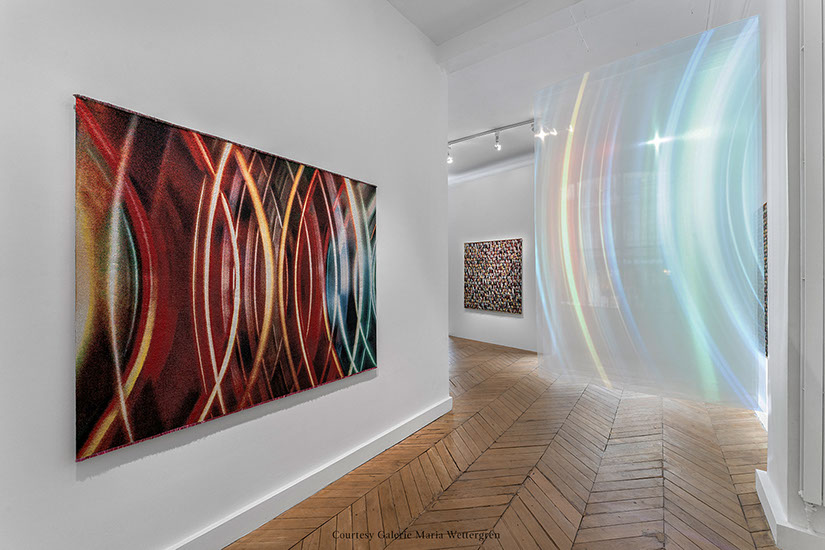
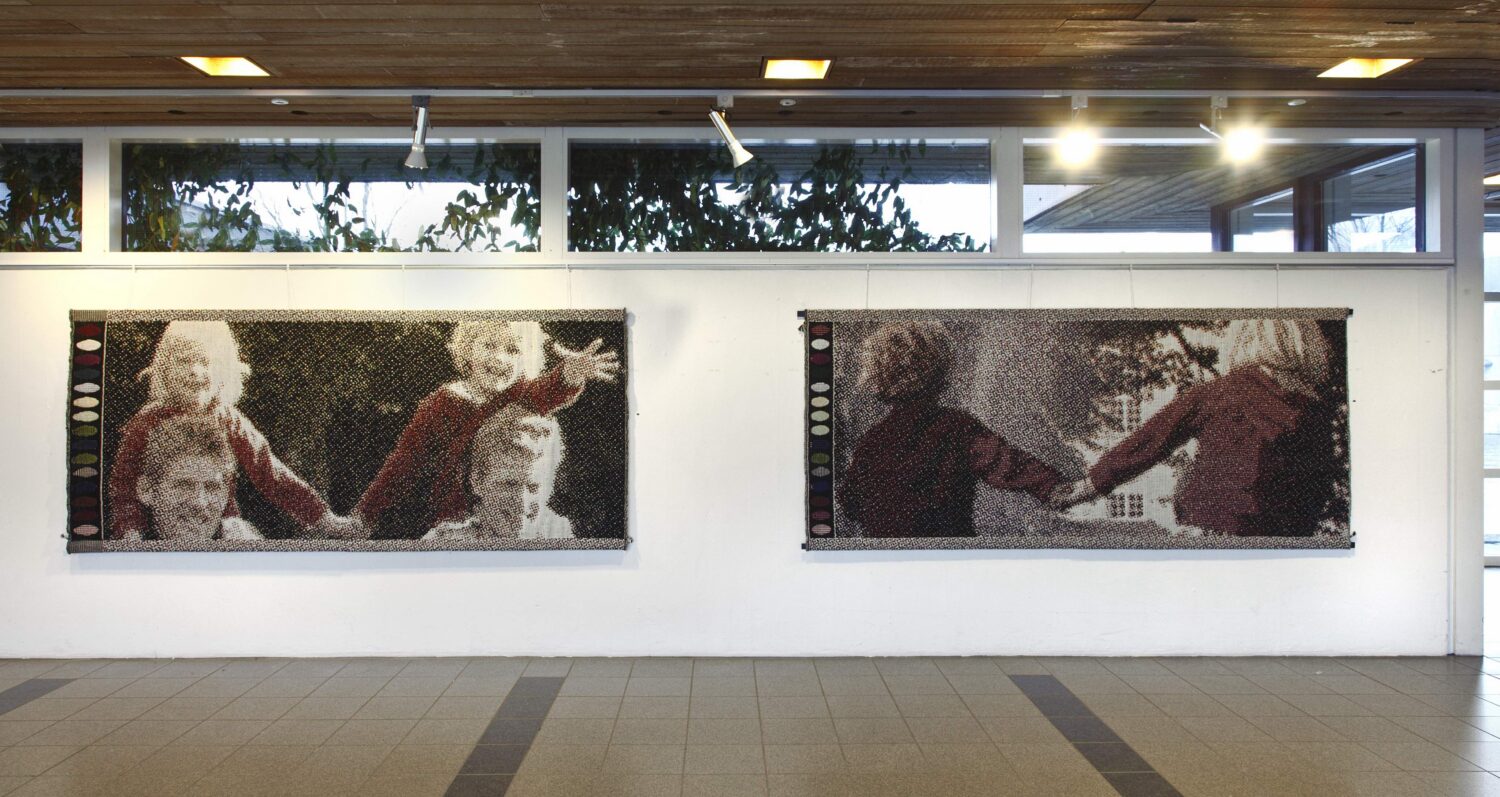
The two artists use the TC loom to create new innovative pieces that are exhibited around the world, from Denmark to Europe, the United States and China. What was initially an abstract concept to most weavers now becomes a tried and tested revolutionary piece of equipment for advanced artists. In many ways, this lays the foundation that Vibeke has been building on ever since.
Art and research
Today, 30 years later, the company’s customers fall into two main categories. One consists of practitioners in the fields of art, design and crafts and are mainly represented by universities, academies and professional weavers. The other group is researchers exploring innovative digital production methods. This includes Stanford University’s Department of Physics, which has bought its own TC loom, Boulder University’s Unstable Lab, which conducts experiments with weaving and electrical impulses, and Cornell University’s Hybrid Body Lab, which develops textiles with built-in sensors in collaboration with medical scientists. Weaving is clearly not just a historical practice but also a part of the future.
In the summer of 2025, Digital Weaving Norway marks its 30th anniversary with a conference where weavers and researchers from all over the world come to Norway to celebrate the development in the field of weaving that the TC loom represents.
The love of weaving
I began this article with a feeling of standing in the future and the past at the same time. That is also where I finish. My own passion as a weaver was extinguished, against my will, almost a decade ago. After spending a number of years weaving for the international fashion industry, I contracted a work-related injury that put a stop to my practice. Even if it may sound absurd to the uninitiated, losing my craft has caused me more grief than any romantic heartache I ever experienced.
Meeting Vibeke Vestby and hearing her life story brought it all back, but it was also a healing experience. Learning about her passionate work was an opportunity for me to revisit my own love of weaving. I do not know if I can ever return to weaving myself, but now I know that my appreciation of the craft is life-long, and with this article, I hope to introduce a larger audience to the magic of the craft.
It gives me profound joy to know that there are people like Vibeke out there who do so much for our profession. She would probably not speak so highly of herself, so I will do it for her: with her loom, Vibeke Vestby has revolutionized the weaving profession. She has done it in a way that has not just influenced traditionally trained weavers but also all the people who have discovered the weaving craft through the development of digital approaches. I am very excited to see what she comes up with next. Viva la loom!
Fabric of Society
Fabric of Society is a podcast by Rosa Tolnov Clausen and Stine Linnemann that explores Nordic societies from a textile perspective. Season one looks at the development from a time when textile craft was about survival to now, when many pay significant amounts to practise it as a hobby. The second, and final, season focuses on the development of the hand loom in the Nordic region over the past 150 years.
Terminology
TC loom: a thread controller loom patented by Digital Weaving Norway.
Warp: the threads mounted on the loom, intersecting with the weft at right angles.
Jacquard loom: a loom operated by a system of punched cards, invented by Joseph Marie Jacquard in 1801.
Punched card: a card made of a rigid material, typically cardboard, with holes punched in it that form a pattern in the weave. It may be understood as the first form of pixels, the smallest element of a visual expression on a computer. The earliest computer programming was based on a binary system of zeros and ones expressed in punched cards.
Harness: the part of the Jacquard loom that hangs above the loom and connects the warp threads to the system of punched cards.
Reference for the description of the Jacquard loom: The golden thread: How fabric changed history by Kassia St. Clair, pp. 7–8. John Murray Publishers, 2018.