
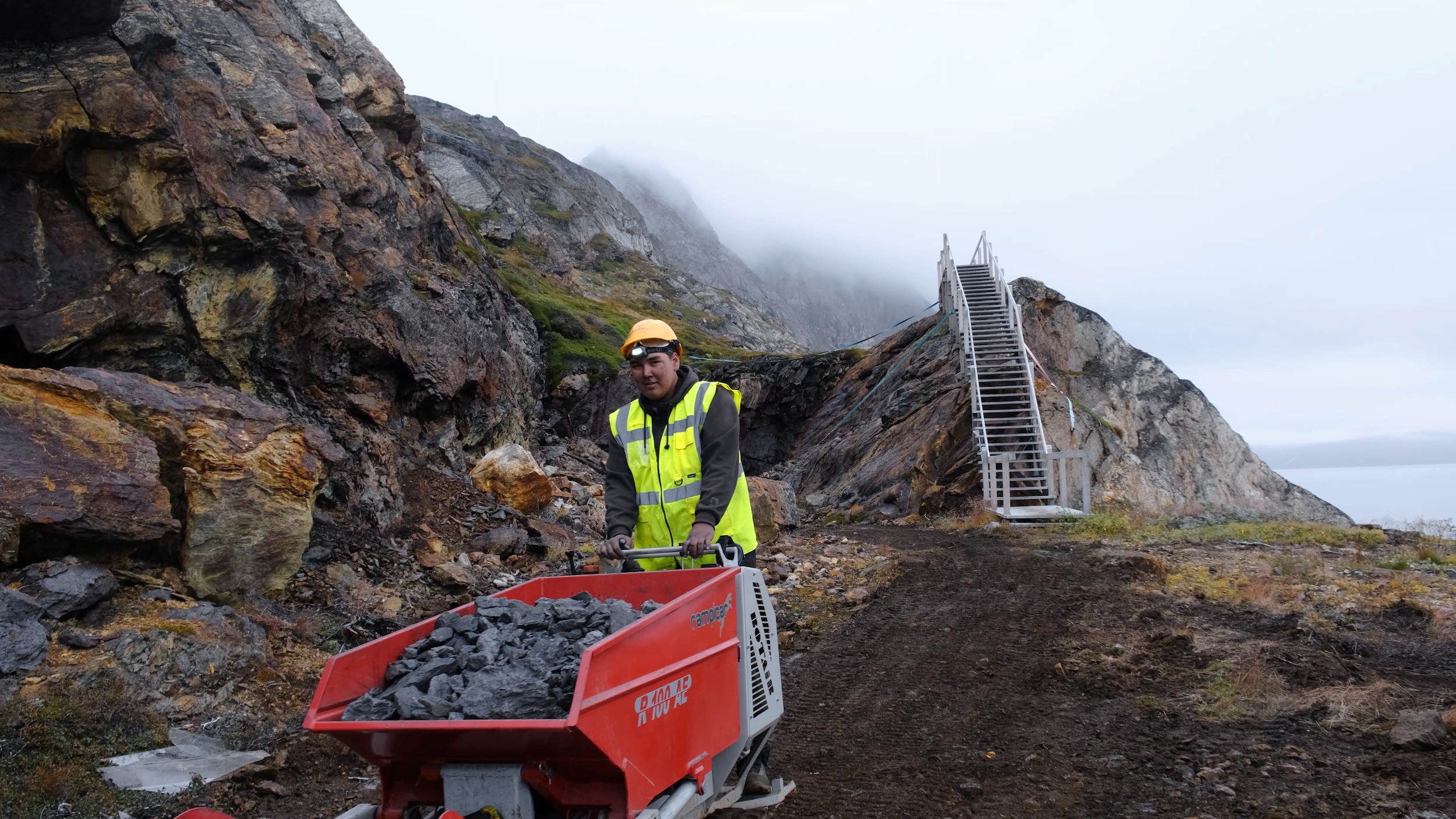
At the intersection of design, journalism and research data, Gudrun Havsteen-Mikkelsen has developed a practice in which design is not primarily a discipline that creates products – but a method for exploring the world, which she uses to make complex knowledge accessible through aesthetic and design-based communication strategies. With the exhibition ‘If in a hole, keep digging’ at Officinet, she explores mineral extraction in Greenland, geopolitics and the narratives that shape our understanding of the Arctic.
She focuses on the reality and tensions unfolding there through visual storytelling, information sharing and a critical perspective, the aim of which is to create transparency, raise awareness and offer a different communication strategy to that provided by research and traditional journalism.
How does one communicate a reality that ranges from geopolitical power shifts to human experiences and values? How does one translate research, open-source data and fieldwork into something that can be experienced, felt and which prompts reflection?
This is precisely the focal point of Gudrun Havsteen-Mikkelsen’s practice, which moves between design, journalism and artistic research and centres on raw materials, geopolitical tensions and the societies shaped by them. It is a practice that does not seek quick answers, but insists on remaining within the complexity. She realised early on that design can serve as an investigative tool rather than a discipline tied to objects, and she developed a language capable of encompassing both analytical research and visual communication.
Exploring the world through design
Havsteen-Mikkelsen describes her practice as comprising two equally important aspects; on the one hand, it is based on journalistic principles of research, source criticism and documentation, whilst on the other, it emphasises artistic freedom to experiment with form, space and experience.
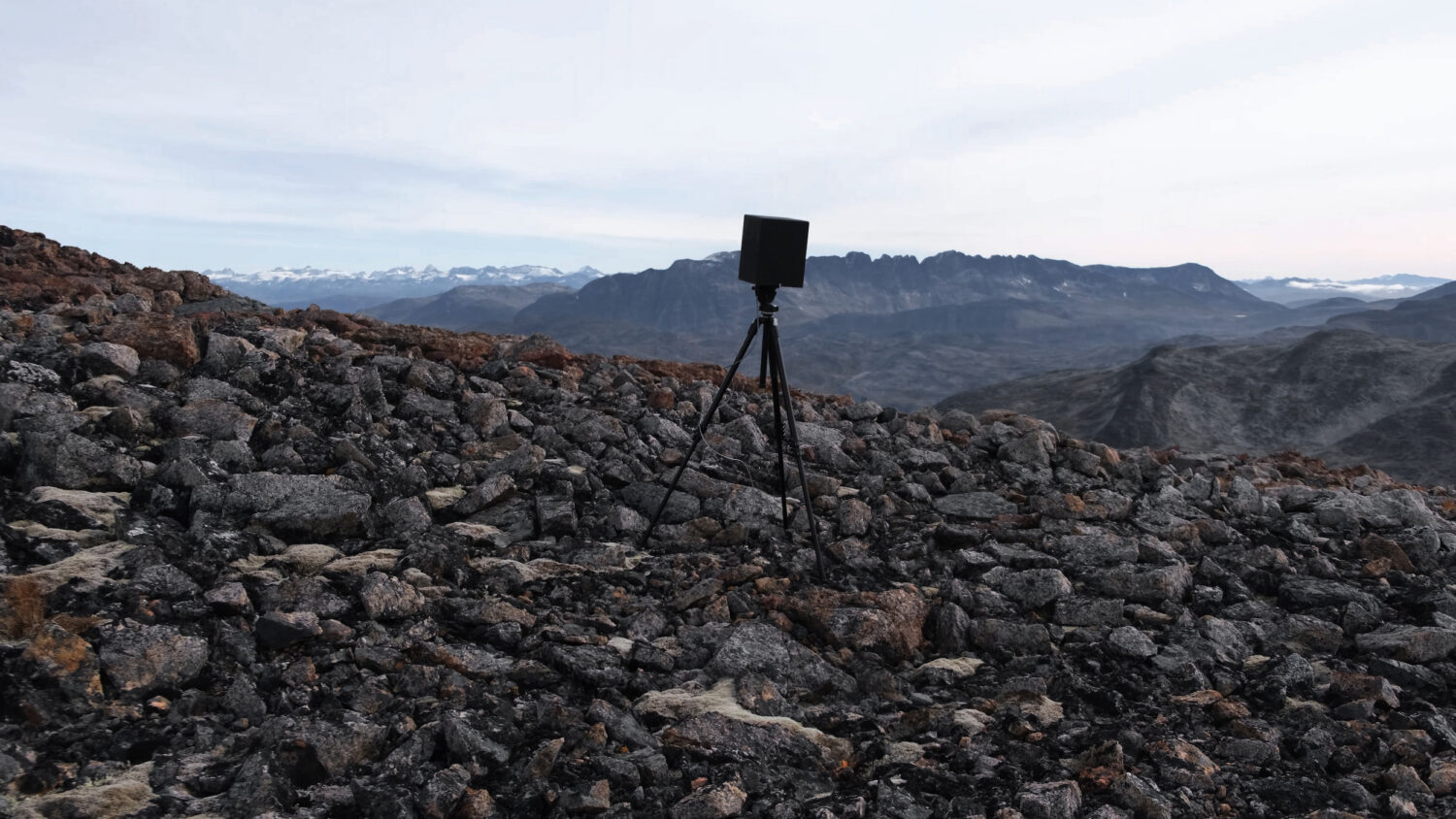
The knowledge on which she bases her projects stems either from open-source data or from her own extensive field research. Interviews, audio recordings, video material, mapping and sensor-based recordings are collected, processed and transformed into installations, films and/or other forms of projects or works. For her, the research is what defines the work itself.
‘In my practice, design research is very much about the process of conducting the investigation – going out into the field to collect data. It is a methodological approach to documenting the structures that shape the world now and in the future.’
It is an approach characterised by curiosity and a spirit of adventure. Not as a romantic notion, but rather as an inner zeal and desire to apply knowledge and skills within a field offering so much potential.
Her great-grandfather was the polar explorer Ejnar Mikkelsen, and although her ‘expeditions’ are undertaken with a camera, microphone and geological maps rather than a ship and sledge, she recognises a driving force and a passion for the same geographical region.
‘There’s something about this masculine dream of making ‘the great discovery’, of investigating and exploring the Arctic. And incorporating that into my design practice, alongside the themes I’m exploring, seems to be an inexhaustible goldmine,’ says Havsteen-Mikkelsen.
Making research accessible
Her work centres on some of the most complex issues of our time. Mineral extraction, international power dynamics and the global supply chains linking Greenland to the US, China and Europe have become recurring themes.
These are not topics that can easily be reduced to short, straightforward narratives. Quite the contrary. They unfold at the intersection of climate, economics, colonial history, technology and national interests. That is why a critical eye and journalistic ethics are also crucial to her:
‘It means a great deal to me that my work is grounded in journalistic principles. I am not creating new science or conducting new research, but I gather information and breathe new life into it. A critical tone is important, although my work also strives to be informative.’
In this way, design becomes a tool for creating an overview and posing questions rather than drawing conclusions, by making research accessible in a new and different way. And this is important to Havsteen-Mikkelsen: that research becomes accessible without losing its complexity. And this is where design, as both a method and a means of execution, can help. Extensive research projects often end up as closed reports or in academic formats that reach only a limited audience. Here, she sees potential in design and visual journalism to communicate in different ways through new formats.
‘There are often large institutions behind major research projects, and they use a specific format to disseminate the research. That format doesn’t really exist in visual journalism or aesthetic journalism. There are other formats and a different kind of artistic freedom. And that’s what I think visual journalism and design work can do – they break the mould of conventional formats. Generally speaking, my view is that the research being carried out should also be made accessible. If the research isn’t accessible, it loses its significance. This also applies to the field of design.’
Film, sound, installations and spatial experiences are becoming ways of conveying knowledge, where the audience does not merely read about a subject, but moves through it.
If in a hole, keep digging
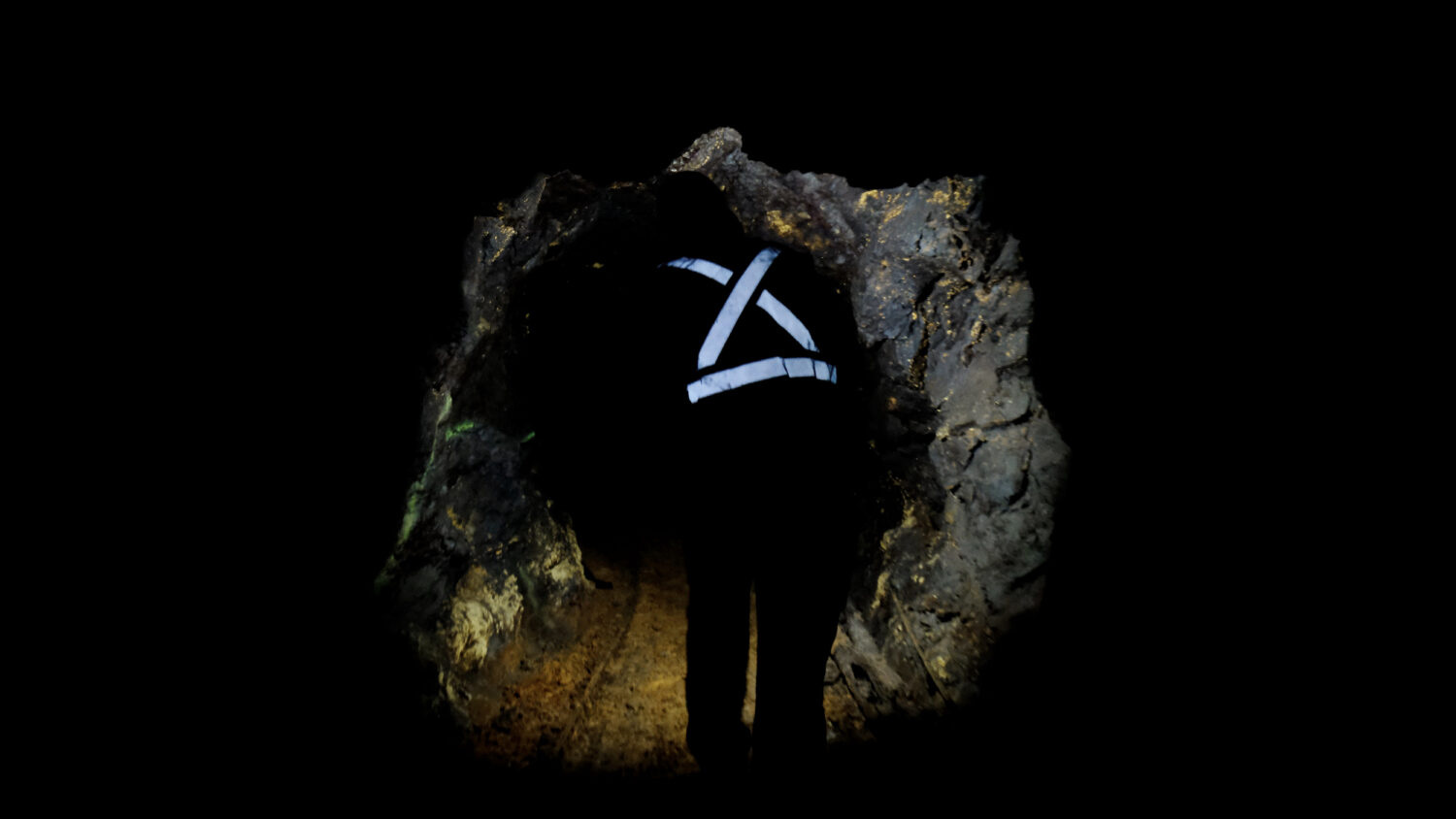
This approach culminates in the exhibition ‘If in a hole, keep digging’, on display at Officinet. The title refers, both ironically and seriously, to the growing global interest in Greenland’s subsoil and to the demand for critical minerals for the green transition, technological development and the defence industry, which has made the Arctic a hot-button geopolitical issue.
At its heart is a three-hour-long video installation spread across seven screens and maps. The exhibition is based on more than ten years of research, interweaving personal travel narratives with broader global trends. Interviews, landscapes, industrial sites and archive material collectively paint a picture of a region where local living conditions are constantly influenced by international interests.
These are big topics, she herself acknowledges. That is why she does not attempt to explain them exhaustively, but rather to let them unfold through specific encounters and narratives. “These are broad, major themes that seek to form a coherent travel narrative.”
She aims to contribute to a greater understanding of the processes currently shaping the Arctic and to forge links between local experiences and global structures. This is also why her projects rarely take their cue from the audience or from considerations of the attention economy. The research and the subject must be given the time they require. The works exist first and foremost on the terms of the investigation. This uncompromising approach is characteristic of her entire practice.
For Gudrun Havsteen-Mikkelsen, design is not primarily a discipline that produces objects. It is a way of understanding the world. A method for linking data with experiences, research with aesthetics, and local histories with global power structures.
At a time when the flow of information is constantly accelerating, she insists on taking the long view. On fieldwork. On thorough research. On the idea that design can also be a critical practice that makes us wiser about the systems of which we are all a part.
The exhibition at Officinet
9.- 29. august 2026
Opening Hours: Tuesday- Saturday 12.00 pm – 5pm.
OFFICINET
Danske Kunsthåndværkere & Designeres udstillingssted
Bredgade 66
1260 Copenhagen
Denmark
Free admission