
How can Denmark secure its position as a design-led society? And how can we ensure that craft is not left out of the narrative when shaping the design policy of the future?
These were among the key questions raised when a number of stakeholders from the design, education, business and cultural sectors discussed the need for a future Danish design policy.
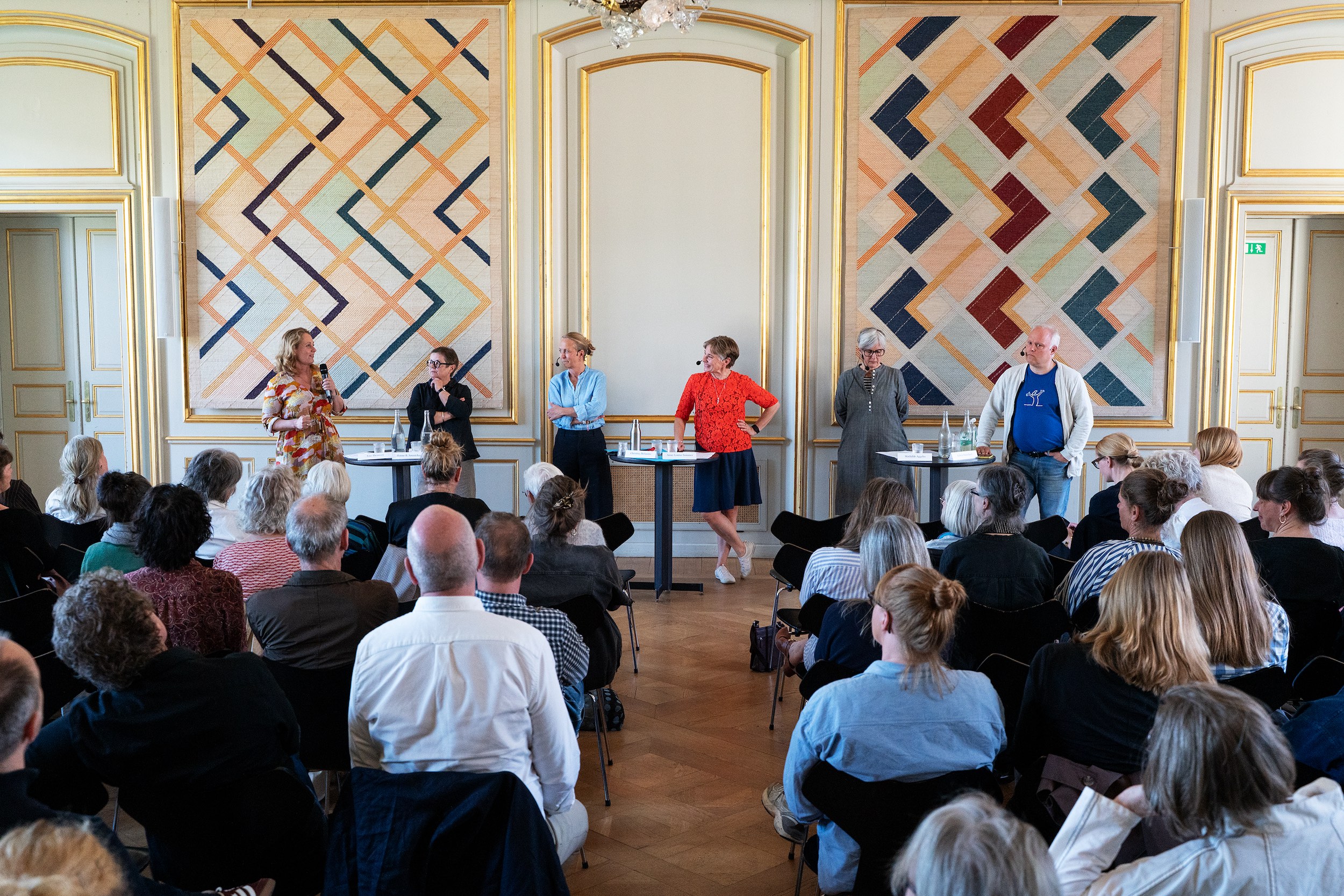
Danish Crafts & Design Association and Formkraft hosted a May Day debate at the Design Museum Denmark to mark the association’s 50th anniversary.
Despite the bright spring sunshine and the 1 May atmosphere in the city, the ballroom was filled with a large and engaged audience from across the craft and design field – all with something to say about design’s role in society and its future political positioning.
There was broad agreement that design plays a far greater role in society than is reflected in political attention. But it was also clear that if a future design policy is to have any real significance, it must embrace the entire field – including arts and crafts, craft-based practices and the many small micro-enterprises that form a significant part of the industry’s foundation.
The panel
Anne-Louise Sommer, Direktør, Designmuseum Danmark
Mathilde Aggebo, Dekan, Det Kongelige Akademi
Esben Danielsen, Direktør, Kulturens Analyseinstitut
Lise Thomsen, Fagleder for Kreative Erhverv, Dansk Industri
Hanne B. Sønnichsen, Forperson, Danske Kunsthåndværkere & Designere
Moderator: Christina Melander, Chief Design Officer, Dansk Design Center
Danish Design is not a natural resource
A recurring theme in the debate was that Danish design does not arise of its own accord. Design is not a natural resource, but requires ongoing investment, development and political prioritisation.
This applies to education, research and talent development – as well as to the practical environments where design and craftsmanship are developed and rooted through knowledge of materials, experimentation and a deep immersion in craftsmanship.
If Denmark is to remain internationally recognised for design, it requires a conscious effort to strengthen the entire ecosystem surrounding the field. From primary school to research, and ideally with a national design day on a similar scale to Sports Day.
Craft is a cornerstone of design
A key perspective in the debate was the need to recognise craft as an integral part of Danish design’s identity and development.
Crafts represent not only a historical legacy, but also a living, innovative practice in which an understanding of materials, craftsmanship and experimentation continuously contribute to the renewal of the discipline.
At the same time, craft helps to maintain and further develop the craft traditions that have historically helped to shape Danish design and its strong international position.
Museum Director Anne-Louise Sommer emphasised that we are not a design nation, but a design society. In the interwar years, there was a willingness on the part of the state to invest in arts and crafts and design, and the understanding of design on which we still rely flourished. Today, we have become blind to the aesthetics that surround us. We take them for granted.
If future design policy focuses solely on industry and scalable growth, there is a risk of overlooking precisely those skills and practices that form the basis of large parts of the Danish design tradition.
Small businesses need to be recognised
Another key theme in the ballroom was the need for better documentation of the true scale and value of the arts and crafts and design sector.
Many craftspeople and designers work as sole traders or in micro-enterprises.
These business forms often fall outside the statistical models used to map the business sector and employment. As a result, a large part of the sector’s activity remains invisible in analyses and decision-making. This undermines the potential for political recognition and targeted action.

Hanne B. Sønnichsen, chair of the Danish Crafts & Design Association, highlighted, among other things, the need for new measurement tools and data sets that can better document the value added by the small, specialised practices that characterise large parts of the sector.
Knowledge transfer and craftsmanship under pressure
Among the panellists, there was also growing concern about the loss of craftsmanship.
In the field of arts and crafts, much of the professional expertise is based on practical experience and is passed on through apprenticeships, collaboration and direct, material-based teaching. This is knowledge that is difficult to standardise, digitise or convey through traditional forms of teaching alone.
When the vital transfer of craft knowledge is weakened, Denmark risks losing essential skills that have cultural, commercial and innovative value.
It was therefore argued that a new design policy should address the need to strengthen the environments and structures in which craft-based knowledge is developed and passed on.
The need for a broader discussion on the value of design
At the same time, the 1 May debate revealed that there remains considerable confusion about what design actually is and what designers contribute.
Several panellists pointed out that, in the public imagination, design is still reduced to form, aesthetics or classic furniture design, whilst its broader societal, strategic and innovative significance is overlooked.
Several panellists therefore called for a broader public conversation about the role and value of design in society. Not merely as an industry or an export parameter, but as a culture, a method, an education and a force that shapes society.
Design policy or greater integration?
There was no complete consensus on whether the solution necessarily lies in a separate design policy.
Esben Danielsen from the Institute for Cultural Analysis argued that design should instead be more firmly integrated into existing policy areas such as business policy, education policy and innovation policy.
Others emphasised that a standalone design policy would precisely send an important signal regarding political prioritisation and recognition.
Regardless of the form, however, everyone agreed on one fundamental point:
That design – including craft – requires a far stronger political and strategic positioning if Denmark is to maintain and develop its position as a design society.
The conversation must continue
In the banquet hall on 1 May, it became clear that the question is not simply whether Denmark should have a design policy or not, but how we formulate a future strategy that encompasses the entire field.
If craft is to have its rightful place in the design narrative of the future, a new policy must not focus solely on large companies and the most measurable growth parameters.
It must also accommodate the small workshops, the practice-based skills, the material-based experiments and the craft traditions that continue to form a crucial part of Danish design’s strength and distinctive character.
The panel debate on 1 May showed that the conversation has only just begun.

Theme: Crafts & Design Policy
Denmark needs a new design policy, but what should it include in order to accommodate independent craft artists and designers? Formkraft explores this question through interviews, articles and debates.