

This year’s KH Award 2025 has been awarded to Professor Ole B. Jensen from Aalborg University for his recently completed research project on exclusionary design and social marginalisation in urban spaces. This year’s prize was designed by the design agency Le bureau and was presented on 9 October.
About the Award
For the past three years, the Danish Arts Foundation’s project support committee for crafts and design has awarded the KH Award, named after Poul Henningsen’s chronicle, Kritikkens Hensigt (The Purpose of Criticism).
The chair seems familiar and unfamiliar at the same time. It is clearly Arne Jacobsen’s Seven Chair, but the cold metal balls make it appear unapproachable, almost hostile. The seating experience is compromised. Just by looking at it, one can imagine that it would feel awkward, even downright uncomfortable, to sit on it. The contrast between the recognisable and the unfamiliar elements is transgressive and requires a few moments of extra decoding. And it is precisely this time, this pause, this slowness that is crucial.
The chair is Le bureau’s KH Award, inspired by Ole B. Jensen’s research into exclusionary design in urban spaces, and it emphasises that design is never neutral. As a designer, you help define the framework for the use of a space, and design choices can influence and regulate behaviour – and, in extreme cases, stigmatise or criminalise presence.

Invisible exclusion
Abroad, exclusionary design – also known as defensive or dark design – is often more aggressive than here in Denmark, especially in large cities such as London, Paris and New York, where you see metal spikes, leaning rails, grilles and automatic sprinklers that are activated to make it impossible to stay or sleep.
Here at home, there are similar but more subtle solutions, such as the slanted bars in the Copenhagen Metro, which make it possible to lean but not sit, benches with centre armrests at train stations that prevent people from lying down, sloping seating in parks and squares, and bright lights and loud music that are activated automatically to discourage people from staying for long periods of time. However, because these solutions are often discreetly integrated into the urban environment, they are easily overlooked, and the debate about where undesirable citizens should be if not here or there is correspondingly less heated than abroad.
‘Originally, we wanted to design the award as a bench for homeless people. We considered add-ons that would make it possible to lie down on the city’s benches, which are equipped with armrests that prevent prolonged stays. However, we agreed that the design language of the prize should be more conducive to debate,‘ says Lene Nørgaard, adding, ’Sometimes design can be almost too subtle or too neat, and that is precisely why there is no debate. It is as if the neatness makes the problem invisible.’
In other words, our national tradition of elegant, understated design solutions can sometimes be a limitation. When the solutions in urban spaces that restrict homeless people’s ability to stay for long periods are so well designed that their exclusionary function becomes almost invisible, there is no debate about whether they are acceptable at all. However, neat and understated designs do not make marginalised citizens disappear, and even those things that challenge us and are uncomfortable to deal with deserve to be discussed. Otherwise, invisible interventions become normalised without a dialogue.
Security is a value that we Danes hold very dear, but one might ask oneself who is actually most vulnerable in urban spaces. For even though the presence of homeless people can be perceived as unpleasant and unsafe, it is often the homeless who are victims of assault. In this context, it is also worth considering whether safety should really take precedence over everything else. Public spaces differ from private spaces in that they must accommodate differences, diversity and conflicting needs, and therefore the requirement for inclusiveness is perhaps more important than a uniform ideal of safety.
Design for places and physical considerations
Le bureau works extensively with design for places: with wayfinding, place identity and place activation that create sensory and inclusive experiences in urban spaces, public buildings and in nature. We will return to the topic of nature later.
When working with wayfinding – guiding people smoothly through a space – the target group is very broad. Everything must be taken into account: different heights, body shapes, functional levels, speeds, sensory profiles and the need for aids. Therefore, the design should be intuitive on an almost universal human level, which may sound like a completely impossible task. But there are common basic rules for movement and behaviour, and good wayfinding supports these and makes them easy to follow, so that the direction can almost be felt in the body.
Lene Nørgaard points out: ‘The hallmark of the best wayfinding is that there is minimal need for signage.’ Wayfinding should feel like an arm around the shoulder of the person you are helping on their way, as if to say: ‘Come on, it’s this way.’ This often requires the senses to be activated – through, for example, light and contrasts, sound, tactility and colours. That sort of thing.
When guiding people in the right direction, you need to activate your senses and take physical considerations into account, but there are also a number of cognitive, ethical and cultural considerations to take into account. For example, norms for gender, physicality and symbol use vary, as we know, and Le bureau is currently working on the design of toilet pictograms with gender-neutral, inclusive iconography so that LGBTQIA users can also find their way around without feeling excluded.
A large part of Le bureau’s work, says Lene Nørgaard, is actually analytical and involves understanding the core of the problem to be solved. Sometimes the answer is not a sign, but a door that opens the wrong way, flooring that is too uniform or cultural reluctance to touch.
Misguided direction and physical presence as wayfinding
The core of good wayfinding design is the enjoyment of a route that seems to reveal itself. It is the calm that arises when everything is as expected and nothing disturbs. But when the designer wants to start a debate – as Le bureau wants to do with their deconstruction of Syveren – or challenge inappropriate behaviour or bad habits, it can make sense to use the opposite design strategy and activate a completely different kind of enjoyment in the user, which could be called ‘the enjoyment of nothing being as expected’.
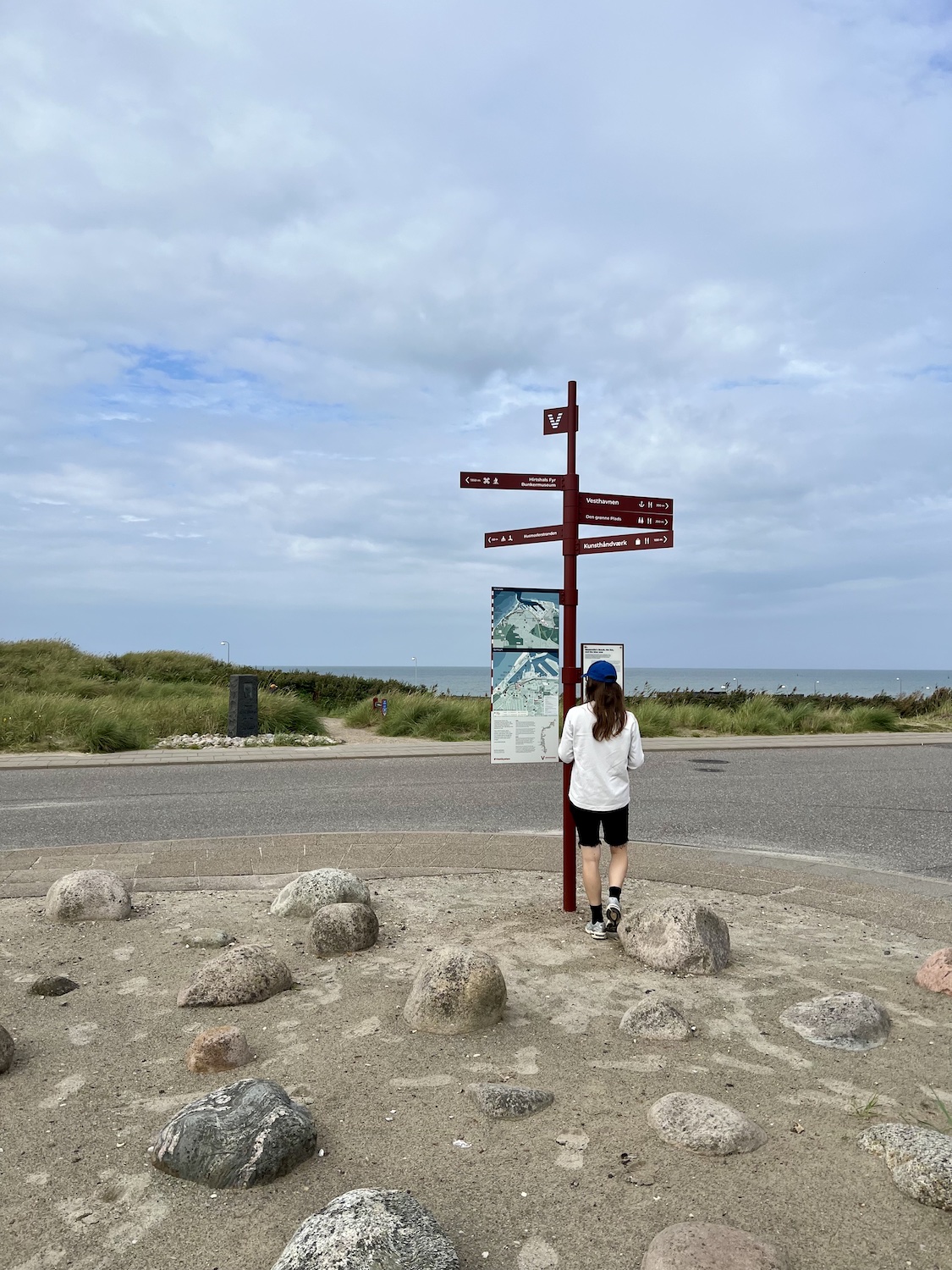
This constructive disruption or quirky anti-enjoyment is behind Le bureau’s slow wayfinding design on Hærvejen along the west coast of Jutland.
Slow wayfinding may sound like a contradiction in terms, because isn’t the point of wayfinding precisely that everything runs smoothly and that you can find your way easily and quickly? Yes, it is, and yet not always. Because perhaps good wayfinding can sometimes encourage us to get lost. Or rather, it can make us feel so secure that we dare to let go of control – because sometimes the best route may actually be a controlled detour. The downside of a completely smooth journey is that it can put us on autopilot and blind us to our surroundings. Slow wayfinding does away with this by inviting us to slow down, stop and take time to reflect.
Le bureau’s work with slow wayfinding on Hærvejen focuses precisely on immersion. They want to encourage immersion and slowness, to linger in the surroundings, because such a process typically leads to a feeling of connectedness. At the same time, the slow approach to wayfinding has another important mission, namely to retrain our collective sense of direction!
This is because it is rather out of practice due to our bad habit of always staring at our phones and using their GPS. When we practise orienting ourselves without a phone, we learn to decode our surroundings, which can give us the courage to get lost and explore. Slow wayfinding is an invitation to see, remember and navigate with our bodies (again – because it’s something all children can do), because magic often happens when we let go of control and shift from an A-to-B mindset to letting ourselves be guided by sounds, smells, signs and rhythms or patterns.
This is where a basic sensory life skill lies, one that has been lost with our downward gaze at our screens: namely, a sense of place. A sense of place requires presence and open senses and provides a sense of belonging that is important for quality of life.
The hyperlocal
An important part of Le bureau’s work with wayfinding on the West Coast has been to convey the stories of the places and invite users to seek out experiences that go beyond the most popular destinations. The ambition is to spread the visitor pressure, open up new routes and highlight the unique and aesthetically nourishing aspects of the local area: the small, special places, diverse nature and cultural traces that are often overlooked.
And it is precisely this hyper-local aspect that tourists are looking for today, both on nature walks and when exploring city neighbourhoods, explains Lene Nørgaard. Tourists want to experience authentic, local life, so the right strategy for increasing tourism in a local area, whether rural or urban, is actually to reduce overt tourist experiences and instead improve conditions for local businesses so that small, unique shops, markets, artisans, cafés and festivals can flourish.
It is the authentic local environment, the sense of community and the presence that make a place special – both for those who live there and for visitors – which is something that is receiving increased attention today. And this awareness is spreading to urban planning, architecture and design as a movement away from the bird’s-eye view and down to street or nature trail level.
Quality of life is…
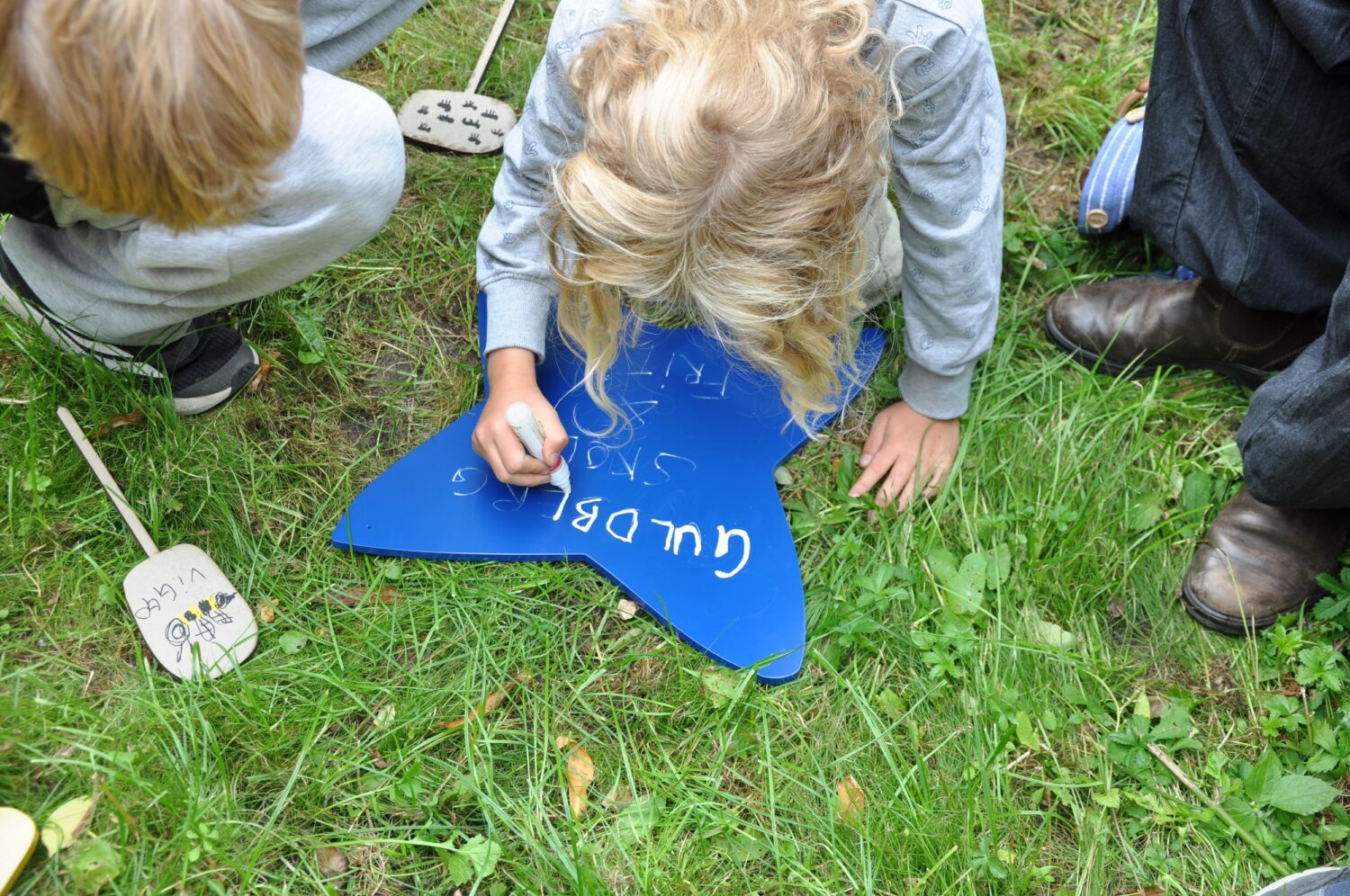
Working to improve quality of life is a central and important approach to sustainable design. Sustainable design is often associated with recycled materials or products that can be disassembled and broken down with minimal environmental impact. But at its core, sustainable design is about creating solutions that improve our lives and enable us to take better care of ourselves, our fellow human beings and our surroundings. Pausing, letting slowness sink in and actually seeing nature – and being inspired by it – can, for example, strengthen sustainable behaviour. For how can we not want to take care of nature when we experience our connectedness first-hand?
Fortunately, the time is ripe for re-establishing our connection to nature: we collectively long for nature, and not the manicured, polished nature of suburban gardens, but real nature, wild nature, as seen in everything from ‘wild by design’ gardens to the popularity of slow, long walks and overnight stays in shelters. And the visions behind slow wayfinding point precisely in that direction, manifesting themselves in subtle landmarks that blend in with their surroundings and offer both the tranquillity of the predictable and the joy of the unexpected, so that we slow down, discover more and form bonds with the place and with those we experience it with. The most important thing for Le bureau is to create places that spark curiosity, strengthen a sense of belonging and invite people to come together.
Quality of life is, of course, also about health. And when it comes to spatial awareness and navigation, there is actually cause for concern. Le bureau has previously worked with people with dementia in urban environments, and in this context has focused on the fact that one of the abilities that is often impaired in people with early-stage dementia is the ability to find their way around. This is a skill that requires maintenance and training, which does not happen when we put our orientation skills on autopilot and let our phone’s GPS take over.
Taking the time to get to know a place strengthens our sense of belonging and nourishes our senses and our ability to find our way. Slowness – as advocated by the slow design movement since the early days of slow food – is a much-needed counterbalance to the digital and a way back to the human; to connections, diversity, sensory perception and real-life experiences, as well as a shift from exclusion towards inclusive, accommodating design solutions.
Le bureau
Le bureau (founded in 2016) is a strategic design agency focusing on architecture, culture, art and nature. Read more
Colophon
Writer: Kristine H. Harper
Managing editor: Helle Dyrlund Severinsen
Editorial Board: Lars Dybdahl, Annette Svaneklink Jakobsen, Ane Fabricius Christiansen, Peter Moëll Dammand, Anne Louise Bang, Pernille Anker Kristensen.
Translation: This article has been translated using AI. The original text is written in Danish.
Publisher: Danish Crafts & Design Association