
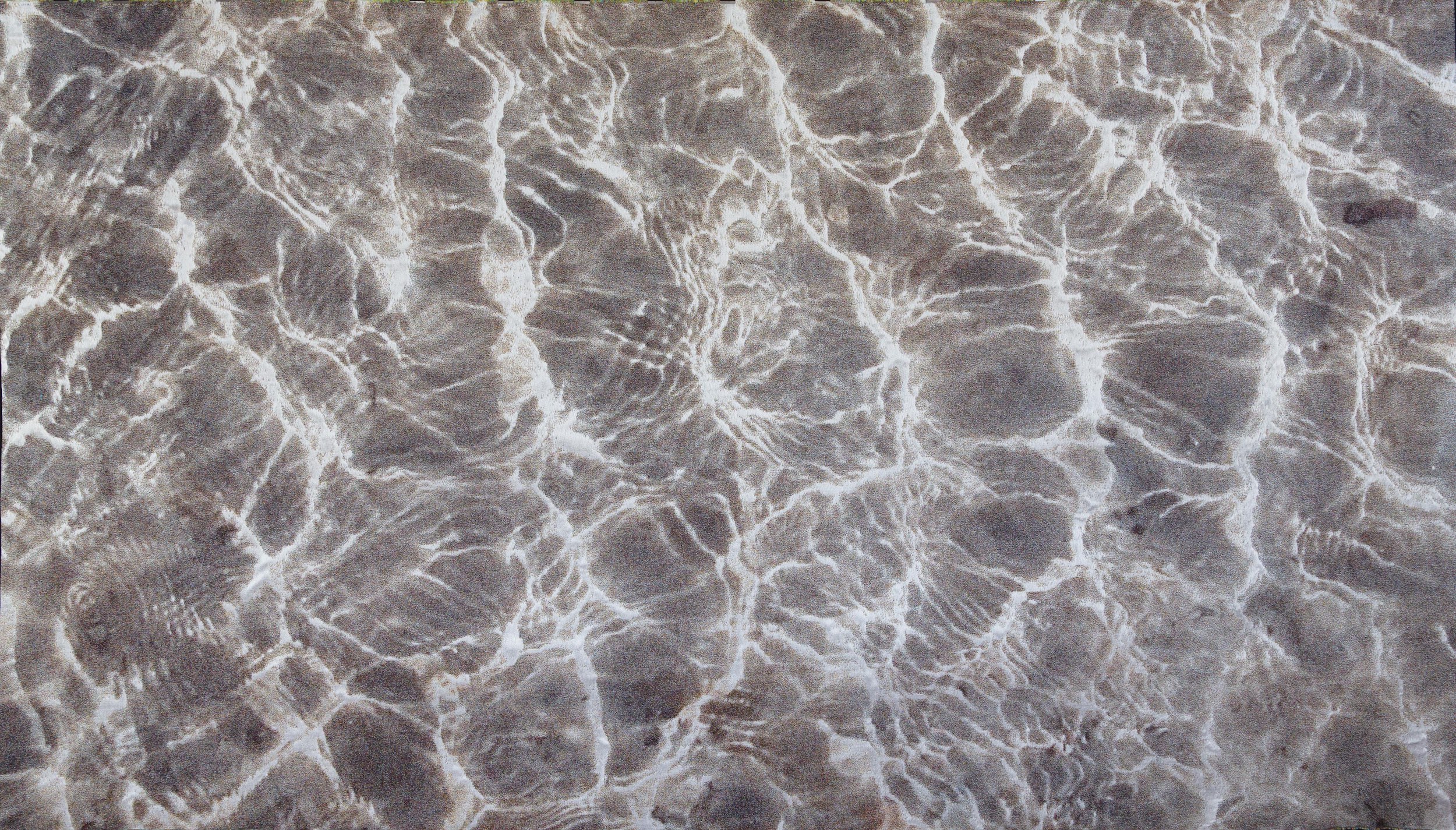
People often talk about the vast differences between generations – and even chasms that can be almost impossible to bridge. They talk about prejudices and times gone by. About how things were easier, simpler and freer in the ‘old’ days. They also talk about how the younger generation lacks respect and is a bit too laid-back. Fortunately, in my conversation with two textile artists, these preconceived notions are proven false.
Grethe Sørensen is a textile artist and weaver, born in 1947 and living in Vamdrup near Kolding. Emilie Palle Holm is a textile artist and weaver, born in 1994 and living in Copenhagen. There is a gap of almost 50 years between the two practitioners, yet they are both passionate about their craft and the digital loom, which they both use in their artistic practice.
The two met in Tilburg – the Dutch Textiel Museum, which also offers training and a laboratory where one can work experimentally with the craft. They were both in residence there to create digital textile works. When I interview Grethe Sørensen at her home in the former school outside Vamdrup, she tells me that Emilie came to her rescue one day in Tilburg, when Grethe had hit a snag in her process. No one understood what she meant – technically, methodologically or in terms of textiles. But Emilie did, and she helped to ‘translate’ Grethe’s challenge.
Right there, a profound sense of generational connection was established. A bond in which age, gender, ethnicity and other preferences no longer mattered, for what they shared was greater than all that. A professional connection that built a bridge between two people, where knowledge and interest wove the generations together through subject matter and methodology.
Part of a generation?
When I ask the established textile artist and weaver whether she feels she is part of a generation, and if so, how she would describe it, she replies:
‘I am acutely aware that I am part of a very privileged generation that grew up in an open society during a time of peace and economic prosperity. A time when all opportunities were open, and you could always get by. If it became too difficult to make a living as a craftsperson, it was possible to take another course of study or find a job. Life was, in a way, simpler, and we arranged our lives so that we didn’t have such high financial expectations. We had security in the form of free education, health insurance and the prospect of a state pension when we grew old.
My identity as a weaver is not defined by being part of a generation. It is rather of a professional nature as a weaver, craftsperson and textile artist – a social group where everyone has more or less the same working and living conditions as self-employed people. I am fortunate to meet other weavers – young and old – who share the same deep interest in weaving, where curiosity and a desire to explore the possibilities of technique, materials and visual expression are the driving force behind the work.
I meet young people who are still in training and find that we can talk on equal terms about dreams, visions and projects, where age doesn’t really matter – at least from my perspective. I’m not blind to the fact that young weavers may have a different experience. Of course, I also remember my own time as a younger weaver. That, from my perspective, the situation looked different – as a young person, you struggle to attract attention and interest in your projects and perhaps feel that the well-established older generation takes up too much space in the picture.’

Shared values such as responsibility
Emilie Palle Holm sees herself partly as part of a generation with shared values, particularly when it comes to the premise of sustainability, which is a fundamental condition that is not up for debate and which influences the current generation’s choices in everything from materials to the questions they ask through their practice.
‘One of the things I see is a generation rediscovering the value of craftsmanship and an understanding of materials, and seeking a closer connection to the processes and materials behind what is created. Working with one’s hands is not at odds with intellectual work, but rather becomes fundamental to the way of thinking, investigating, developing and challenging.’
‘I also sense a certain distancing from mass-produced and highly commercial goods. There is an interest in understanding how things are made, where the materials come from, and what consequences production has.
It is not necessarily about rejecting industry, but about questioning the systems and consumption patterns we are part of, and exploring how they can be challenged, rethought and improved through greater attention to materials, craftsmanship and production processes.
If I were to characterise my generation, I would describe it as material-conscious, inquisitive and keen to forge new connections between craftsmanship, aesthetics and responsibility.’
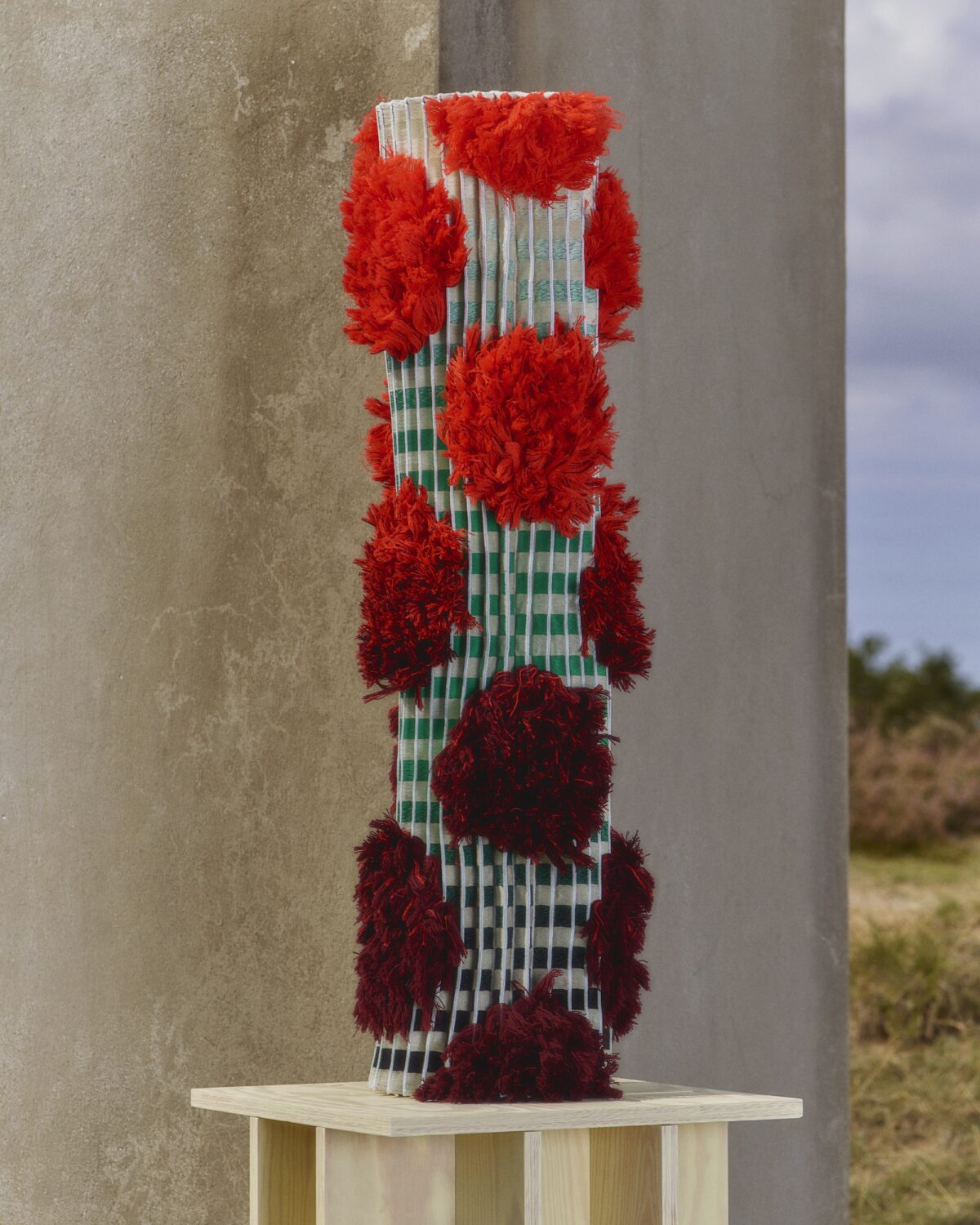
For Grethe Sørensen, sustainability is not a new concept that she approaches existentially in her professional life. It has, in a sense, always been part of her. It is reflected in the way she, her family and several of their friends from the art and design world have chosen to live their lives.
‘My dream was to set up my own workshop and make a living as a weaver, producing unique textiles by hand. That required space, and we were lucky enough to be able to buy a disused school together with some friends. We wanted to live a harmonious life close to nature, where we could set our own course and pace – with a strong environmental consciousness and an organic lifestyle as a prerequisite. We wanted to be as self-sufficient as possible with organic vegetables; after all, they weren’t available in shops at the time, so we set up cooperative buying groups where we could purchase organic food in larger quantities.
I carried out my textile projects using natural materials. In the early years, I spun raw wool from our own small flock of sheep and sold the yarn through the Frilandsmuseet museumshop. I preferred Danish or Swedish flax for tapestries, and silk and wool for other projects.
Over the years, my approach to production has changed. Throughout the first 25 years, I explored various fields within weaving and always pushed the boundaries in my exploration of artistic possibilities – in complex weaving techniques, in woven three-dimensional forms, in the utilisation of materials’ inherent properties, in thread sculptures, in the thread’s own weight or load-bearing capacity, in the possibilities for gradation in dyeing, and so on.
In my work, there has always been a close connection between idea, expression, technique and material, as I develop the necessary technique to achieve the expression I desire.
Since 2000, my weaving has been digitised, so now traditional and digital tools work together. The heddles and the beater function as usual on my handloom, whilst the loom’s conventional control mechanisms – treadles, shafts and pedals – have been replaced by digital thread control. The first few years were spent familiarising myself with the new technology, getting to know the tools and learning how to make the most of the many new possibilities.’
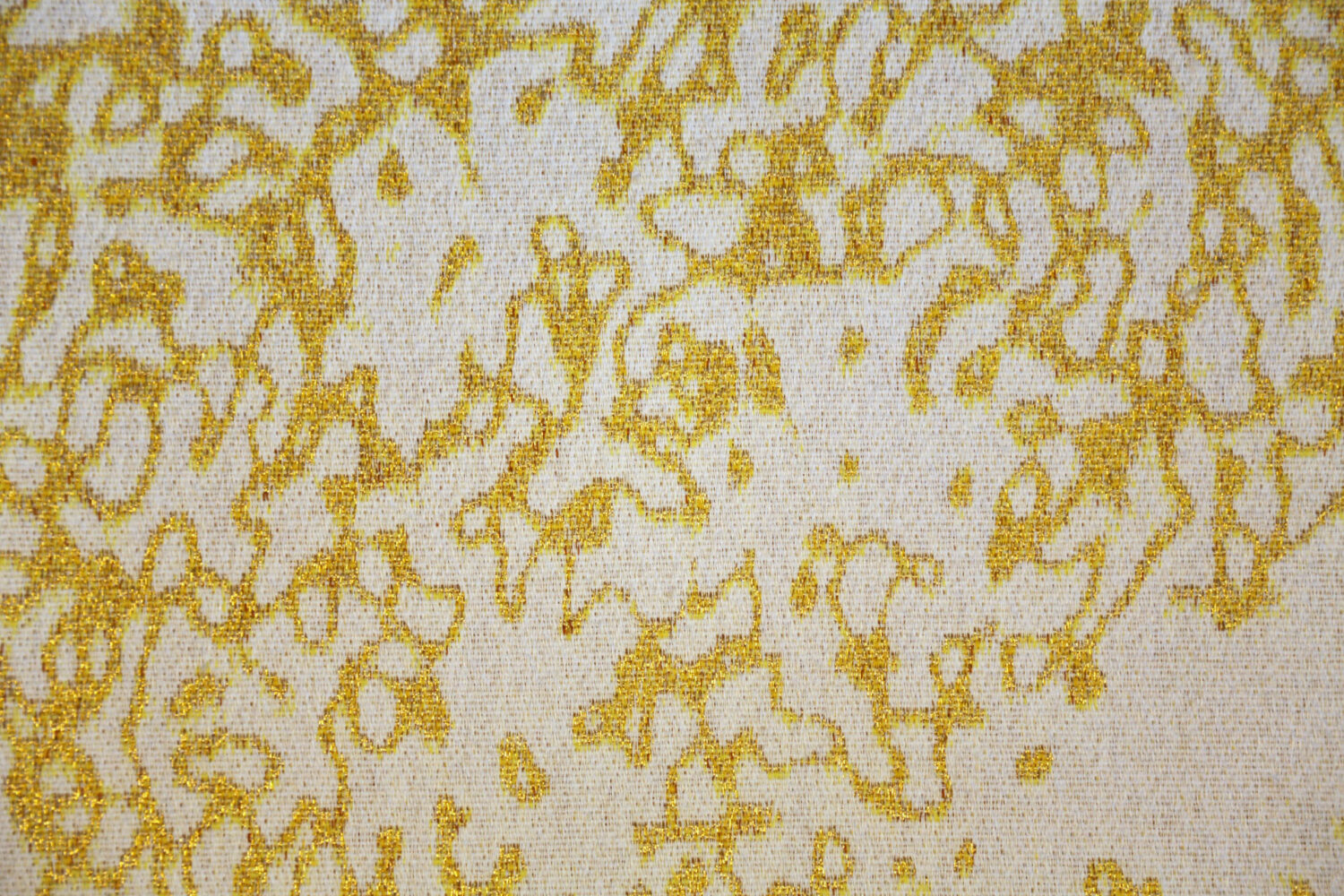
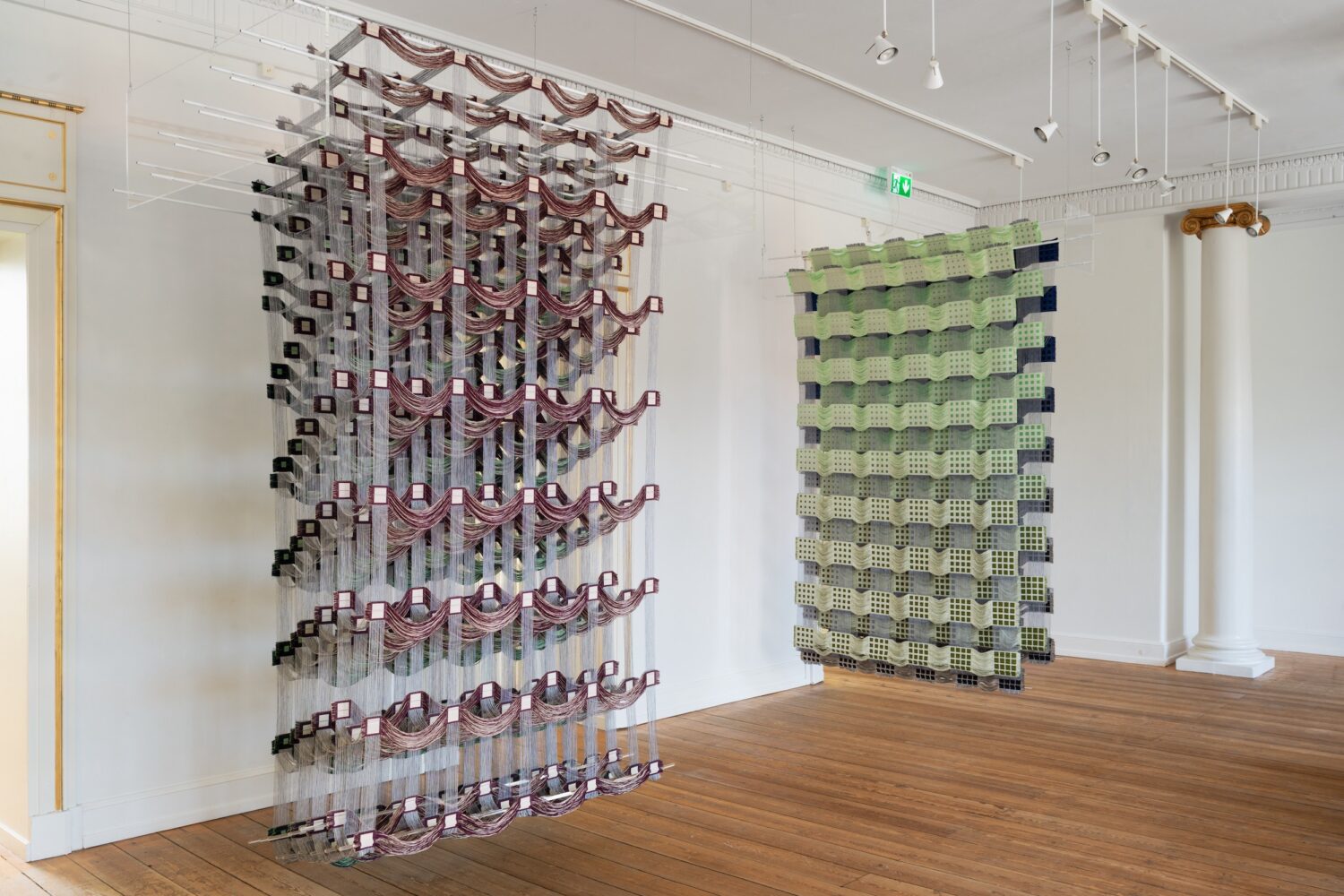
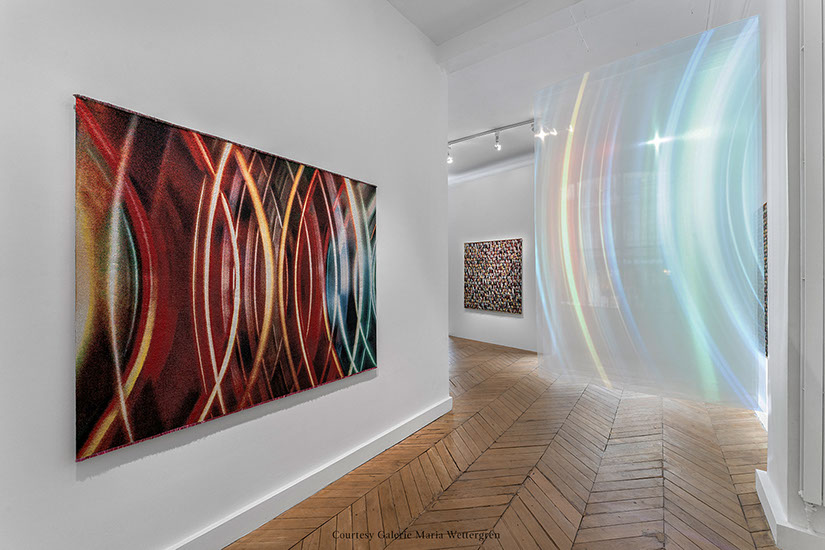
‘Digital thread control and pattern processing have opened up the possibility of entirely new forms of expression in woven textiles, which could not previously be achieved on a loom. The patterns in my first major project, ‘Interference’, from 2005, could only be created using digital tools. The smooth colour transitions in my next major project, ‘Spor af Lys’ from 2012, could not have been woven without digital thread control and a method I developed myself for translating the design into a weave structure – and this remains the case to this day.
Many of my projects from recent years are site-specific installations. I carry out the entire creative development process, test weaving and preparation of weaving files in my own workshop. The actual weaving of the finished textile is carried out as unique pieces on a digital Jacquard loom at the Textile Museum in Tilburg. For the Textile Museum, sustainability is a top priority, and they use the most sustainable materials available on the market at any given time, such as organic cotton and recycled polyester.’
It starts with education
A fundamental difference between generations often lies in their education and the resources that have been available to them. It is probably no secret that educational programmes have been significantly streamlined since Grethe Sørensen completed hers, just as different demands are now placed on vocational work placements and academic disciplines.
‘I attended the School of Arts and Crafts in Kolding (now Kolding School of Design, ed.) from 1968 to 1972. The school had been newly established in 1967, so I was part of the second cohort to graduate in 1972. By then, I’d gained a basic understanding of weaving and complex weaving techniques, and I expanded my knowledge through self-study, courses and work placements, including in damask weaving and traditional tapestry weaving,’ she explains.
Emilie Palle Holm says:
‘I completed my Bachelor’s degree in textile design at Kolding School of Design and my Master’s degree in textile design at The Swedish School of Textiles in Borås. Both courses have had a significant influence on my way of working, but perhaps particularly in terms of my view of the role of craftsmanship.
For me, it is a fundamental premise that one must understand the techniques and logic of a craft before one can challenge them in a meaningful and experimental way. Experiments do not arise in a vacuum; they spring from an understanding of the material, the technique and the process. It is often during the actual execution that new ideas, connections and possibilities emerge.’
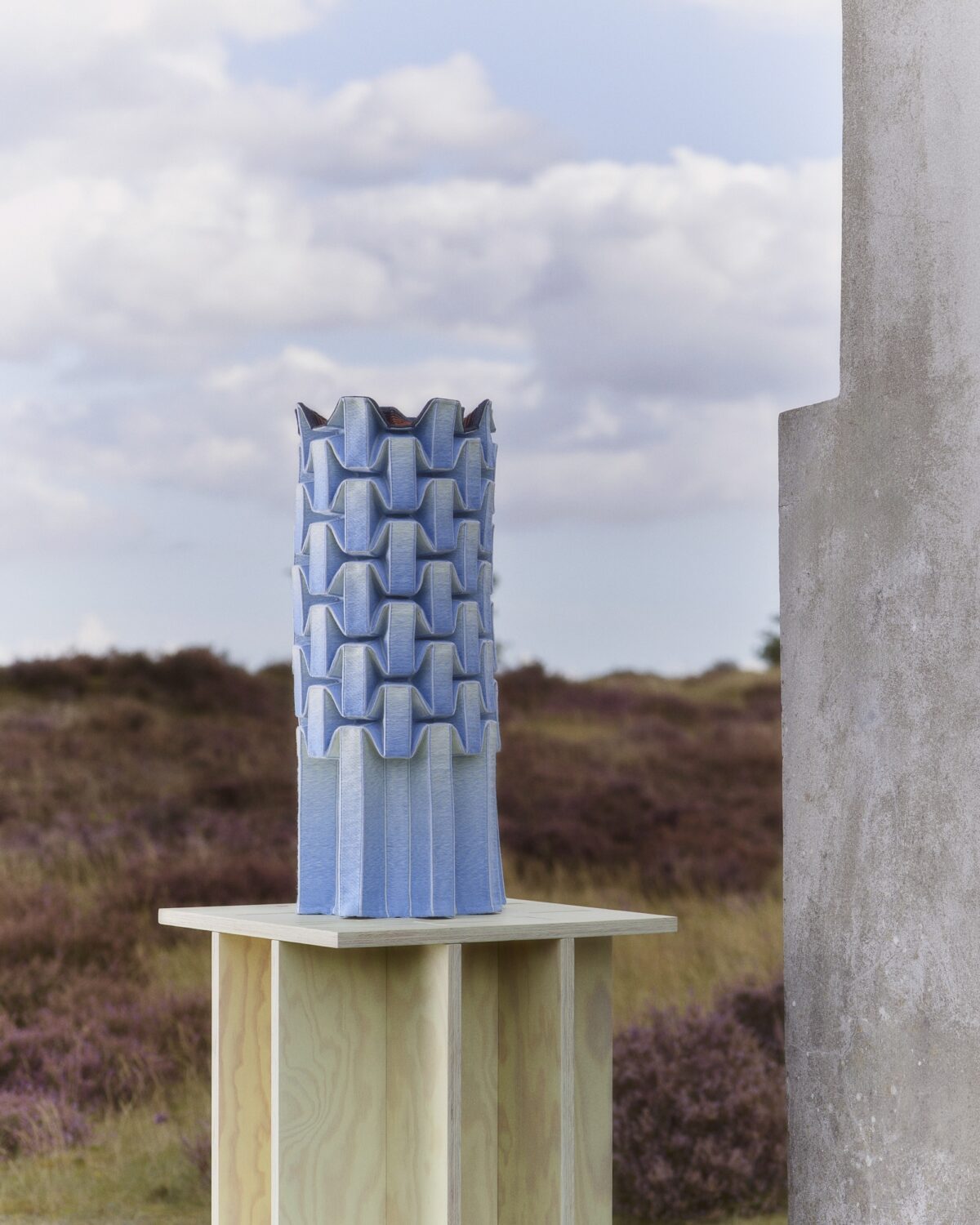
‘When I was choosing a master’s programme, I realised that the opportunities to specialise specifically in textile design had become fewer in Denmark. That is why I applied to The Swedish School of Textiles, where textiles can continue to be the focal point of the design process. Here, there was scope to let the textile, the material and technical investigations drive the process, and to explore the potential of the material and textile techniques. This meant that the form, function and final context of the work often emerged through the process rather than being predetermined from the outset.
I do not know whether the educational institutions or the spirit of the times have directly shaped my works, but they have greatly shaped my working method. A focus on craftsmanship, an understanding of materials and the value of challenging technique, material and format – with a desire to explore new areas of the textile field – have become central elements of my practice. My works often stem from an exploratory process, in which textiles are not merely a means of realising an idea, but the very starting point for thinking and creating.
Perhaps my educational journey also reflects a broader trend within my generation.
I graduated at a time when design courses were becoming increasingly interdisciplinary and concept-oriented, and when the focus had often shifted from specific craftsmanship to processes, strategies and interdisciplinary collaborations. At the same time, I have noticed a growing interest in material-based practices and textile craftsmanship amongst both designers and artists.
For me, therefore, it has been important to maintain a deep understanding of materials and craftsmanship as the foundation for my experimental work. It is precisely in the tension between tradition and innovation that I find one of the most interesting areas in which to work as a textile designer and textile artist today.’
Textile comeback in a new era
Textiles are back as a form of expression. Both the Venice Art Biennale and the Venice Architecture Biennale have, on their last two occasions, featured a predominance of textile installations and works. But whereas previously the focus was often primarily on aesthetics and historical, cultural, political and existential references, today there is a different and overriding premise that pushes the others into the background: sustainability and responsibility. Having to address the climate as an overriding necessity may seem to stifle any free artistic expression, but on the other hand, this constraint has the potential to make a real difference to a planet that is struggling to breathe.
And if one views arts and crafts as a long-term endeavour, where frugality has always been an integral part of the craft’s ethos, the climate premise is simply an extra layer added to an already quite sensible approach to materials and their management. And when skilfully and beautifully crafted works of arts and crafts find their place in the world, they remain there for a long time, because people form an emotional attachment to them and do not part with them lightly – thereby falling into the category of aesthetic sustainability. (Read The sustainable object: a celebration of the raw and changeable)
Time is a strange concept. Is time a circular process? A paradigm shift? A set of codes meant to be broken, developed or rewritten? Perhaps, but time is also concrete and lived experience, and both textile artists devote their time to becoming more skilled in their craft every day. Emilie Palle Holm is at the start of her career, whilst Grethe Sørensen is nearing the end of hers. What do they see as the most important things for Grethe to pass on, and for Emilie to strive for?
Grethe Sørensen says:
‘Textile craft is enjoying a resurgence of interest these days. In a way, it reminds me of the 1970s, when I started out as a weaver. There was the same great interest in our field, and there were many breakthroughs both nationally and internationally within textile art. I hope we will see a similar development. Today’s world needs visionary, innovative and skilled craftspeople who work directly with techniques and materials. All my life I have worked as a weaver and textile artist, with unique textiles as my primary product. So it is indeed possible to make a living in today’s society, and I hope this can serve as an inspiration for future generations of craftspeople.’
But what about working conditions? Has it become easier or harder to be a textile artist and weaver today? Grethe Sørensen believes that the younger generation spends too few hours in the workshop during their training.
‘I’m glad that I’ve had a broader training in weaving than they do today. They’ve had very limited experience of setting up a loom. What I hear from the students who occasionally visit me in the workshop is that they have to go out and seek further knowledge once they’ve finished their training. They need to learn the very basics of weaving. It’s a major shortcoming that the younger generation has so few workshop hours where they can get their hands on the materials and become proficient in the analogue approach. After all, it’s hard to call yourself a weaver if you’ve only tried setting up a loom four times.’
Dreams for the future
As a newly qualified textile artist and craftsperson, Emilie Palle Holm is aware that the future has the potential to be even better. The opportunities within the textile field are, in fact, just waiting to be taken to a new level, one that involves taking the field far more seriously in terms of its potential for innovation. Her own practice, which challenges spatial elements and perspectives through her formal experiments on the digital loom, is one of the avenues that deserves further research.
‘My work is generally centred on the loom as both a technical and artistic field of inquiry. I work to challenge our understanding of the woven textile by exploring how material, structure and form can be developed simultaneously during the weaving process. Through experiments based on the manipulation of traditional weaving techniques, I explore the spatial and form-transforming potentials of textiles and seek to create new aesthetic and structural possibilities within the world of woven textiles.’
When asked about her thoughts on her own future and her hopes for the field, Holm replies:
‘First and foremost, I wish to challenge our understanding of the woven textile’s aesthetic format, three-dimensional qualities and dynamic properties. Weaving is often associated with a two-dimensional surface, but I am keen to explore the textile’s spatial, dynamic and shape-shifting potentials. In my own practice, I explore how material, construction and design can merge into a single, coherent process, in which weaving and shaping are not separate phases but become one and the same field of inquiry. I aim to create works that invite reflection, aesthetic perception and value-creating dialogue, and which convey the innovative potential and tactile quality of the craft.’
‘At the same time, these studies point towards a broader understanding of craft and design. We stand on the shoulders of a long line of craft traditions, for which it is essential to have both an understanding of and respect for. But tradition, to me, is not something fixed or static.
Precisely because craftsmanship has such strong roots, it is also important to continue working with it across disciplines and techniques, to challenge its immediate limitations and to develop it through engagement with new materials, technical possibilities and contexts. In this way, tradition does not become something that is preserved unchanged, but something that lives and changes through practice.’

History in a new light
In this instance, it seems as though the circle of time has taken a turn that brings the two generations closer together than before. Perhaps because time has once again been shaped by intimacy, authenticity and a slower pace – even though it is created using a digital loom which, it must be added, can only achieve such a subtle level of quality because the weavers are so thoroughly familiar with analogue weaving practices that they can harness the digital potential. Grethe Sørensen adds:
“There isn’t much difference between the generations when I think of Emilie Palle Holm. It was so lovely to meet someone who was so focused and really got what it was all about.
Someone who understood what I was saying. We share a common mindset and a love for the craft. It makes me feel happy inside when I meet a young person like Emilie.”
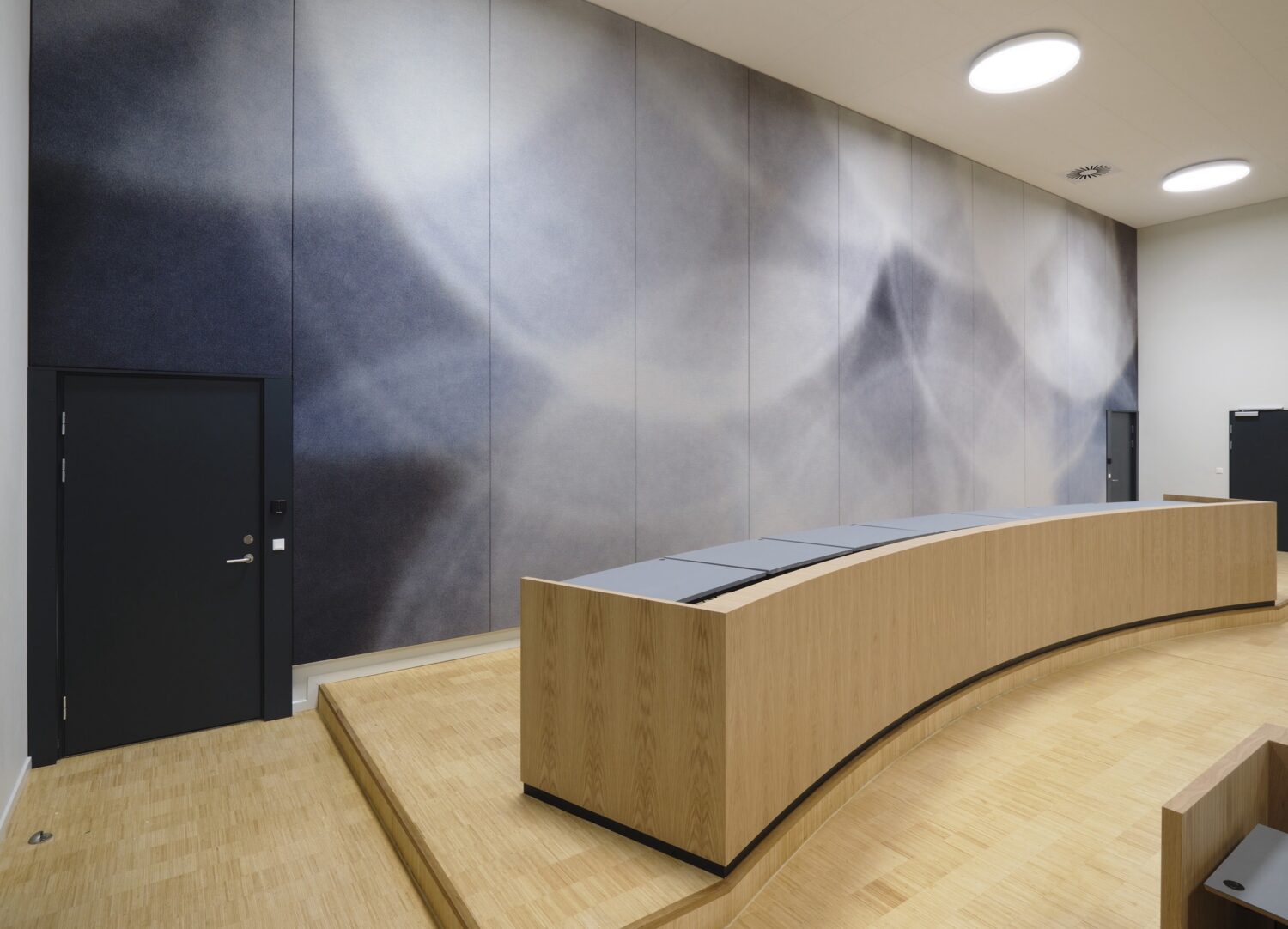
Over the past many years, Grethe Sørensen has worked on several major, site-specific installations, including for Hermès in Paris and New York, and for her, the textile craft is a cornerstone of the world:
‘Weaving is one of the world’s oldest crafts and it is still evolving.
Working with textile materials and structures is life-affirming. The craft possesses so many qualities that are worth preserving, developing further and passing on – it is creative and human work that involves the mind, heart and hands – from the easily accessible, simple forms of weaving to the deeply complex. This creative process is of great value in today’s society, where many areas of work and roles are being rendered redundant, automated and taken over by robots and AI. It is important here to hold on to the traditional crafts, to continue developing them and also to make use of the expanded possibilities that have arisen through digital tools, without losing human control.’
Grethe Sørensen continues:
‘For several years, I have been working on commissioned projects involving site-specific woven textile installations in Denmark and abroad. It’s incredibly rewarding to be given that sort of work, but right now I need a well-deserved break. And then I want to experiment with my own projects – such as spatial forms created by the inherent tensions in double-sided constructions. I want to keep working and have no intention of retiring, even though I’m technically a state pensioner on paper.’
Does that sound nerdy? It is, just as it is also thoroughly life-affirming. For although the current generations are far apart in age, they are closely linked by their professional kinship and their desire to keep experimenting and pushing the boundaries of their disciplines and capabilities. What a high!
Grethe Sørensen
Having graduated from Kolding School of Arts and Crafts in 1972, with a spell in France and Switzerland to immerse herself in tapestry weaving, she has run her own practice alongside teaching at Design School Kolding. Over the past 25 years, she has devoted herself to digital TC weaving, where she has been a pioneer in developing a new visual language, through which new aesthetic expressions find their way and expand the scope of textile and artistic craft. In recent years, Sørensen has been engaged in site-specific commissions and installations for companies, local authorities and iconic brands such as Hermès in Paris and New York. Throughout her career, she has exhibited extensively both at home and abroad.
Link to more
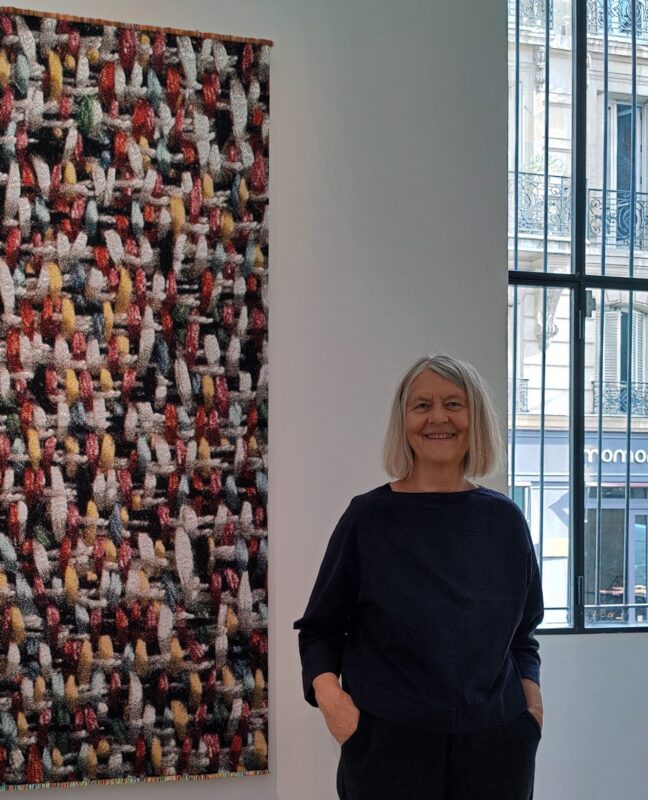
Grethe Sørensen.
Emilie Palle Holm
She graduated with a Bachelor’s degree from Design School Kolding in 2020 and a Master’s degree from The Swedish School of Textiles in Borås in 2023. Since graduating, she has made a name for herself in 2024 by being one of the winning projects in the One & Twenty design competition organised by the German Design Council, and she was also among the winners of Ung Svensk Form that same year.
In 2025, she was nominated for the Biennale Prize at the Biennale for Crafts & Design and held a solo exhibition at Officinet. Furthermore, she has on several occasions received working grants from the Danish Arts Foundation, including a three-year working grant in 2026.
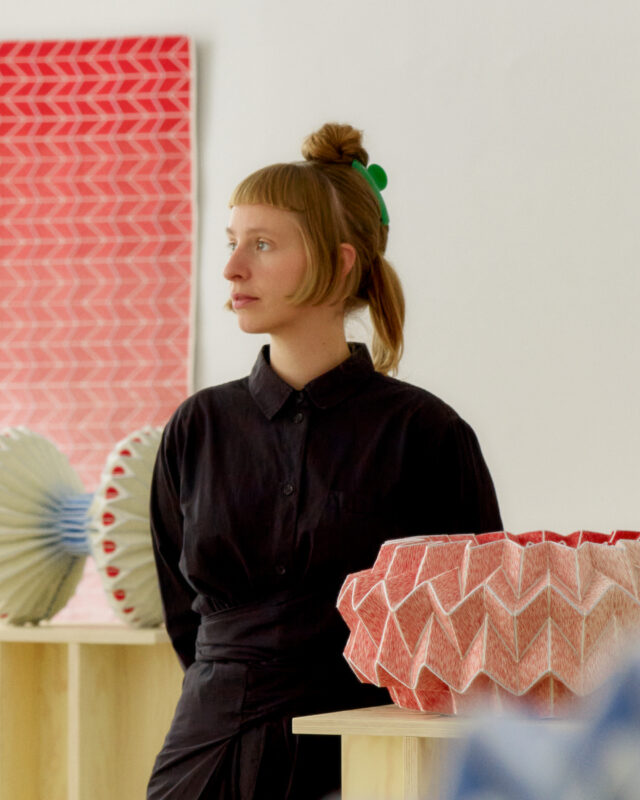
Emilie Palle Holm. Photo credit: Peter Willian Vinther.
Theme: Legacy Reimagined
What defines contemporary craft and design? How is a practice shaped by the era in which it emerges? How does it endure as times change?
Every generation of designers and craft artists works at the intersection of heritage and innovation. They inherit techniques, ideals and institutions from those who came before, yet must simultaneously engage with their own era: its values, crises, technologies and visions of the future.
In this issue of Formkraft, we explore how crafts moves through generations, , and how the times leave their mark on methods, materials and mindset.