

A crucial fund – both financially and symbolically
The new project support committee will next meet in June to consider the many applications for funding. This year alone, over 15 million kroner is at stake in the project support committee’s fund. According to Hanne Brøbech Sønnichsen, the fund is of crucial importance to the discipline and the association’s members – not only financially, but also symbolically:
‘It is a substantial fund that is significant both for the development of organisations and for individual practitioners. And there is a significant approval factor in the fact that these are government funds.’
A unique opportunity to build momentum
The new committee is taking office at a time when there is a fresh and positive wind sweeping through the field. Hanne Brøbech Sønnichsen explains:
‘Right now, there is enormous momentum for crafts and design, both nationally and internationally. There is a great focus on craft. A good example is the popular TV programme ‘Denmark’s Next Classic’, where the chair of the project support committee, Kasper Salto, is also a judge. Here, craftsmanship is highlighted as a key discipline – people have realised that it matters.’
That is why it is Hanne Brøbech Sønnichsen’s fervent wish that the committee devises a strategy for the annual awards that capitalises on the momentum the field currently enjoys. This can be achieved, among other things, by enhancing the field’s visibility – including in the public sphere.
Visibility in the public sphere
‘We feel that we have become more visible in the cultural policy landscape. Whether we like it or not, there is a hierarchy of sorts in the art world, but we want craft and design to be on an equal footing.’
‘It is a key priority for us to promote opportunities for craftspeople and designers to contribute to art in the public sphere, which has otherwise been reserved for visual artists. So we are fighting to highlight that craft and design also have a significant place in the public realm – and this is also something we bring to the table in our collaboration with the project support committee.
That is why we want the committee to support projects that take place in the public realm. But the boundaries between disciplines are blurring these days, and we recognise that it is perfectly possible to work in a cross-disciplinary manner. That is why we recommend that support also be given to interdisciplinary projects, preferably in collaboration with the Visual Arts Committee, which may involve light, sound and other disciplines.’
The importance of understanding smaller players
For Hanne Brøbech Sønnichsen, it is of paramount importance that the committee understands the significance of the fact that many craftspeople and designers work alone.
‘Precisely because many craftspeople and designers work as small, independent units, access to support is absolutely crucial. Both small and large grants have been awarded in the past, so it is the committee’s strategy that determines whether it aims to support large or small players.
One example of a large project that received support is the digital platform Green Craft & Design Guide, which craftspeople and designers can use to strengthen their sustainable practices. Here, several parties, both large and small, worked together on the project.
Otherwise, however, the sector consists of a great many small entities with a more modest approach to finances – and many who do not aspire to grow larger. And they are keen to apply for grants for projects, training and travel – in short, everything that helps them and their practices to develop. So here, the committee’s strategic choices are crucial, and they must be conscious of their responsibility to strengthen the development potential of the smaller entities. This requires the committee to know and understand the field – and fortunately, the new committee does,‘ states Hanne Brøbech Sønnichsen.
Apply for multi-year funding
She points out that uncertain funding is generally a challenge in the sector, and that raising funds is a resource-intensive way of securing money – for both organisations and individual practitioners. It is therefore important to recognise that continuity is essential for developing projects.
‘It is important that applicants know that they can apply for multi-year funding. If a project is not complete, they must rewrite their application, as they cannot apply for the same project for several years in a row, and that is cumbersome.’
In addition to the wishes regarding presence in the public sphere and the conditions for smaller players, the association’s chair highlights a couple of other priorities that she would like the committee to be aware of.
‘In relation to the sector’s focus on sustainability, we must continue to work on the growing interest in utilising shared production spaces. Interdisciplinarity, collaboration and international relations must remain high priorities. And then we need to consider how funding allocations can have the greatest impact. Is it by investing in the sector’s activities or by launching our own projects?’
Dialogue is key to cooperation
When asked what role the association will play in its cooperation with the new committee, Hanne Brøbech Sønnichsen states: ‘We need to work with a greater political focus. In practical terms, this means that we intend to seek involvement and that we will be proactive on issues that concern us.’
She believes that close dialogue between the association and the committee is essential for success.
‘The committee needs to understand the entire field, and with only five members, they cannot cover everything in advance – but I hope they are interested in dialogue. And I am very pleased with the composition of the committee.’
Will the association and the project support committee then be able to agree on the proposals? To this she replies:
‘I cannot imagine that there will NOT be disagreements on some points – and that is why we need the dialogue. We were engaged in a discussion about crafts and design in the public space with the previous committee. We’d like to get that discussion going again. Over the last five years, we’ve had a really good frequency of meetings, both with the committee and the civil service. There, we can ask about the things we don’t understand, as well as pointing out the trends we see.
That dialogue means a lot to us!’
Formkraft invited Kasper Salto, chair of the Project Support Committee, to take part in the interview, but he did not wish to comment on the committee’s work and strategy at this time.
Facts
The Project Support Committee for Crafts and Design is a specialist committee under the Danish Arts Foundation, which works to promote the development of Danish crafts and design by providing support for projects, exhibitions and outreach – both nationally and internationally.
The committee has an annual budget of approximately DKK 15.1 million (2026), which is distributed to artists, curators, institutions and collaborative projects within the field.
The committee consists of five experts with artistic and curatorial expertise, appointed for a four-year term (2026–2029) by the Minister for Culture and the Danish Arts Foundation’s Board of Representatives respectively. The current members are:
· Designer Kasper Salto (committee chair)
· Graphic designer Cecilie Nellemann (vice-chair)
· Senior curator Pernille Stockmarr
· Designer Kasper Friis Kjeldgaard
· Ceramicist Gitte Jungersen
Hanne Brøbech Sønnichnsen
Hanne Brøbech Sønnichnsen is a textile designer and a qualified weaver from what was then the School of Arts and Crafts in Kolding (now Design School Kolding). As chair of the Danish Association of Craftsmen and Designers, she represents the association’s 580 or so members, who are spread across the country.
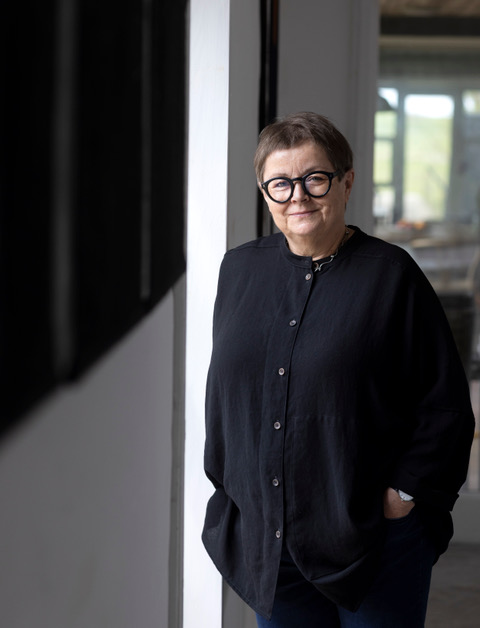
Hanne B Sønnichsen.
Theme: Crafts and Design Policy
Denmark needs a new design policy, but what should it include to support independent craftspeople and designers? Formkraft explores this question through interviews, articles and debates.