
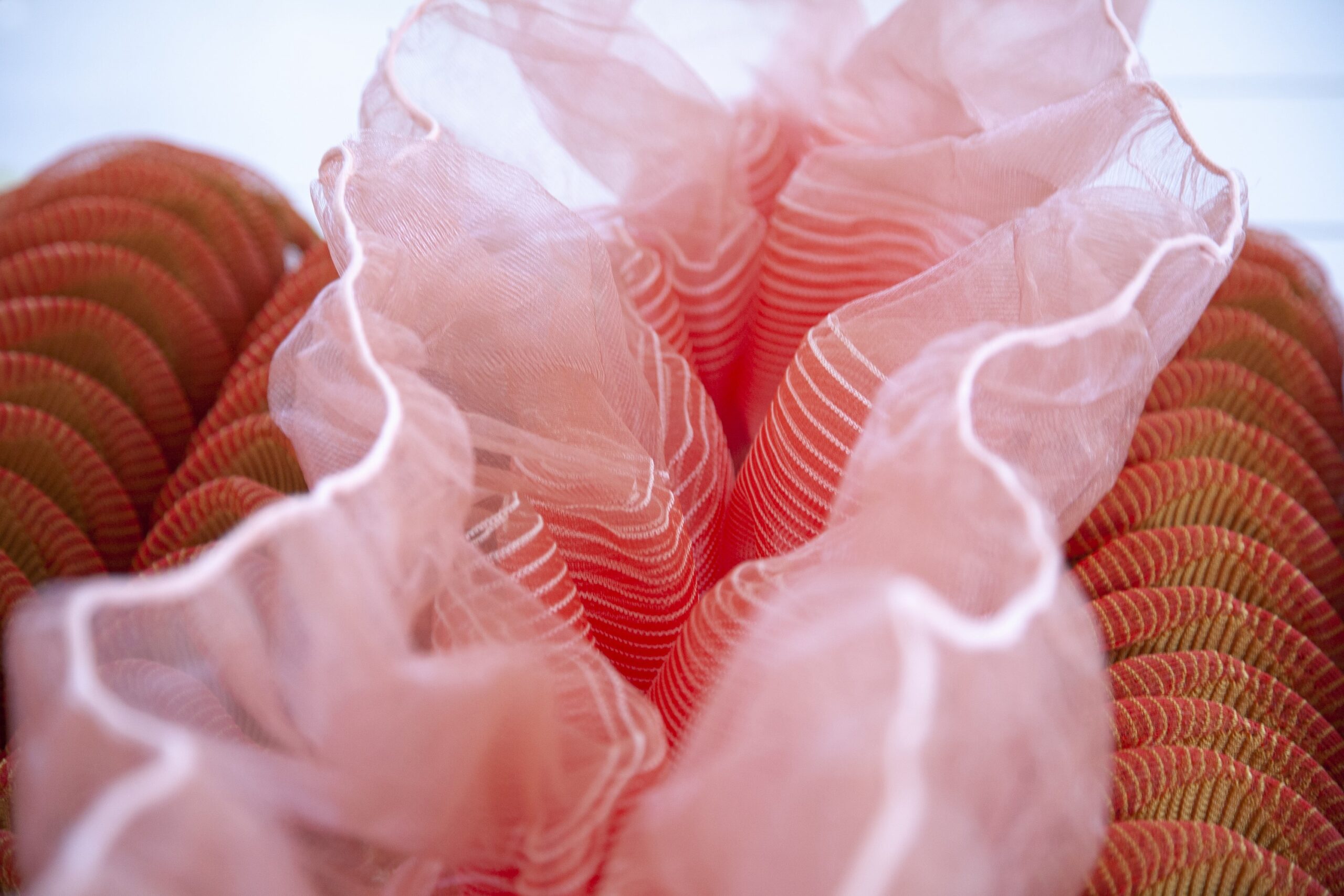
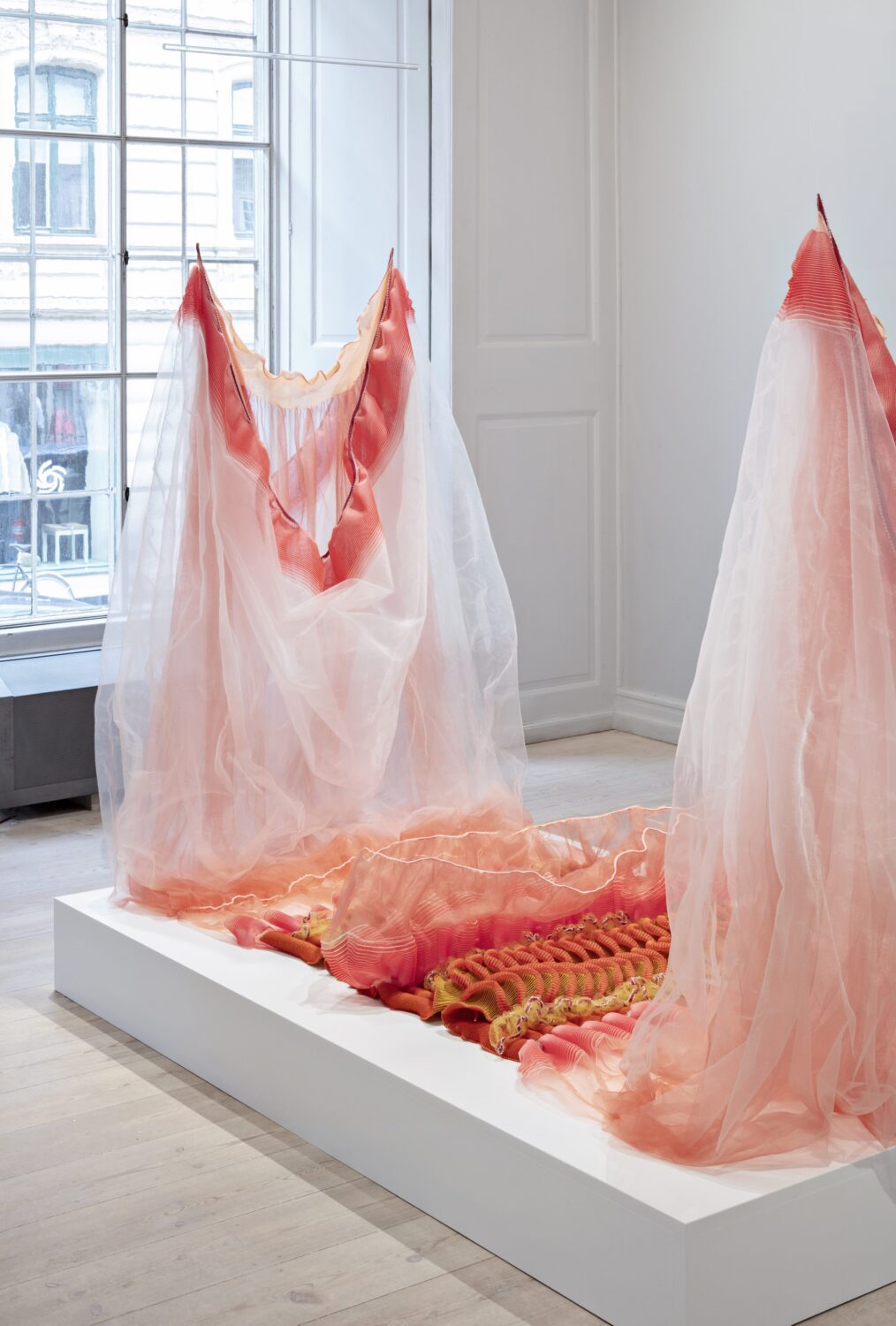
Udstillingen er bygget symmetrisk op og består af to store installationer, to podier med prototyper samt to højtalere, der findes på hver sin side af indgangen. Centralt står de to store installationer, der får hele rummet til at vibrere. Her er de strikkede objekter er udspændt i uforudsigelige figurer og forløb. Mønstrene flyder ind i hinanden på langs og på tværs, og får tekstilerne til at hæve sig og folde sig ud i, hvad der føles som uendelige, åbne formationer.

Insight into the process is always a gift, especially when the process is as innovative and unique as Drua Sif Simone Albrechtsen’s. Through the prototypes, one has the opportunity to study the exploration of form and colour up close and see the virtuoso, intricate patterns unfold in different techniques. This gives a sense of getting closer to her working method and visual universe.
But where are the musical prototypes? Where are her spatial experiments that show how the prototypes could rise from the table and become installations? On the podiums, the samples lie still, strangely lifeless compared to the stretched works. Only one is allowed to lift itself, float in space and sparkle in its colours. What distinguishes this one from the others?
I would have given a lot to experience Albrechtsen’s working process in this very leap from static sample to spatial, sensory work.
Digital craftsmanship
In recent years, I have witnessed a significant return to digital weaving and knitting in art and design, a rediscovery of digital craftsmanship. This movement can be seen as a reaction to the “black boxes” that today’s computers represent: closed, commercial systems where the processes are invisible and inaccessible to the user.
By working with technologies that can be felt, shaped and understood through the hands and senses, designers and artists insist on bringing the digital out of hiding and into a space where it can be sensed and perhaps, as a result, better understood by more people.
Historically, there is a crucial connection between textile craftsmanship and digital technology. The mechanical Jacquard loom from the early 1800s controlled its patterns via punch cards and is often considered a crucial step towards the development of the modern digital computer.
When designers and artists today return to weaving and knitting, it is also a way of reactivating this historical connection – reminding us that the digital has its roots in a concrete, material craft.
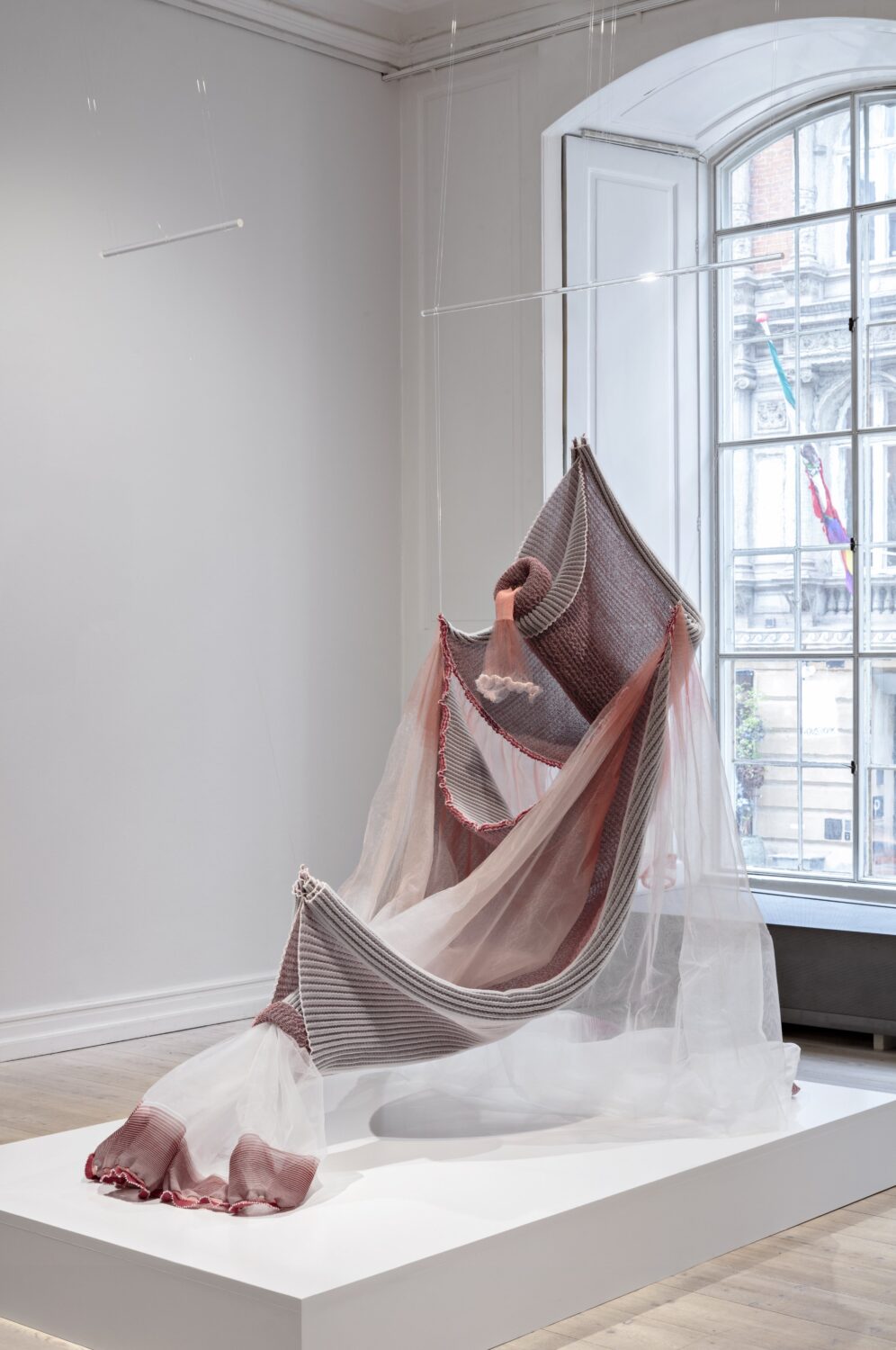
Drua Sif Simone Albrechtsen also moves effortlessly between the past and the future. She draws on historical understandings of digital craftsmanship while simultaneously innovating digital knitting in the creation of unexpected forms – forms that I personally have never seen before.
She works with a mixture of humour and subtlety, which she combines with intense professionalism and a deep seriousness in her view of what knitting can do. Her works are both playful and monumentalising, and her colour combinations and patterns are surprising and precise.
The Carry Bag Theory
In her essay The Carry Bag Theory of Fiction, author Ursula K. Le Guin challenges the traditional view of early human technologies as weapons and tools for combat. Instead, she points out that the first technology was a tool for gathering and carrying – a “carry bag”.
She describes the carrying bag as a technology that, unlike weapons, does not pierce, pierce or destroy, but holds, supports and collects. Le Guin’s interpretation represents a caring and collaborative approach, where the purpose of technology is to connect elements and carry resources forward. Understanding technology as a ‘carrying bag’ also means viewing technology as a container for multiple stories, experiences and processes at once.
I read Drua Sif Simone Albrechtsen’s approach to digital technologies through Le Guin’s eyes. Her way of working with digital knitting becomes a demonstration of what the digital can also be. Through her knitted objects, she points to technology’s potential to be inclusive, sensual and supportive – a force that not only shapes, but also holds and carries forward.
A digital community
Similarly, there is a responsiveness in Roar Cornelius Albrechtsen’s digital composition, a softness and a desire to maintain an auditory space for the viewer. It is not sound that imposes itself and insists, but sound that flows through the space and complements the experience of care and subtle seriousness in the objects. Roar Cornelius Albrechtsen has used the knitted pieces as a score and explored his sister’s colours, patterns and the visual programming that forms the basis for it all.
The acoustics in the room are difficult; apart from the soft, knitted works, there are only hard surfaces. This makes it almost impossible to hear the details in the soundscape that I imagine exist. It is a shame, and there are passages in the composition that occasionally become so blurred that they are difficult to listen to. Nevertheless, the sound contributes to the overall experience. You realise this because the sound occasionally stops. The composition loops, but has a four-minute pause that contrasts with the sense of flow I otherwise feel in both the composition and the knitted objects. It becomes strangely quiet in the room. This means, of course, that you notice Roar Cornelius Albrechtsen’s sound, but also that the atmosphere in the room drops.
Sound as an Echo
The sound is a response, an echo, as the exhibition title suggests. The word echo originates from Ovid’s tale of the nymph Echo, who was cursed to only be able to repeat what others said. It is an exhibition where the starting point is the physical installations, with sound existing as an echo. It is interesting to see the two digital disciplines shaping each other; perhaps they could one day become equal?
As mentioned, the two artists are siblings, with ten years between them. Ten years in which Drua Sif Simone Albrechtsen has developed her own unique signature through her own art and design practice and as a teacher of machine and digital knitting at the Royal Academy of Fine Arts – Design & Architecture, while Roar Cornelius Albrechtsen is now about to begin in earnest when he starts at the Rhythmic Music Conservatory in August.
There is a great curiosity and openness towards each other’s approach to the digital and a unique potential for not only an auditory echo, but an opening dialogue between two special digital artists and disciplines.
I dream of a digital world that is based more on the caring approach of Drua Sif Simone Albrechtsen and Roar Cornelius Albrechtsen. A digital world based on the sensory, the soft and the lasting.
About the writer
Majken Overgaard is a curator and writer focusing on art, technology and science. She is the curator of Snart – Laboratory for Possible Futures and has previously worked with VEGA, the National Gallery of Denmark and Christiansborg Palace. She sits on the board of the Nordic Institute in Åland and advises companies and decision-makers on using art and technology as strategic tools for shaping the future.
Source
Ursula K. Le Guin, Bæreposeteorien om fiktion (Forlaget Virkelig og Laboratory for Aesthetics and Ecology, 2017).