

Munkeruphus, once the home and studio of the architect, visual artist and designer Gunnar Aagaard Andersen (1919–82), is blessed with a lovely natural setting offering sweeping views of the sea.
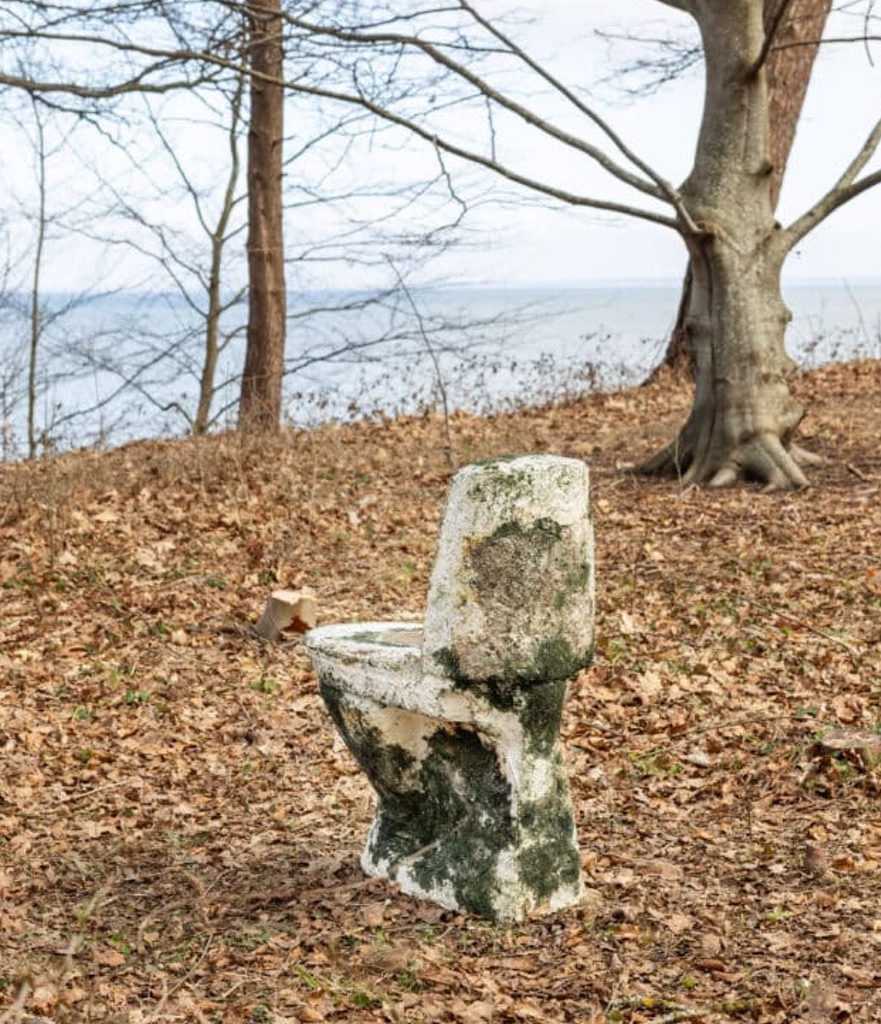
Near the coast stands a sculpture that resembles an ordinary, everyday toilet. The view is magnificent; not least for a toilet. But of course, you cannot use it. Nearby, however, there are two chairs, perfectly positioned close to the slope leading down to the water. Here you can sit and reflect on how beautiful it is here, and how much we ought to look after our surroundings.
Concepts such as sustainability and recycling have, after all, been themes in both the international and national exhibition world for a number of years; at the Venice Biennale of Art and Architecture, here in Denmark for example at both DAC (Danish Architecture Center) and Louisiana, as well as in galleries specialising in design and crafts.
The toilet-like sculpture was created specifically for this site and occasion by Siska Katrine Jørgensen, one of the 11 craftspeople and designers whom Munkeruphus has invited this summer and well into the autumn to take part in an exhibition entitled Nature to Nature.
The title elegantly plays on the words of the funeral ritual, that we come from the earth and shall return to the earth, thus becoming part of ‘The Great Cycle’. This is also the basic premise of the works in the exhibition. They are created by nature – and they return to nature.
The exhibitors’ challenge
There was one rule for the participants: all materials had to come from nature – and all materials used had to be biodegradable and break down into the soil from which they originated. So that something new might emerge.
The materials for Siska Katrine Jørgensen’s toilet sculpture consist of topsoil, twigs, leaves, mushrooms and so on. Everything has been collected from the natural grounds situated between the sea and the exhibition venue itself.
Inside the listed buildings, in addition to the exhibition spaces displaying the other participants’ works, there is a special room dedicated to a permanent exhibition on Gunnar Aagaard Andersen and a space called ‘The Workshop’. Among other things, it features a video explaining how the participants have worked to overcome the constraints imposed by the exhibition’s concept.
The film and a catalogue serve as the exhibition’s medium, an exhibition which, incidentally, shines through its sensuality. It is almost impossible to go wrong when you are greeted by winding willow branches in an installation by Jette Meldgaard, which draws the visitor up through the stairwell to the first floor. Here, among many other things, are the immediately beautiful reliefs and objects made of sheep’s wool, processed on Claudy Jongstra’s organic farm, as well as a related installation in willow, honeysuckle and human hair created by Karin Lorenzen.
Also on display are pattern prints by Zena Holloway, salmon-skin reliefs by Oscar Yran, and finely crafted woodwork, in which cabinetmaker Teis Dich Abrahamsen and architect Sus Ormark demonstrate both the diversity of wood types and the beauty of crafted objects.
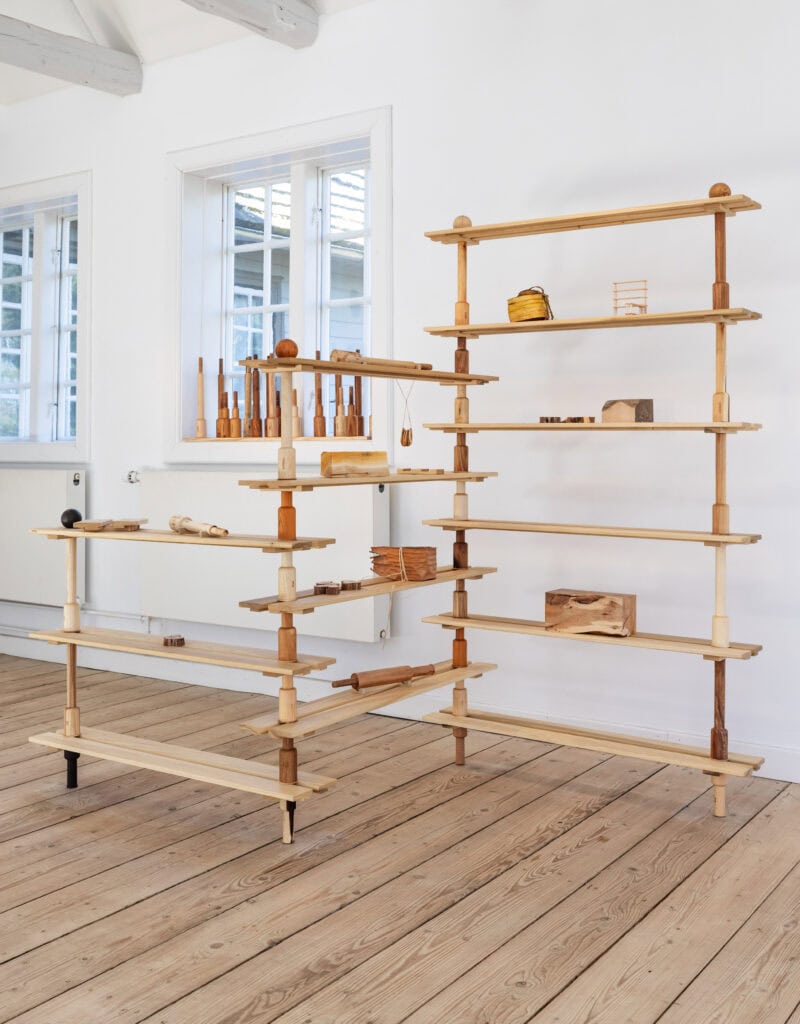
An information panel in the Workshop draws attention to the fact that the synthetic materials we take for granted in our everyday lives did not exist 150 years ago.
Paints were made from linseed oil extracted from, for example, flax seeds and animal blood. We used binders extracted from bones and hides, etc. Goldsmith Kasia Gasparski demonstrates how she has crafted a range of bone tools from scratch. These are not tools reminiscent of those we use in our daily household chores, but they resemble something that could have been, had developments taken a different course or perhaps in a different time and place.
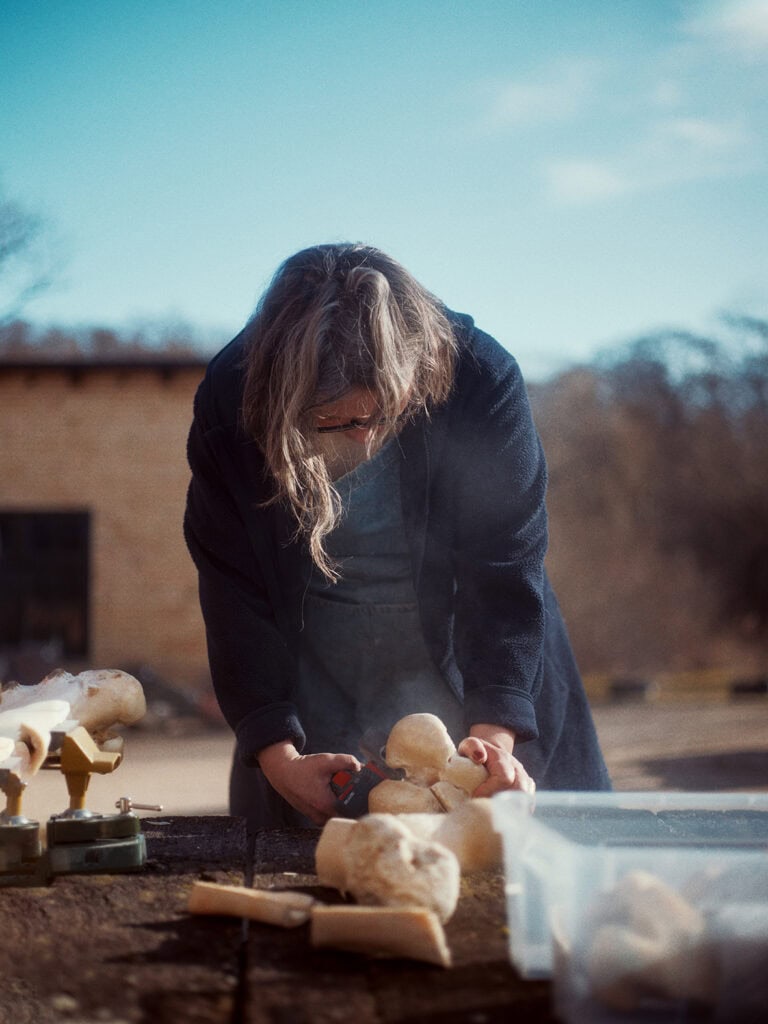
Many of the exhibition’s contributions take the form of collections of examples showing: ‘This is how you could do it’.
This is how one could – like Chris Liljenberg Halstrøm – add new experiences to the DIY concept by building and embroidering a teenage bedroom for the year 2026 without visiting the usual furniture stores. Instead, creating something from recycled materials with personality.
This is how one could – like Jonas Edvard – design chairs from eelgrass and other materials, so that in context they seem to send a friendly thought to Gunnar Aagaard Andersen himself, who, in keeping with his time but in contrast to the progressive part of our own era, was happy to work with synthetic materials.
That Gunnar Aagaard Andersen’s formal explorations still arouse interest is demonstrated by Tanja Kirst in her objects, whilst Julia Lohmann and Alberte Holmø Bojesen present, in rows or seemingly floating in the space, tactile examples of how they have taken natural materials and processed them.
Not necessarily as an invitation to go home and do it yourself. This is not a hobby or DIY exhibition, but a community of dedicated, professional artists and designers who have taken Munkeruphus’s call to work with nature’s great cycles seriously. The result is a cohesive exhibition that invites visitors to reflect.
Facts
The exhibition Nature to Nature is on display at Munkeruphus until 1 November 2026.
Discover 11 new works created for the exhibition by the artists Alberte Holmø Bojesen and Julia Lohmann, Chris Liljenberg Halstrøm, Jette Mellgren, Jonas Edvard, Karin Lorentzen, Kasia Gasparski, Line Depping, Oscar Yran, Siska Katrine Jørgensen, Tanja Kirst, Teis Dich Abrahamsen and Sus Osmark. As well as existing works by Claudy Jongstra and Zena Holloway. In addition, you can explore materials, processes and historical artefacts.
You may also be interested in these articles:
New demands for sustainable production: The revolution of micro-companies?
Can you equate locally produced with sustainability? How do craft and design micro-businesses work with green solutions? And is it enough to think circular economy?
Connections through time: Materials, nature and creativity from the 16th century to now
Materials have always been a key condition of human creativity, but in recent decades, they have taken on renewed prominence in artistic practices. This article examines how today’s focus on materials relates to ideas from 16th-century understandings of nature and materials and how these connections can shed new light on the ongoing departure from modernism and on the artist’s role and position.
