
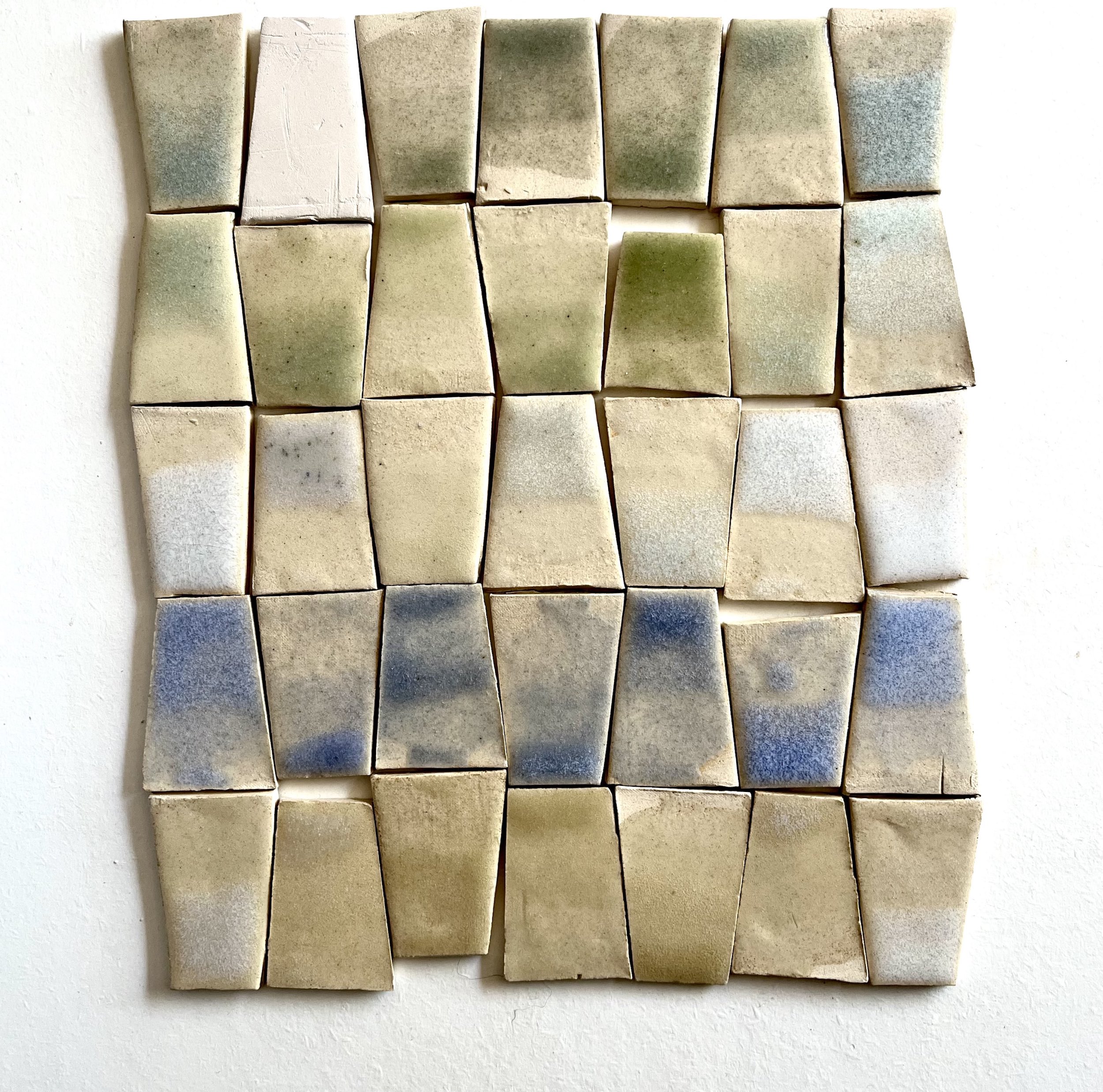
When a toilet is replaced, it is usually regarded as waste and rarely as what it actually is: a large, high-fired porcelain mass with the potential to be incorporated into new materials. But for ceramic artist Thora Finnsdottir, a discarded toilet became the focal point of an extensive investigation into how one of the construction industry’s most overlooked waste materials can be given new life.
What began as an artistic experiment with a small rock crusher in her studio has since evolved into an interdisciplinary project in which she, together with researchers, architects, and the demolition industry, is investigating how high-fired ceramic waste can become a resource—and perhaps even form the basis for a new material aesthetic in the construction of the future. ‘Waste is material,’ says Finnsdottir.
And it is precisely this approach that forms the basis for GenForm, which has received funding from the Danish Arts Foundation”
The project builds on a wealth of artistic material studies and experiments that began long before GenForm. To understand how the work with ceramic waste evolved from the initial material experiments into an interdisciplinary research and development project, we must rewind to the exhibition *Ødeland*, which Thora Finnsdottir developed together with the ceramic artists Signe Fensholt and Christina Schou Christensen.
Being Wasteful
Ceramics present a paradox. We associate the material with durability—with something that can survive for generations and, in archaeological excavations, tell stories about people who lived thousands of years ago. But it is precisely this durability that poses a problem in relation to the way we use and consume the material today. For it is that very durability that makes high-fired ceramics difficult to reintroduce into the cycle.
When a plate breaks, a sink is replaced, or a toilet is discarded, the material does not cease to exist, yet from one moment to the next it is regarded as waste. But what if the story didn’t end there? What if discarded high-fired ceramics were not primarily regarded as waste, but as the beginning of the material’s next chapter—with its own materiality, its own colors, and its own aesthetic potential?
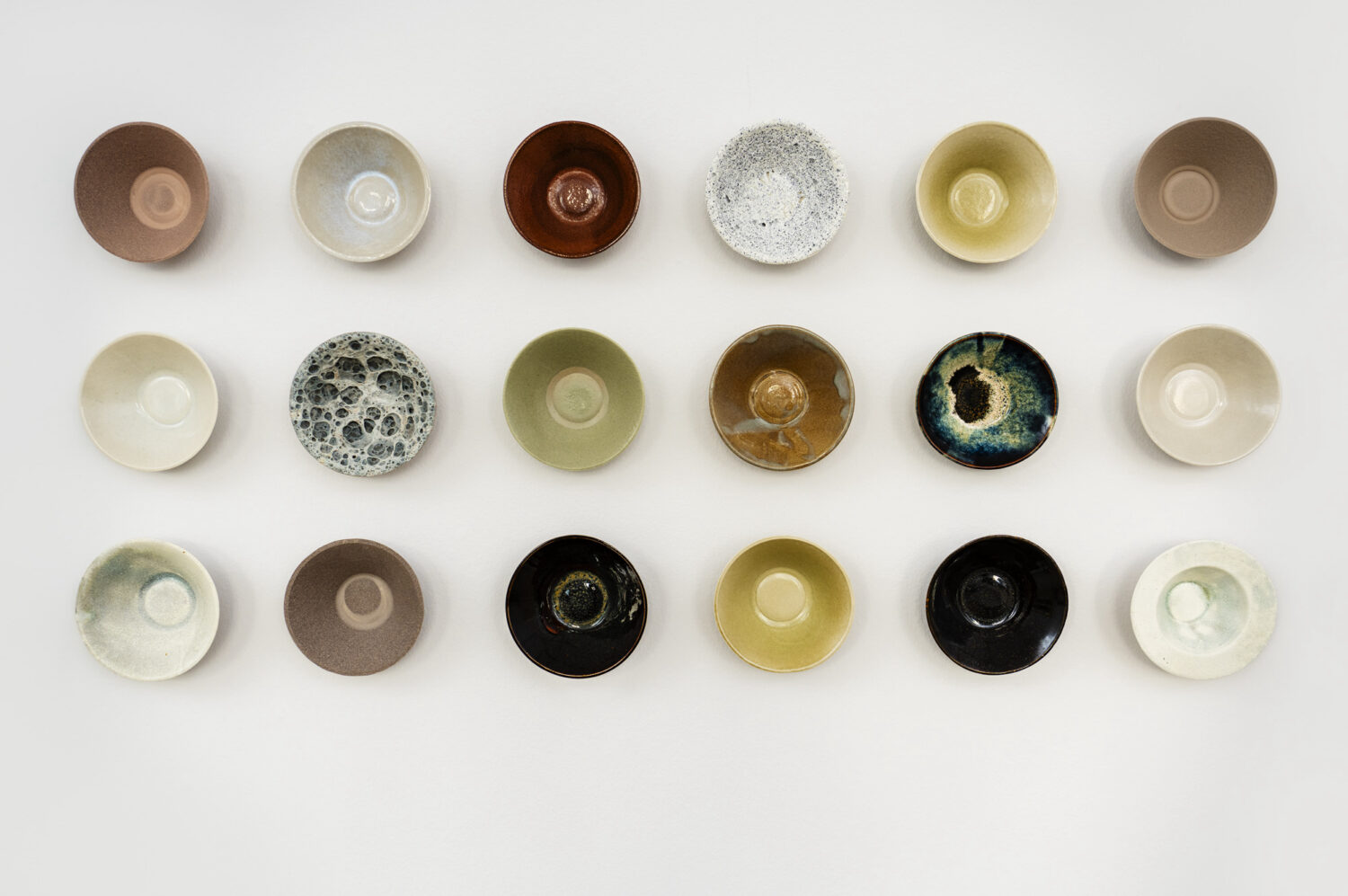
It was precisely these questions, among others, that served as the starting point for the exhibition Ødeland.
The title Ødeland has a double meaning. It refers both to landscapes that have been depleted or scarred by human exploitation, and to the word’s older meaning, in which an “ødeland” is a person who squanders their resources.
Both meanings share the same central theme: a culture in which materials are extracted, processed, used—or rather, consumed—and ultimately disappear from our consciousness as waste. Or as the three ceramic artists wrote in the exhibition text: ‘For millennia, we have drawn upon the earth’s riches. In the field of ceramics, we have transformed clay and minerals into wonderful ceramic objects. We humans have squandered these resources as if they would never run out. But the raw materials used to make ceramics are non-renewable resources.’
However, Ødeland did not begin as an exhibition concept, but as an experiment with materials. During the GenJord symposium on more sustainable ceramics at the Aarhus Academy of Fine Arts, participants were invited to choose an aspect of sustainability they wanted to explore further, and Finnsdottir chose materials.
She spent the next two months researching high-fired ceramic waste—precisely because almost no one was working with it—and the experiments gave her an initial sense of what might be possible.
Finnsdottir had seen a few international examples, including an Australian ceramicist who crushed defective cups and mixed them into new ceramic slurries. But high-fired porcelain and sanitaryware are generally considered materials that are difficult to recycle.
So she bought a small rock crusher (the kind gold miners use to crush rocks in search of gold) and began experimenting at home in her studio. And over the following months, she systematically worked with various types of ceramic waste: porcelain from restaurants and cafeterias, discarded pieces from her own practice, and brick waste.
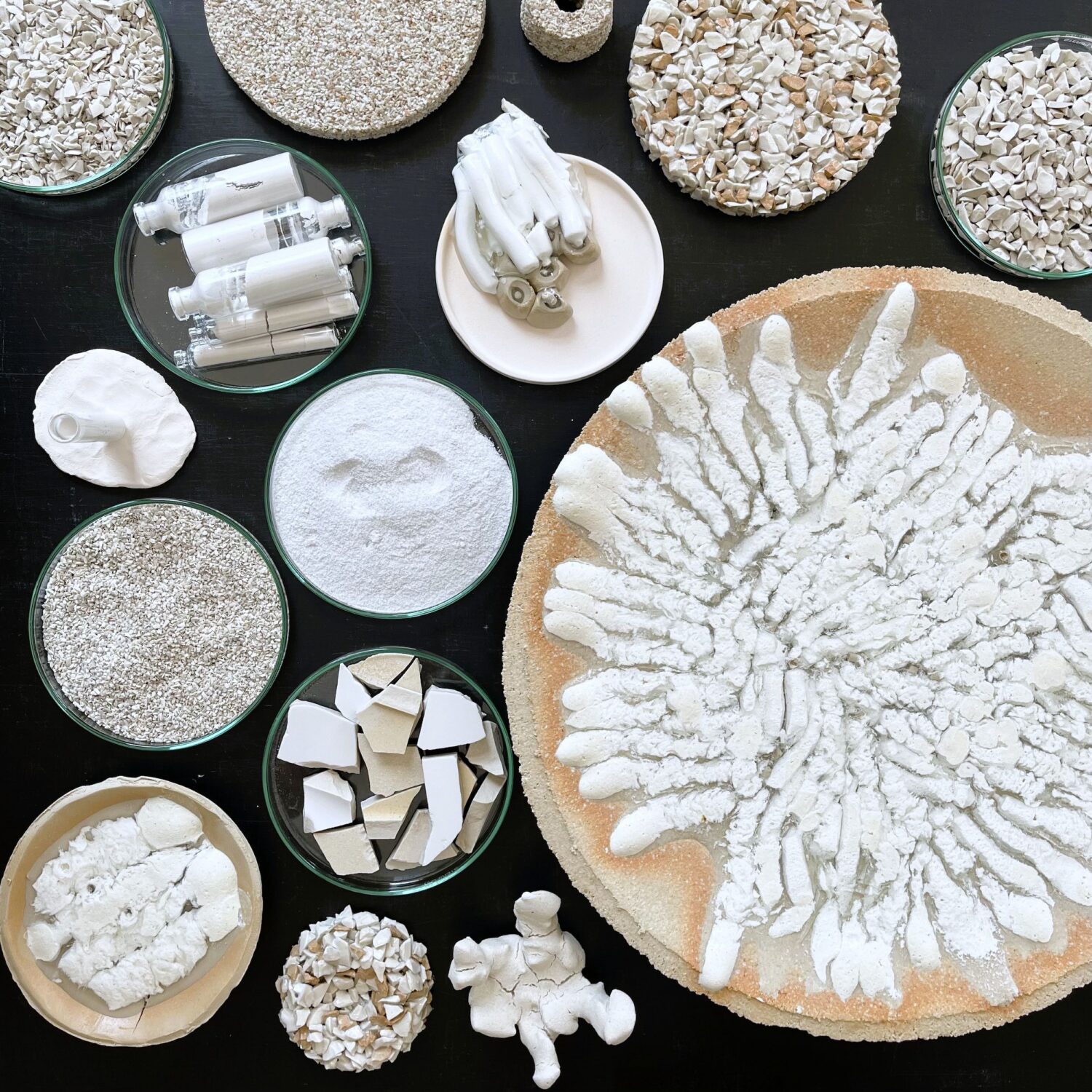
The materials were crushed, sorted, and gradually mixed into the clay mixture in ever-increasing quantities. ‘I kept increasing the amount of waste in the clay mixture to see where the limit was,’ she explains. ‘When I reached about 50 percent, I started to think that this might actually be possible.’
But the goal of the experiment wasn’t just to find the technical limit of how much waste the clay could accommodate. It became at least as interesting for her to observe how the material’s character changed. The crushed porcelain shards left marks on the surface, the colors changed, and the coarser particles—which at first resembled a byproduct—turned out to impart new qualities. The material did not try to hide its past; on the contrary, its history became part of its expression.
Reuse does not necessarily have to aim to make a material look like something new. Perhaps the greatest potential actually lies in the exact opposite: in developing an aesthetic where the material’s past life is not hidden, but emerges as a quality in and of itself—where the traces of time have become embedded in the material as part of its expression.
The results of the experiments inspired Finnsdottir to explore the material further. She therefore contacted Christina Schou Christensen, who works extensively with ceramic materials and glazes, and asked if they should develop an exhibition together at Officinet. Signe Fensholt was later brought on board, and the three ceramic artists began meeting on Bornholm to develop the materials and explore their possibilities.
And that’s when they began to turn their attention to a waste stream that very few people deal with: worn-out toilets and sinks.
As in the rest of Denmark, Bornholm also has to dispose of ceramic waste, and thus enormous quantities of ceramic waste are shipped off the island every year. The high-fired ceramic waste cannot be easily recycled and typically ends up in landfills. Some of it is sent to Norway, where it is landfilled in former limestone quarries. This solution is possible due to the geological conditions in Norway but does not exist in the same way in Denmark. For the three ceramic artists, this raised an obvious question: Could the material that the waste management system regarded as a burden instead become a resource?
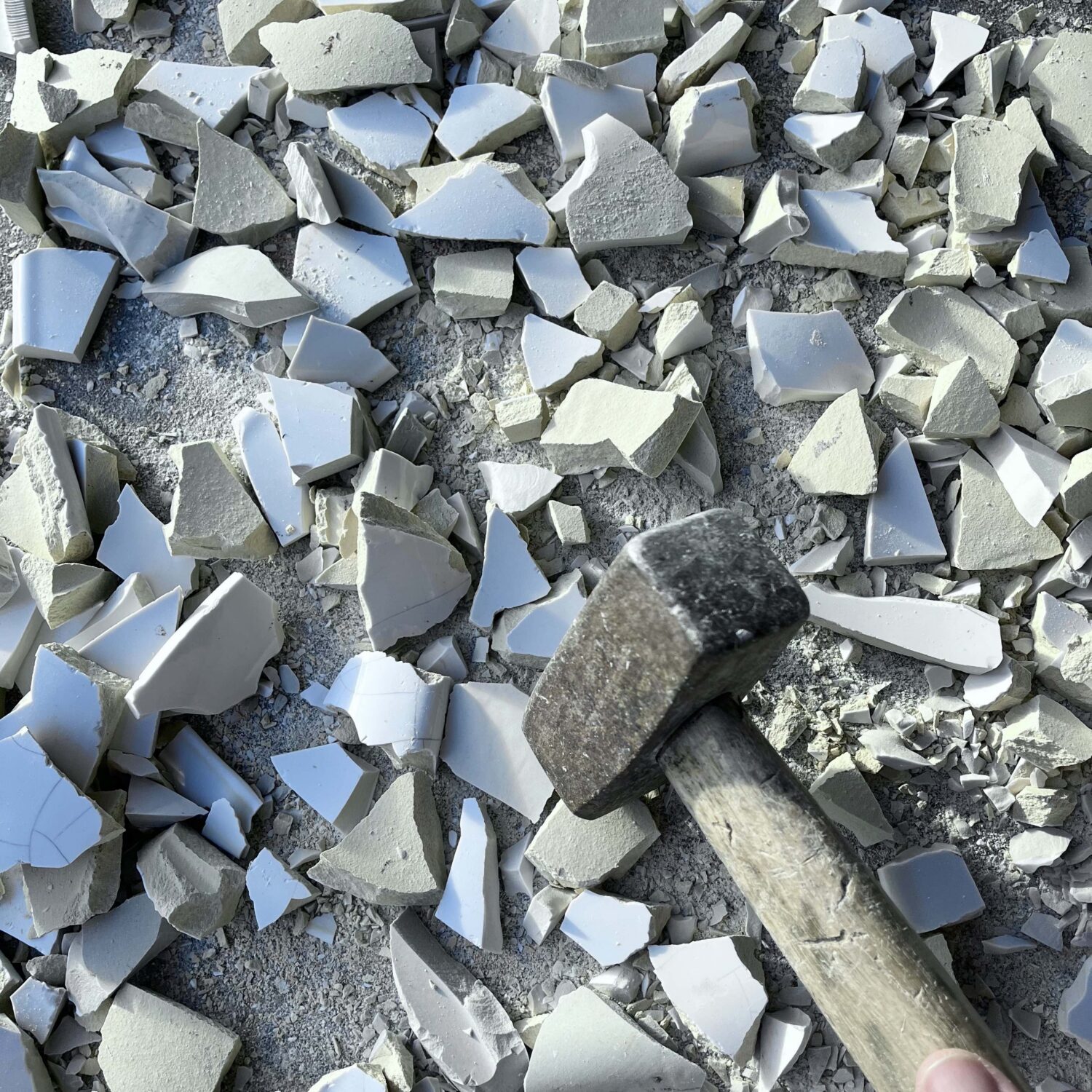
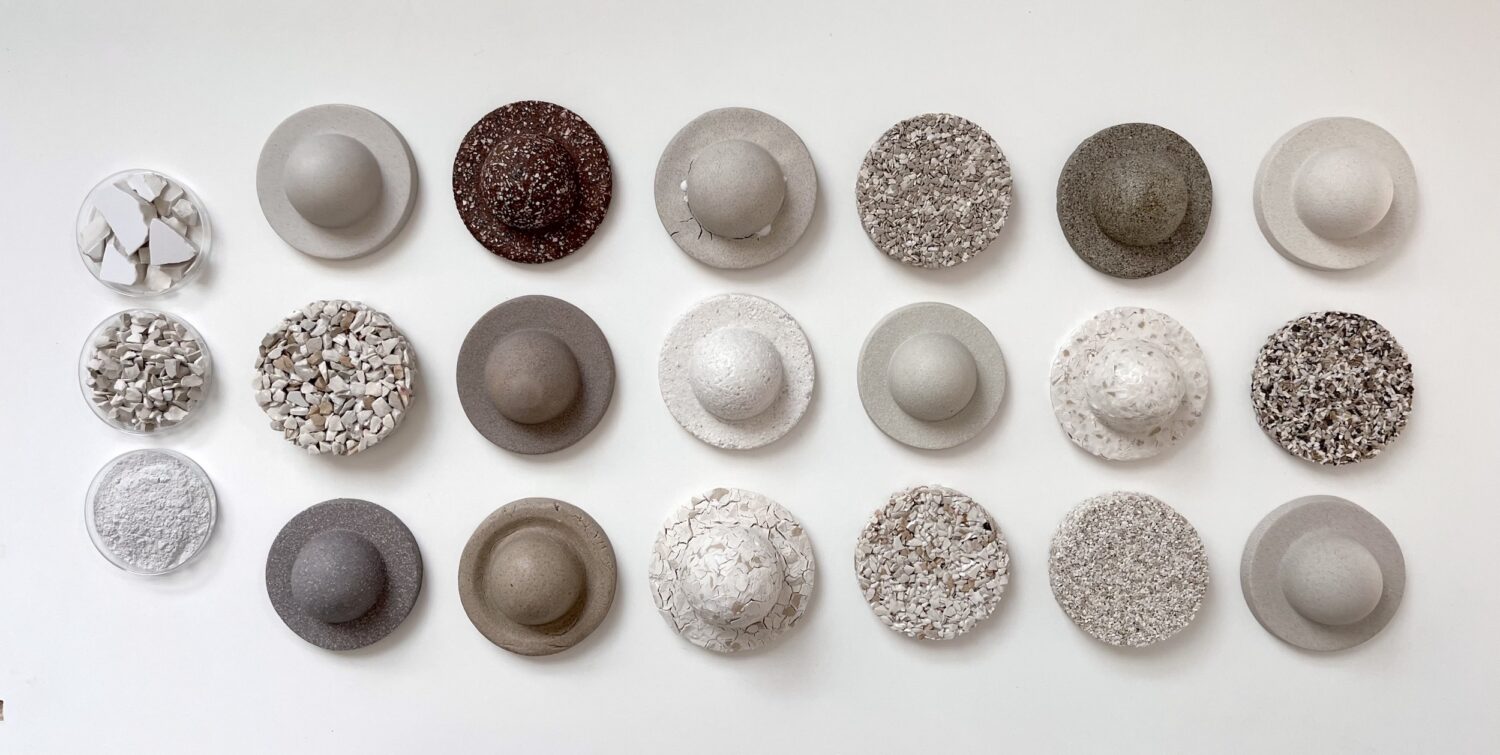
The work began on a very practical level. Toilets and sinks were smashed with a hammer, then crushed in a coarse crusher and subsequently in a finer laboratory crusher in Christina Schou Christensen’s workshop in Nexø on Bornholm, until the material could be mixed into new clay mixtures.
The research centered on the following questions: Can waste material replace virgin materials such as kaolin, feldspar, and quartz—and be used for both clay bodies and glazes? What colors and textures emerge? And can a material considered waste develop its own set of design principles?
Ødeland thus became more than just an investigation into whether ceramic waste could be recycled. The exhibition highlighted that a residual material does not have to mark the end of its history, but can enter new cycles and develop new aesthetic qualities along the way.
Thinking in terms of recyclability
But Ødeland also pointed out a limitation: There is simply far more sanitaryware than artisans will ever be able to utilize. If the material is to have a real future, therefore, research must shift from the workshop to the systems where the waste is generated and where it can potentially be brought back into the cycle.
“We realized that it didn’t make sense to work with this solely as ceramicists. There are such large quantities of material that the craft sector can never tackle the task alone. If this is to make a real difference, we’ll have to consider the entire value chain,” explains Finnsdottir.
This became the impetus for the GenForm project, for which she applied for funding from the Danish Arts Foundation together with DTU Sustain, Tscherning, Henning Larsen, and the Design Museum Denmark. The project explores both the technical and aesthetic potential of sanitary waste as a material for new ceramic production for architectural applications.
One of the first partners was Tscherning, a major Danish construction firm with strong expertise in civil engineering, demolition, and circular resource management. Their interest in the project stemmed directly from a potential solution to a fundamental problem: What do you do with the enormous quantities of sanitary ceramics that cannot be directly reused? The question was closely tied to Finnsdottir’s research. The work in Ødeland had shown that sanitaryware could be reused. Tscherning saw an opportunity to help develop a solution that could handle the large waste stream, which today largely ends up in landfills.
Precisely because Tscherning handles large quantities of sanitary ware, the company also played a central role in developing a more systematic strategy for the material. During the work on Ødeland, the toilets came from BOFA, Bornholm’s Waste Sorting Facility. They were unsorted, and no one knew exactly what models the individual toilets were or what materials they contained. This made the work both difficult and uncertain.
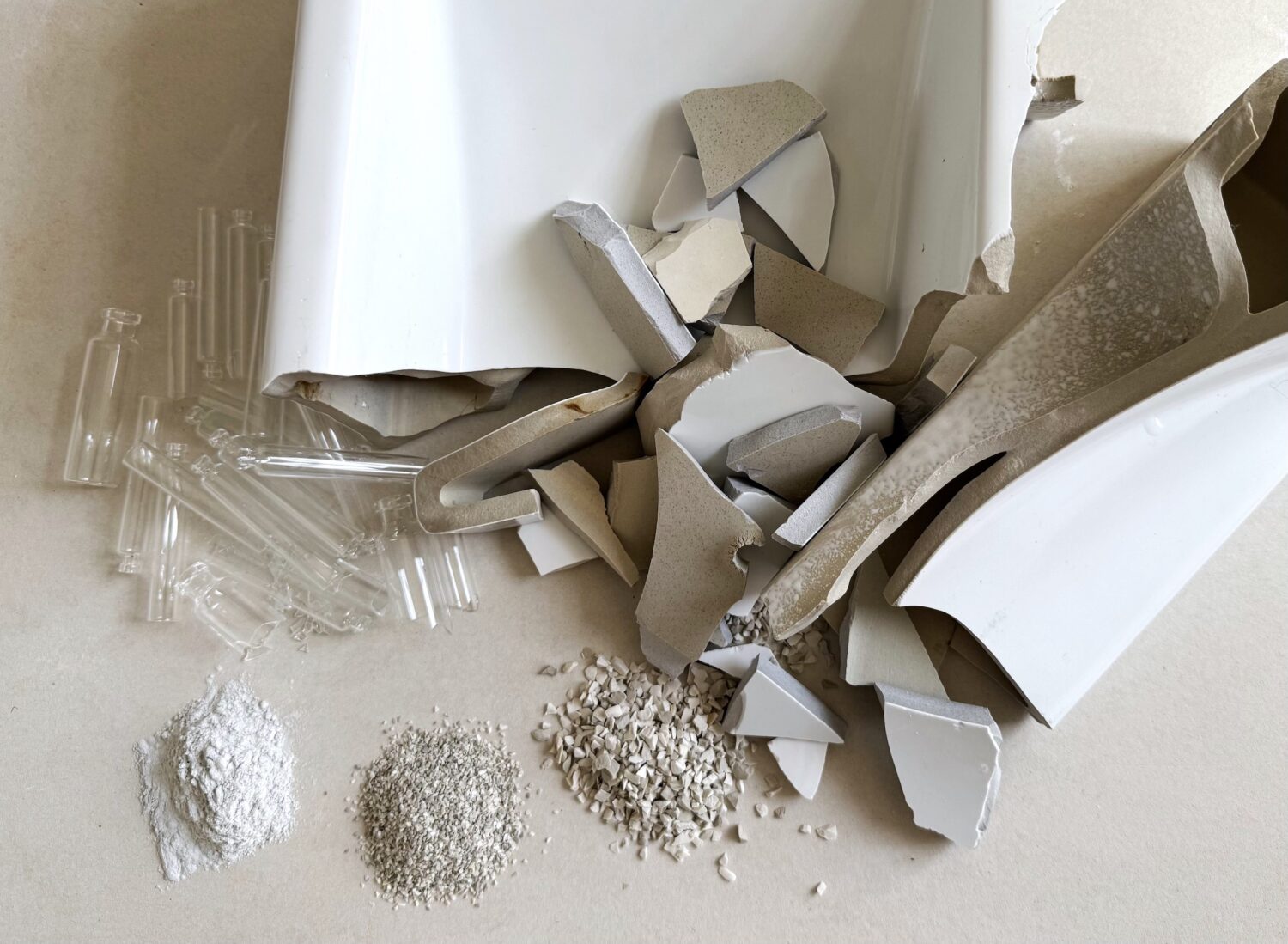
At GenForm, Finnsdottir is working with Tscherning and DTU to develop a method for systematically selecting the sanitary ware best suited for recycling. Not all toilets are the same; older models may contain heavy metals or other problematic substances that make them unsuitable for new materials, while newer models are far more likely to be incorporated into a circular value chain.
While Tscherning manages the material’s path out of demolition sites, DTU Sustain is responsible for the scientific research. Researchers from DTU will contribute analyses of the materials’ composition, investigate potential environmental and health risks, and develop methods to document which types of sanitary ceramics can be safely incorporated into new products.
This includes, among other things, analyses of heavy metals, dust generation, and the technical properties of the materials—all of which are essential knowledge if the material is to be used in industry in the long term.
Crafts, research and construction
Finnsdottir brings a different perspective on the material to the project. While the focus has traditionally been on technical properties and function, she asks what happens when the material’s aesthetic qualities also become part of the equation.
Lisbeth M. Ottosen, a professor at the Department of Environmental and Resource Technology at DTU Sustain, sees the intersection of arts and crafts and research as the project’s strength:
‘Interdisciplinarity is essential if we are to reuse alternative resources in the production of building materials. Thora’s ideas and knowledge are unique. At DTU Sustain, we can test and optimize the material designs she develops so that they meet the functional requirements demanded of them in construction.’
Working with these alternative resources also raises new questions. The materials vary in composition, and according to Ottosen, understanding exactly which factors are crucial to their quality is a prerequisite for their eventual production.
It is precisely this combination of an understanding of materials, aesthetics, and circular thinking that opens the project up to the construction industry. A material only truly becomes part of a circular practice when it can be reused in a new context.
Therefore, collaboration with the construction industry was a prerequisite from the very beginning of the project, and Henning Larsen Architects is a key partner in exploring the material’s architectural potential.
The architectural firm had seen Ødeland and recognized the opportunity to explore how the recycled ceramic materials could be incorporated into architectural solutions.
In many contemporary construction projects, bricks often serve as exterior cladding on buildings with a load-bearing concrete structure. Finnsdottir sees a potential application for the new materials in this context. Not necessarily as traditional bricks, but also as facade panels, tiles, or other architectural elements where ceramics can contribute both durability and a distinctive textural quality.
It is precisely this combination that has piqued the interest of Henning Larsen Architects. Katrine Juul, Lead Sustainability Architect at Henning Larsen, says:
‘Thora’s work demonstrates what can emerge when aesthetics, an understanding of materials, and a concrete societal challenge come together. The result does not feel like a compromise, but rather like a sensuous and attractive product with architectural quality. It is precisely this type of solution that can move recycled materials from a niche application to the obvious aesthetic choice.’
But GenForm also has a cultural dimension. The project not only challenges the way we develop new materials and architectural solutions but also raises the question: How do we change our view of the materials we call waste? That is precisely why the Design Museum Denmark is also part of the partnership. While the other partners are working on the material’s technical, scientific, and architectural potential, the museum will place it within a broader cultural-historical narrative.
In the long term, the project’s results could form the basis for an exhibition that not only presents the new material experiments but also tells the story of sanitary ceramics: from everyday object to waste and on to resource. At the same time, the results will be shared with the construction industry, including through Building Green, where they can contribute to a broader discussion about the materials of the future and circular construction.
Learning from Nature
Although the project now involves researchers, architects, a demolition company, and a museum, the workshop continues to play a central role. It is here that Finnsdottir continues to explore the properties and possibilities of the materials. For her, every new waste stream is first and foremost a material to be understood—through her hands and the ceramic process. And this also applies to the materials used in the glazes. Glass waste from the pharmaceutical industry, bottle glass, granite dust from Bornholm, and other industrial waste streams are tested as raw materials for new glazes.
Each material holds its own aesthetic potential: for example, granite dust immediately produces a deep brown surface, but for a ceramicist, the iron it contains is also the starting point for a much broader color spectrum. Depending on composition and firing, the same minerals can develop yellow, green, and warm earth-toned hues. Copper scrap can release copper oxide and create clear turquoise glazes, while blue hues can be achieved by crushing discarded ceramics with cobalt-containing glazes and incorporating them into new mixtures. Even ochre sludge from drinking water treatment has proven capable of forming the basis for beautiful new glazed surfaces.
‘One material constantly leads to the next,’ says Finnsdottir. ‘The more you explore waste, the more possibilities you discover.’ That same openness characterizes her approach to recycling. She doesn’t just try to make waste resemble virgin raw materials. On the contrary, she also allows the crushed porcelain grains and the patterns of the minerals to emerge as part of the material’s identity, so that the traces left by time and use become part of the material’s expression.
Another recurring theme in Finnsdottir’s practice is her fascination with the way nature creates form. Long before ceramics became her medium, she was captivated by nature’s own systems, and she even studied biology—in part because she was fascinated by how forms in nature arise, develop, and are shaped by nature’s cycles. When she later chose ceramics, she brought those same questions with her into the studio. In the past, she has been particularly interested in diatoms—microscopic organisms in water whose delicate, complex silica skeletons have, over millions of years, been deposited and accumulated in nature. Silica is a fundamental material in the production of both glass and ceramics.
She is fascinated by how we humans can learn from nature’s own processes—from the way forms emerge and materials enter into cycles. “We often view nature as something separate from ourselves,” she says. “But we are, after all, nature. When we begin to understand that, we also see materials in a different light.”
Alongside her work with GenForm, Finnsdottir continues her work as a ceramicist and designer. She has just launched new products for Kähler and is simultaneously in the process of restructuring her practice so that, going forward, it will be based almost exclusively on recycled materials.
Finnsdottir’s approach to sustainability is not about pointing a moral finger. Quite the contrary; new narratives need to be brought to the table. Because if we are to change the way we use materials, it also requires that we change the way we view them. The ambition, therefore, is not merely to develop new materials, but also to help create a new narrative about them—a narrative in which waste is not primarily something to be hidden or removed, but something that can be understood, valued, and reshaped.
GenForm aims to highlight an aesthetic that does not attempt to erase time, wear, and signs of use, but instead allows them to emerge as part of the material’s identity. An aesthetic where beauty does not arise in spite of the material’s history, but precisely through it. Perhaps our time is ripe for this kind of beauty. It certainly should be, for waste materials are, in many ways, the greatest resource of our time.
The most sustainable approach is not to restore the materials to what they once were, but to reshape them or allow them to continue their story in a new form that bears the traces of what has been, while remaining open to what is to come. Just as in nature, where forms change and materials take on new contexts, what we consider superfluous can become the starting point for something new.
Theme: Places and Materials
In this theme, Formkraft explores how craft and design can help shape our environments: from materials and architectural details to landscapes, raw materials and global power structures. What unites them is an interest in how materials, design and craft can forge connections between people and their surroundings.