
Silversmith Lone Løvschal opens the door to her workshop in Roskilde, west of Copenhagen, and I immediately struck by a remarkable sense of calm. Everything is well ordered, each thing in its place, and yet, the place resonates with a vibrant energy. On the shelves and walls, I glimpse little stories: a jar full of plastic spoons, framed art combining nature and function, a collection of spoons that once turned into both damask tablecloths and wallpaper – and the special strawberry spoon that once earned Løvschal admission to the Royal College of Art in London.
Where does the story of your spoons begin today? I ask, once we are seated across from each other in her Panton chairs.
Lone Løvschal (LL): It begins with an open question. I had long wanted to challenge myself and my profession – and when the Biennale for Craft & Design in Ebeltoft announced a very open call, I decided to submit a proposal. I did not have any sketches, as the project was emerge during the process, and in fact, the application text exceeded the maximum number of words. Nevertheless, my project found its way into the curated exhibition.
I (MLH) ask Løvschal whether she remained true to her brief. She promptly and enthusiastically replies, Yes!
Lone Løvschal’s self-imposed ground rules for her Biennale project
Using an unchanging material base, I will craft 30 spoons during a 30-day lunar cycle without prior sketching.
The spoons are crafted from silver bars measuring 10 x 10 mm x 7 cm.
The spoons must be functional tablespoons, meaning that, as a minimum, they have to consist of a handle and a bowl.
Naturally, the spoons should be well-crafted, meeting my usual, high standard.
My thoughts and reflections will be recorded in a journal during the project and may be included in the exhibition.
What are these spoons going to look like, and will this change my self-perception and my practice?
Taking ownership of the process
MLH: And the result was 30 spoons – one for each day – from full moon to full moon?
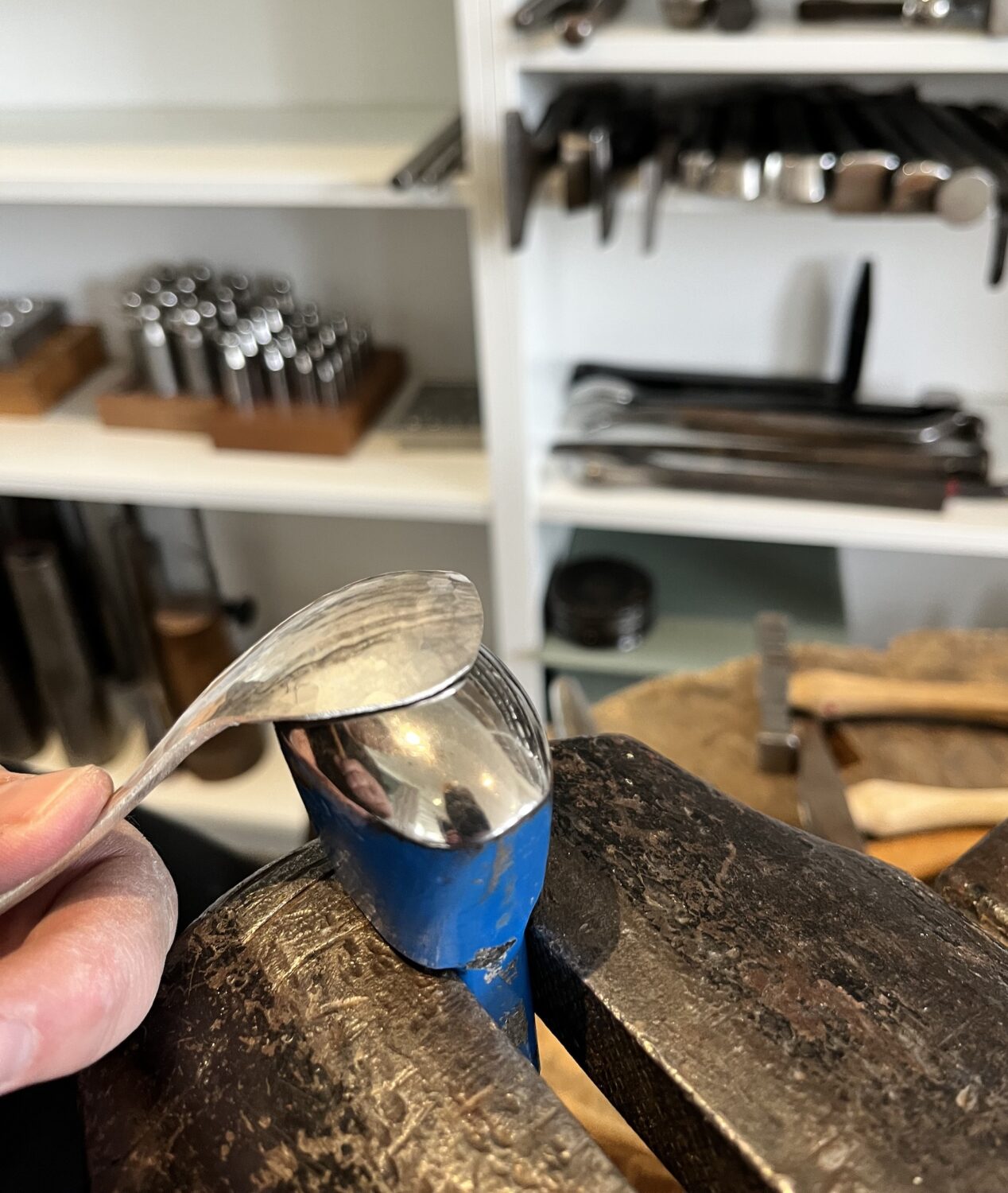
LL: Exactly. I set out to make one spoon a day for 30 days. No sketches, just a silver block of 10 x 10 mm x 7 cm and, of course, the hammer, the tools, my hands. Some days, I got into a flow; on other days, I was tired or disappointed, but I still finished the spoon. It was important for me to see the project through – to accept that not everything turns out perfect, but everything is real, tangible.
MLH: I hear both discipline and intuition in your description.
LL: Yes, it was a cycle. The lunar cycle and my own. I am in menopause, and that became an inescapable starting point. My body is changing, and my hormones are toying with me. At first, the doctors insisted I couldn’t possibly be in menopause – but I knew that something was up. I began to read up on and accept the new conditions. That is why my daily journal notes became a parallel element to the spoons. That too was a vulnerable process, but it was also liberating. I realized that experience, even during the changes of menopause, can be part of a SUPERPOWER.
MLH: That word, ‘superpower’, is strong – and brave.
LL: Yes, because it’s about taking ownership.
After consultations with her doctor, Løvschal decided that, instead of allowing menopause to define her, she would define it. The experienced silversmith, who trained as a hollowware maker in the Georg Jensen firm, aims to demonstrate that this phase of life can lead to reflection, strength and clarity. There is so little knowledge and research in this area, and in many ways, menopause is still treated as taboo. Lone Løvschal insists that we should talk about it – just as she insists on talking about craft in a time when digitization is distancing us from materials.
Honesty is a source of strength
I ask whether she intends the spoons as both objects and stories.
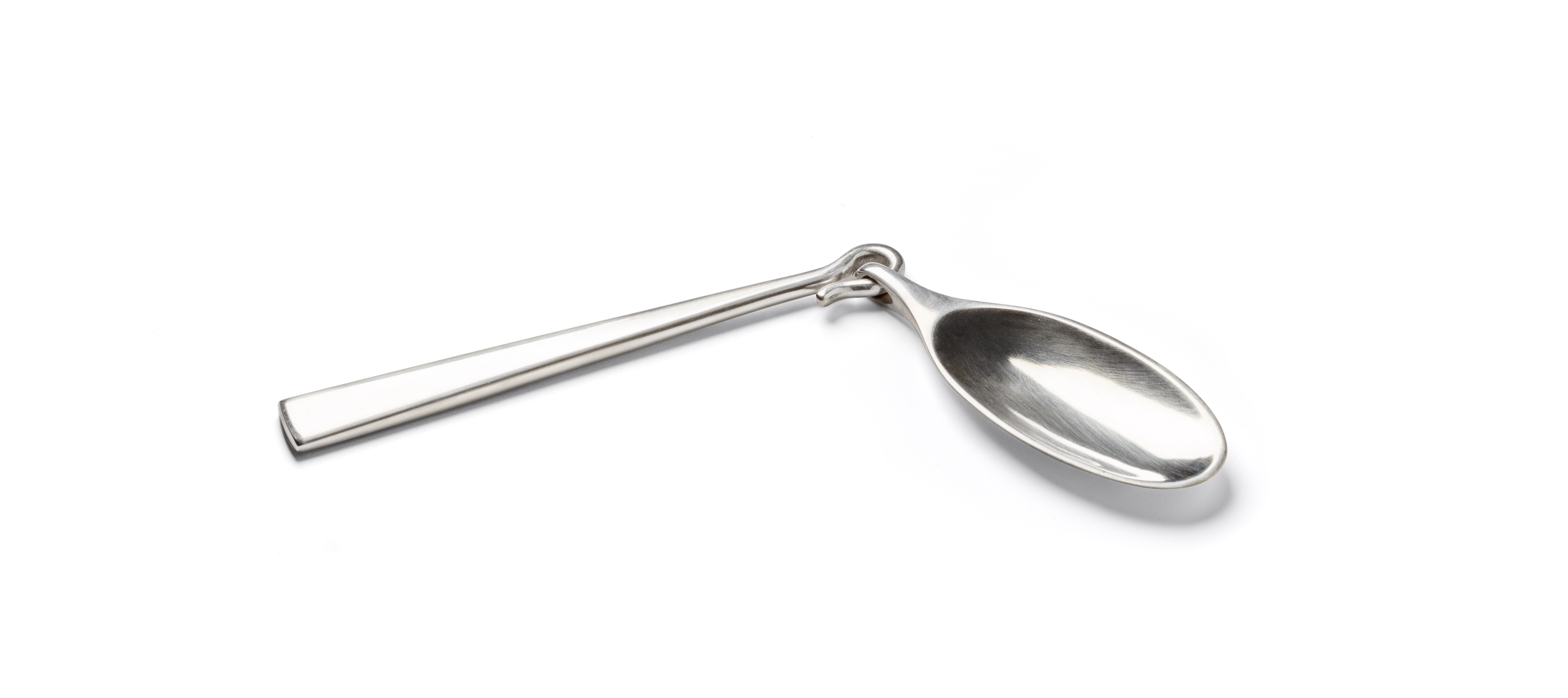
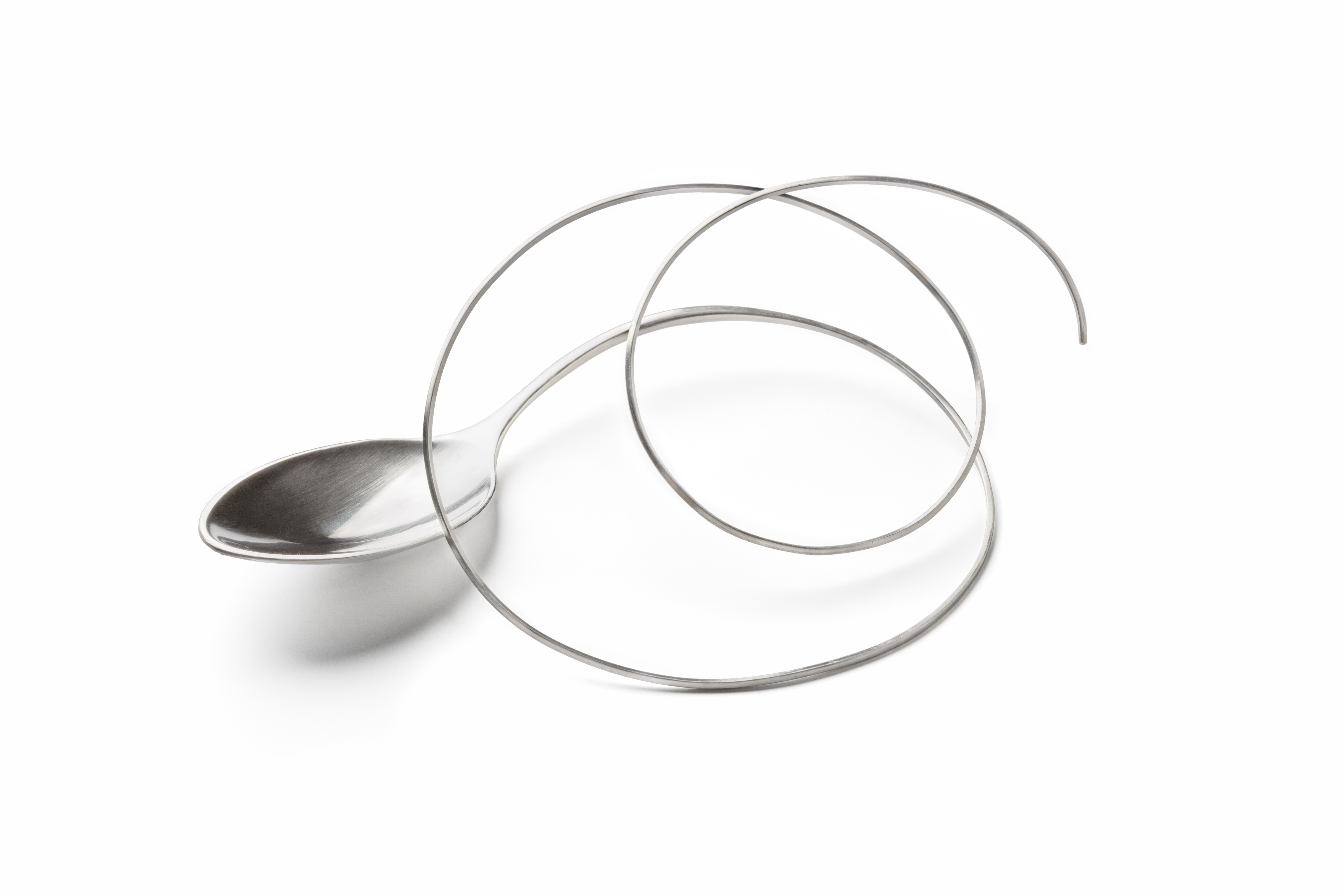
Lone Løvschal answers in the affirmative, adding, They are not intended as a set but as 30 individual pieces – like the days of a month, each has its own particular character, mood and expression. Some spoons are edgy and have iconic features, others are almost like jewellery. One has two bowls, one looks like a ginkgo leaf, one feels like a medicinal spoon from a different era. They are functional and indefinable at the same time. You could lay the table for 30 guests, giving each their own unique spoon – and it would be a celebration, full of curious openness towards function, material and each other.
MLH: You seem to reach a deeper state through variation and in the process?
LL: Precisely. According to Søren Kierkegaard, repetition can lead to transcendence and depth. For me, it was an experiment to dare make snap decisions, give up the search for perfection, go with the process. Not everything is beautiful, but it’s all honest. And this honesty is a source of strength.
MLH: When I see your spoons, I perceive them as comments on something bigger – not just the role of cutlery but also the way we live and the Biennale as a celebration of craft. Your own craftsmanship is evident in every single spoon.
LL: You’re right. We take the spoon for granted, as an old, simple tool. But it can be a reminder of focused presence: eating, sharing a meal, being in the moment. The project is also a comment on the right to maintain a working life, continuing to create something. On the labour market, women – whether in menopause or not – are pressured into a system, a structure, created by men. We need to make room for experience, new rhythms, diversity, looking after our bodies and our lives.
Lone Løvschal adds, Before the project began, I had a residency in a workshop in Scotland. While there, I decided to refine certain techniques and to immerse myself in the work and in some of the more specific areas that I don’t often take the time to refine my grasp of.
MLH: What did you learn from the cycle project, your journalling and the design of 30 unique pieces?
LL: That discipline and intuition can co-exist. That mistakes have value too. That experience can be a power. And that I’ll never be done with the spoon as form – it continues to hold my fascination. I also learnt when to stop, to choose my projects more deliberately. And I discovered how good it feels to engage in hands-on work, every day, with hammer and silver.
Passion and drive set the mind free
More than once, Lone Løvschal describes menopause as a superpower. A liberating process that puts life and practice into perspective. Is that also her gift to the Biennale and to the audience? The project demonstrates that we can stand by ourselves, our experience and our bodies – and that physical, hands-on craft offers a counterbalance to the digital world.
The spoons are individual, just like us. They are a reminder for us to insist on dialogue, on research, on the uniqueness of every human being. And perhaps they are a reminder that we can learn to love our bodies again – because they contain memory, purpose and beauty.
I wonder if the 30 spoons might be used on a table laid for dinner. A dinner that would revolve around both silver and life itself. In a focused presence, 30 individuals, each unique, has to relate to the specific spoon they have been given. How does it feel to touch, lift, hold? What is like to eat with this spoon – and does the food taste when you use that particular silver spoon, compared to the spoon you normally use?
Personally, I would love to sit down for a lovingly prepared meal at a table laid with specially selected cutlery. I would love to take part in the conversation that would unfold in the physical interaction, when the spoon does not behave the way spoons normally do. My mind is set free in the company of 30 beautiful objects that are both exquisitely crafted and exceptional.
In modern society, where everything is served and delivered to us, we risk growing lazy. By surrounding ourselves with hand-crafted objects, we bring in a sensuous materiality and a physical presence that stand in contrast to the parallel life on our screens. This physical presence is a key quality in Løvschal’s work, where passion and drive set thoughts and ideas free.
LL: Yes – because every day is new. And tomorrow, we’ll do something else, something new, based on our experience and the world around us.
Facts
Lone Løvschal received the prestigious Biennale Award for her spoons at the opening of the 2025 Biennale for Craft & Design.
The award-winning piece, which consists of 30 unique spoons, is titled ‘Fluctuating Spoons’. It is on display as part of the Biennale for Craft & Design at Glas – Museum of Glass Art in Ebeltoft.
Exhibition period: 9 October 2025 – 22 February 2026.
The 2025 Biennale was curated by Ukurant and is held at the initiative of Danish Crafts & Design Association.
Theme: Various bodies
Crafts and design are closely linked to materiality, sensuousness and the physical – both in the inherent qualities of the works and through the hands that shape them.
In this issue, Formkraft explores corporeality with multiple perspectives on bodies and materiality.