
When craftspeople or designers enter into a collaboration to create decorative works for public buildings, there are many factors to consider. There may be specific requirements regarding materials, maintenance or sustainability, and there will always be tender documents and contracts that need to be read thoroughly.
Furthermore, one becomes part of a larger process involving many other professional groups, which can span several years.
‘You become part of a huge mountain, and it can be difficult to take in all sides of it,’ as Jonathan Prochazka Fromholt puts it.
He is an architect and senior consultant. at the Danish Building and Property Agency, working with art in government buildings. He acts as a link between the artists and the client, ensuring that the Agency’s construction projects meet the requirements for art in public buildings, as set out in the Art Circular, amongst other sources.
Jonathan Prochazka Fromholt has agreed to talk about how the Danish Building and Property Agency works with art and decoration, and to provide an insight into some of the challenges – and opportunities – that can arise when dealing with new government buildings and renovation projects.
The Art Circular
There is no getting round the need for art when the state undertakes construction projects. The 2004 Art Circular stipulates that 1.5 per cent of the cost of building works must be allocated to artistic decoration. If the cost of the decoration exceeds 250,000 kr., the Danish Arts Foundation must be involved in the form of an art consultant who assesses the building’s suitability for artistic decoration.
This is where Jonathan Prochazka Fromholt and his colleague, Mette Bech Kokkenborg, come into the picture. The Building and Property Agency provides premises for, amongst others, universities, the police, the courts and central government. And every time a building is refurbished or a new one is built, art is factored into the plans.
‘We ensure that the projects are carried out and coordinate with all stakeholders, both internally and externally. The Danish Building and Property Agency has a wide range of specialist areas. We look at timetables, legal matters and finances, and try, for example, to incorporate art early on in the tender documentation,’ explains Jonathan Prochazka Fromholt.
Maintenance and operational requirements
One of the details that often needs to be taken into account in decorative projects is that government buildings may change tenants.
‘This means that when creating art for a building, the work should not be specifically aimed at the current users. Tenants may change. In nine out of ten cases, one should focus more on the architecture, the spirit of the place and its quality, and less on who the tenants are at the moment.’
If new tenants move in, walls may need to be moved, and in that case it is not feasible for a work to be bolted in place or an integral part of a wall. Artistic decoration can also be integrated into the building, in which case it is important to ensure that the artwork is thoroughly incorporated into the permanent structural elements.
‘This is one of the challenges we can set an artist or craftsperson. In my experience, most artists love challenges because they can spark new creative ideas. We also stipulate that the works must not require any more maintenance or upkeep than the rest of the building. This also helps to increase the likelihood that the artwork can be preserved for as long as possible.’
Our surroundings affect our well-being
Jonathan Prochazka Fromholt is a qualified architect and has always been interested in art. Whilst his primary school classmates went to football, he visited the Aalborg Art Museum. He firmly believes that beauty, aesthetics and atmosphere have an impact on us.
For him, art in public buildings is not just about specifications and tender documents.
‘Broadly speaking, it is a question of democracy – that we have something to come together around, something that sparks conversation. Our surroundings affect our well-being. That well-being is important in terms of our productivity. Our productivity is important for society, so everything is interconnected. Personally, I find that aesthetics, intention and care matter a great deal when we design workplaces.’
Lengthy processes
It can take a long time to complete a new build or a refurbishment, and so it can also take a long time for a work of art to progress from concept to finished installation. It is important for anyone submitting works for government buildings to bear this time factor in mind, explains Jonathan Prochazka Fromholt.
In some cases, it is necessary for the artwork to be factored in from the outset if a floor is to be subject to artistic treatment. This must be made clear in the documentation that contractors, amongst others, need to take into account.
‘The processes can be lengthy, and this does not always fit in with how artists work. A great deal can happen over a period of two to three years. The artists may be in a completely different place to where they were when we first started talking, or may have changed their artistic practice, secured an exciting exhibition or a working grant that has taken them in a new direction.’
The Building Authority tries to be transparent about what it offers artists.
‘They need to know what they’re getting into, and a tender pack is always available from the outset, together with the contract. This gives them time to go through everything or ask a solicitor or trade association to review the contractual terms. We always hold an initial meeting where we explain what the commission involves and answer any questions. For some artists and craftspeople, being presented with so many documents is unfamiliar. It requires some explanation so that the artists do not feel we are approaching them with scepticism, but that this is simply the basis for collaboration with a public client.’
The wooden building on Funen
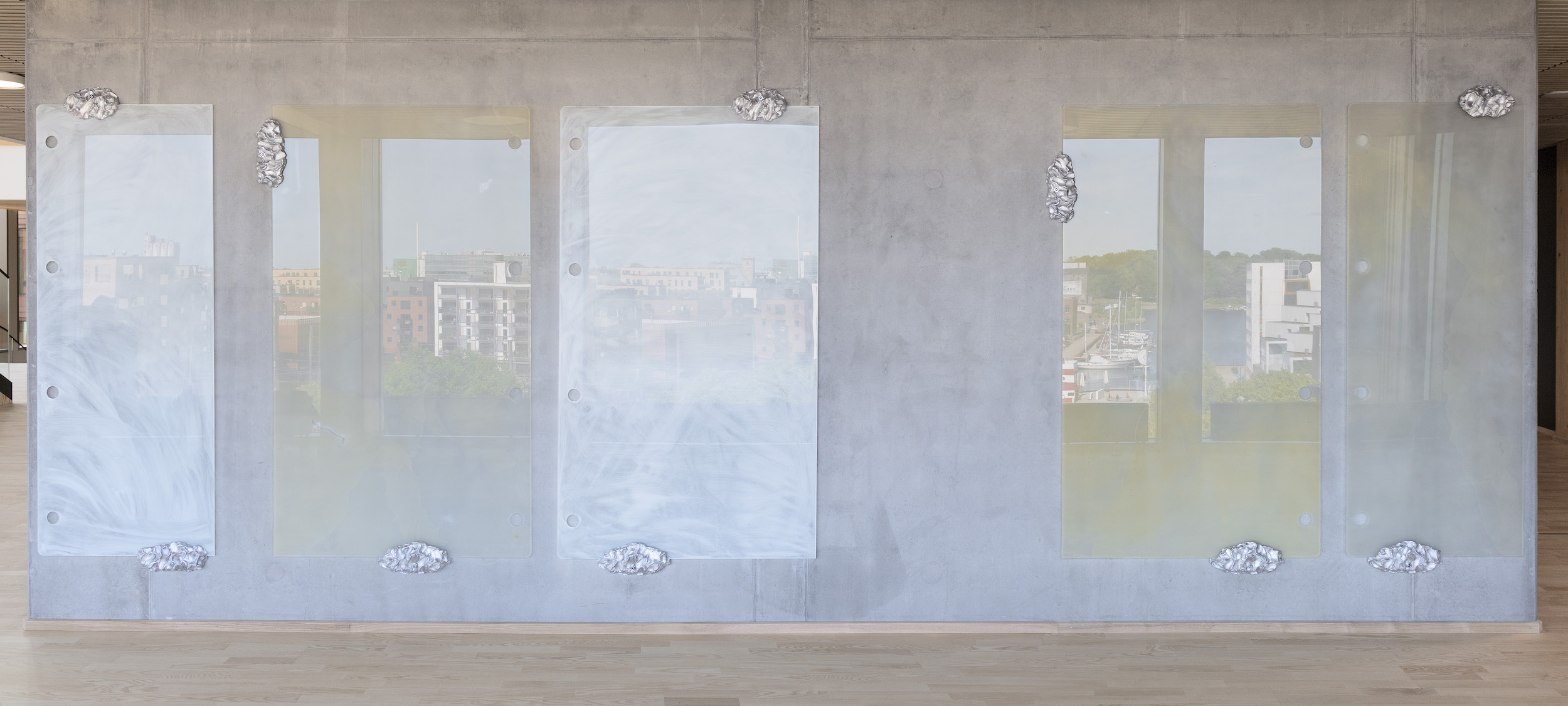
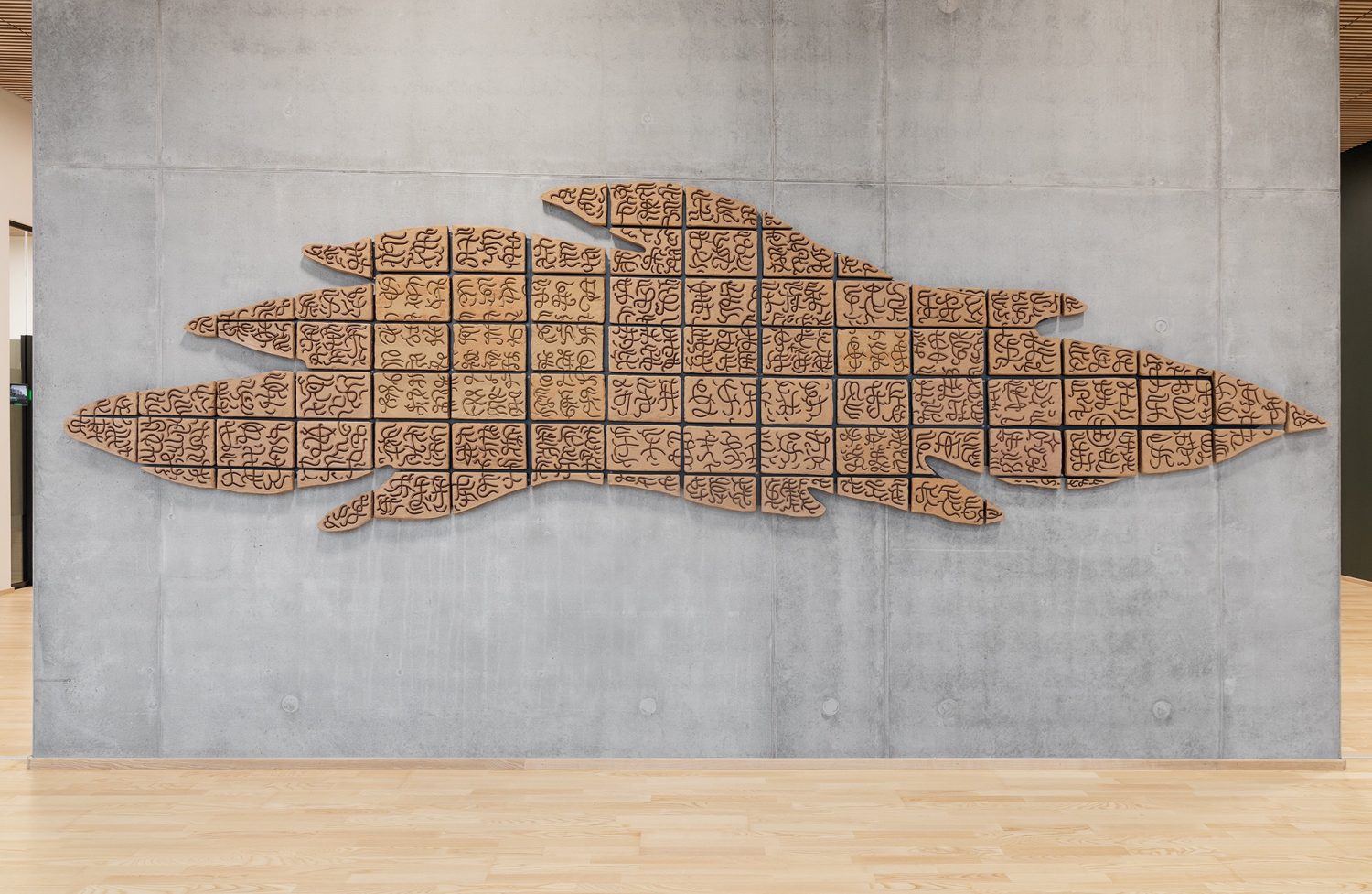
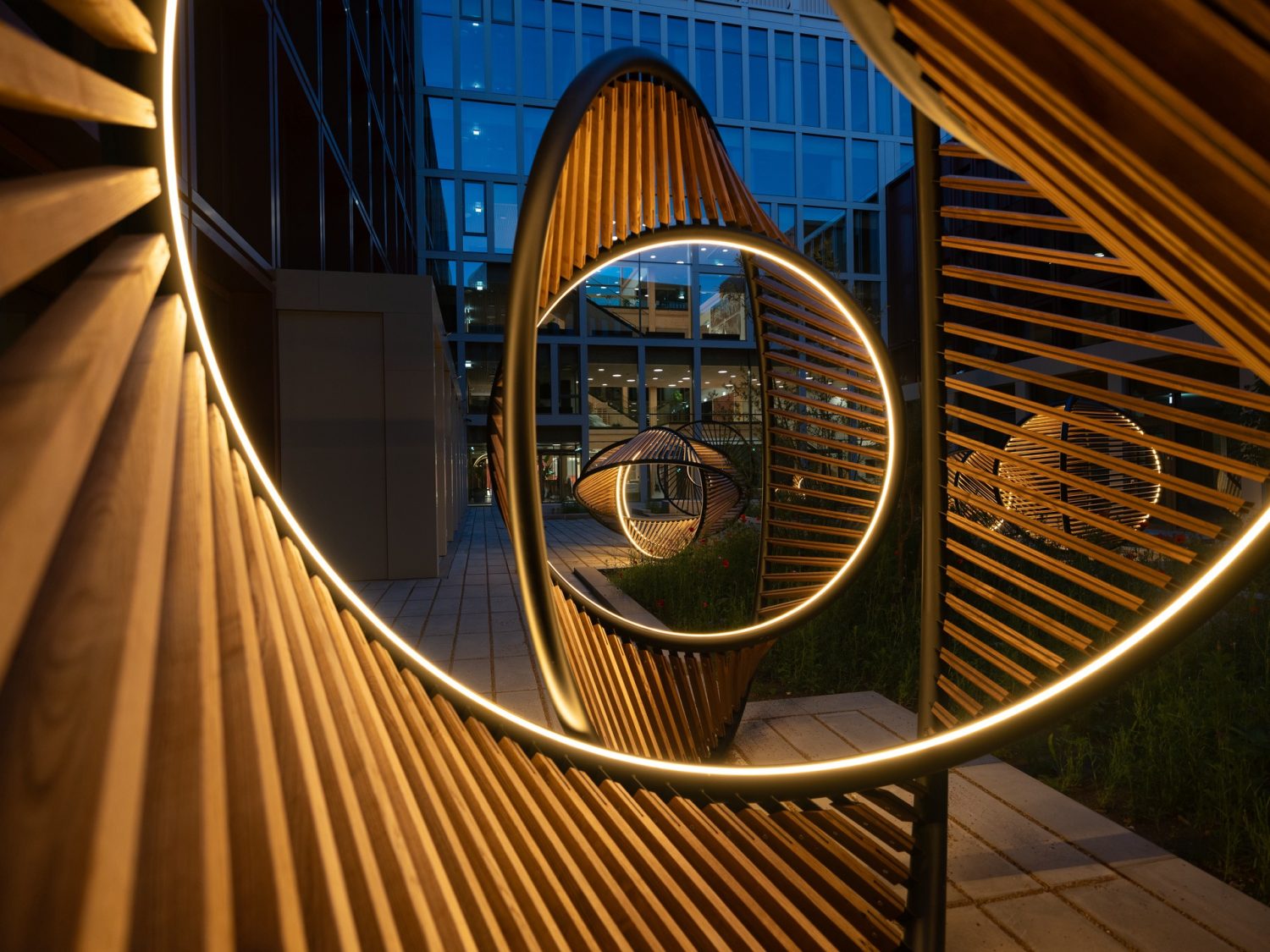
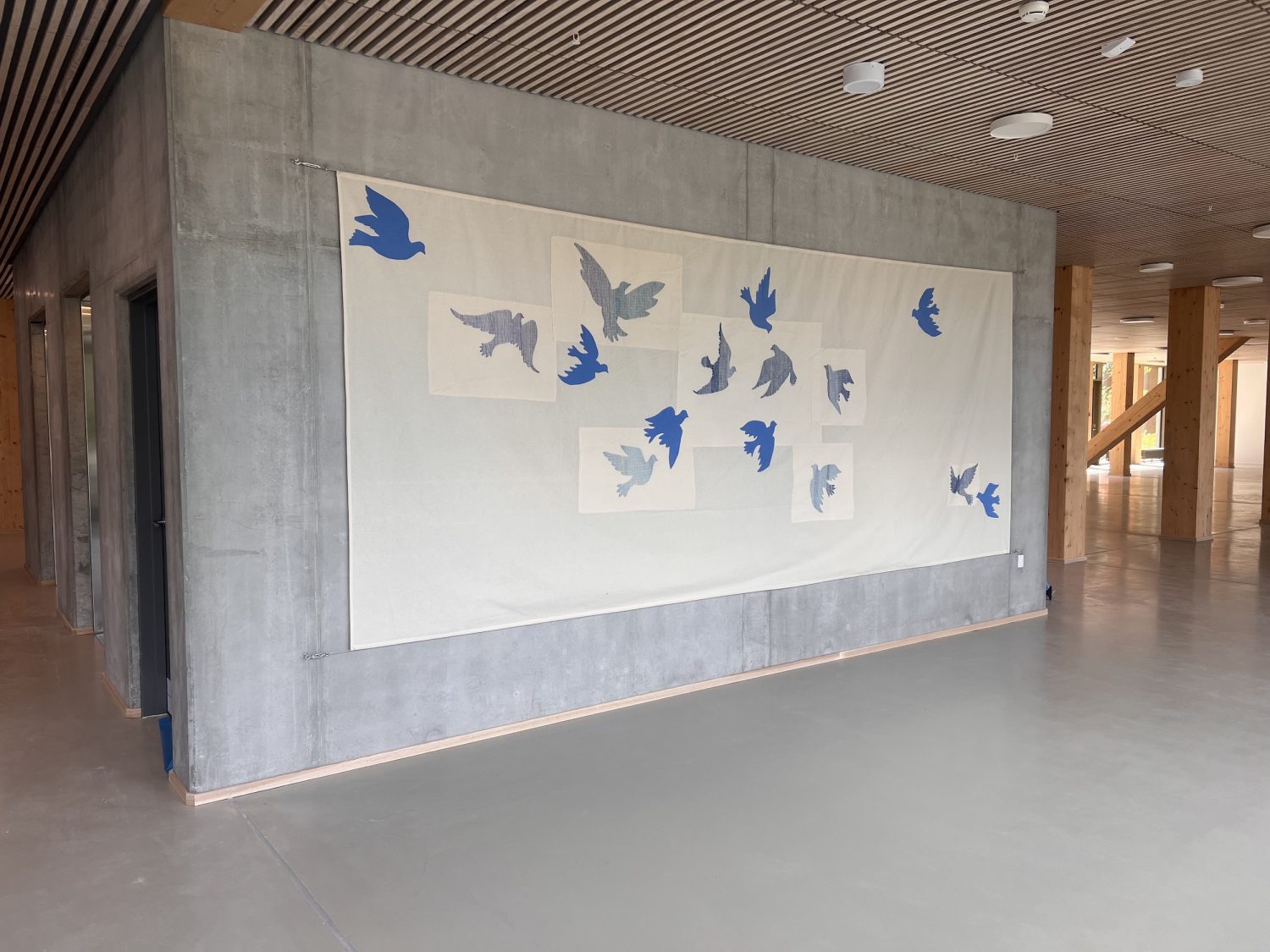
WoodHub in Odense is an example of how the Danish Building and Property Agency works with art. The building itself is out of the ordinary. The load-bearing structures are made of timber, and the office building, which has 1,600 workstations, is adorned with a wide range of artworks created specifically for these unique surroundings. Some of the art can be enjoyed by anyone entering the publicly accessible courtyard, whilst other pieces are only visible to staff moving through the communal areas.
‘It’s a major project, so we collaborated with an art consultant from the Danish Arts Foundation. Through an open call, we found 11 artists who are either studying at or have graduated from the Funen Art Academy. It was a site-specific challenge. Each was assigned a wall for which they were to create a work.’
An interesting requirement often set by the board is that the artwork must be accessible to everyone without any special prior knowledge. A work of art on or in a public building is seen by all sorts of people and, unlike visitors to a museum, very few of them have planned to look at art.
‘Of course, the work may well have an intention behind it. It should be possible to experience something if you give it your attention, but you don’t need to be an art historian to enjoy it,’ emphasises Jonathan Prochazka Fromholt.
Tastes may change, but the works remain
All works of art are products of the era in which they are created, but their significance may change over the years. The Building Authority does not remove works of art, even if the colour may no longer be in fashion and public taste changes.
‘The basic idea is that you build something that will be preserved for as long as possible. We do not move art simply because some people have grown tired of it. This places demands on durability at several levels. Some art created in the 1970s or 1980s may be perceived as less relevant for a time, but then perceptions begin to change again, and the art acquires a new status. We try to think long-term.’
Sometimes artists or craftspeople are given free rein to create their works. At other times, a creative framework is provided. For example, a university has requested a work that embodies the concept of wonder.
‘In that case, we at the Building and Property Agency have to work out how to incorporate this into the brief and create the best possible conditions for the work’s creation and execution.’
Jonathan Prochazka Fromholt refers to an example from Aalborg University, where the site and the art are closely intertwined. The artist Marie-Louise Andersson has created a sound installation consisting of three sculptures that can be activated by striking them with a hammer. The work is milled from blocks of aluminium and features free-hanging resonance plates. The form is inspired by three species of wild flora growing around the university. In this way, the work engages both with its surroundings and with the people who pause to interact with the art.
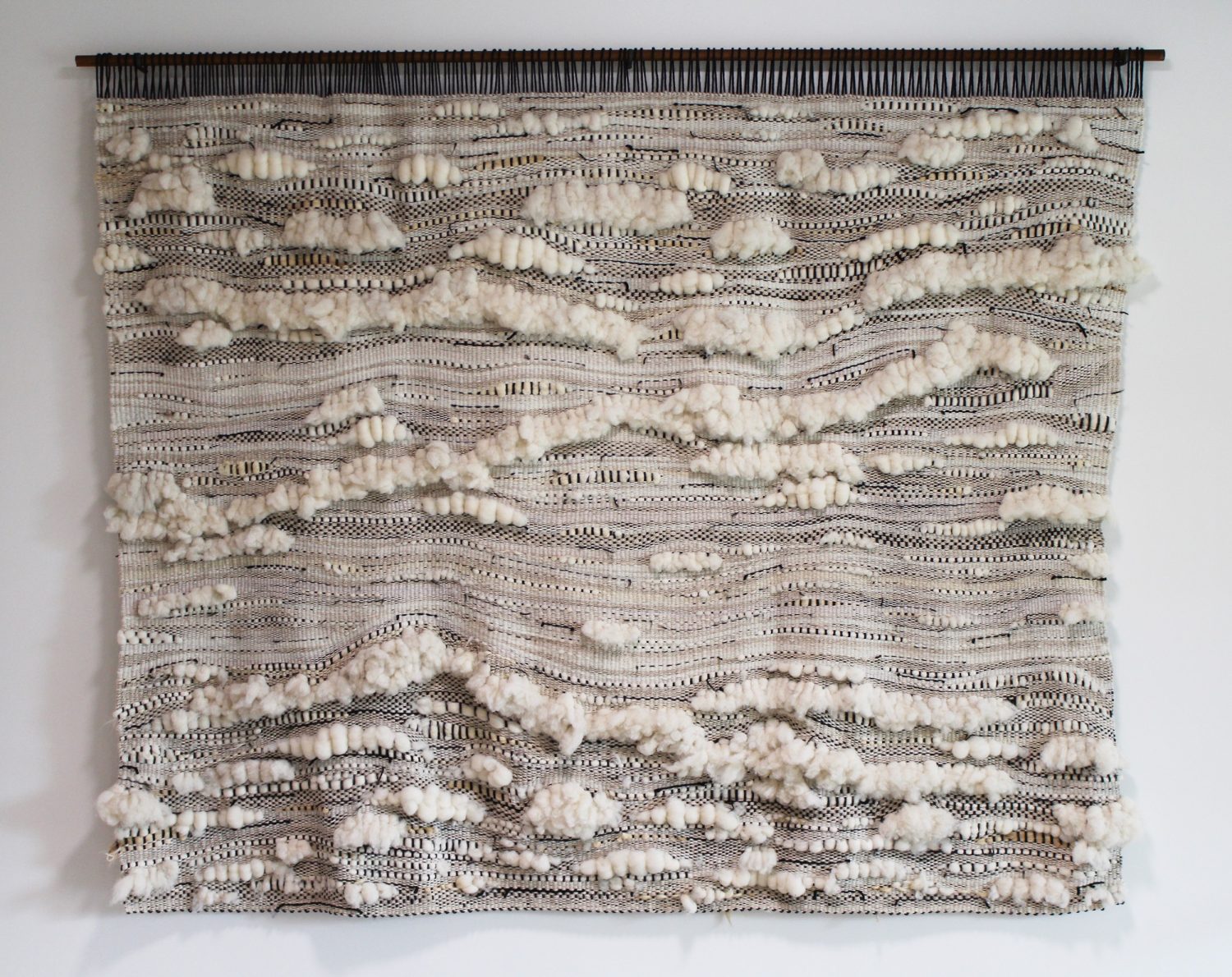
Could there be scope for additional collaborations?
The Ministry of Culture’s recent architecture policy includes, amongst other things, a call to prioritise beauty, care, craftsmanship, design and durability. Does this mean that, in future, there will be scope in government buildings for greater collaboration with artists, craftspeople and designers?
‘That particular aspect is already regulated in the Art Circular. It provides specific guidelines on how much money must be set aside for art in a building project, and stipulates that an art consultant must be appointed for projects costing over 250,000 kr. In many cases, art and craft can be intertwined and inseparable. We work with professional artists who create a wide variety of art, but we always place great emphasis on materials, craftsmanship and workmanship of the highest quality.’
Facts
Jonathan Prochazka Fromholt.
Senior Consultant at the Danish Building and Property Agency and Head of Art since 2019.
Graduated as an architect from Aarhus School of Architecture in 2010.
Woodhub
Read about the project and the selection process here
Theme: Places and Materials
In this theme, Formkraft explores how craft and design can help shape our environments: from materials and architectural details to landscapes, raw materials and global power structures. What unites them is an interest in how materials, design and craft can forge connections between people and their surroundings.
The space of possibilities: Perspectives on art, crafts and design in the public spaces and the built environment
