

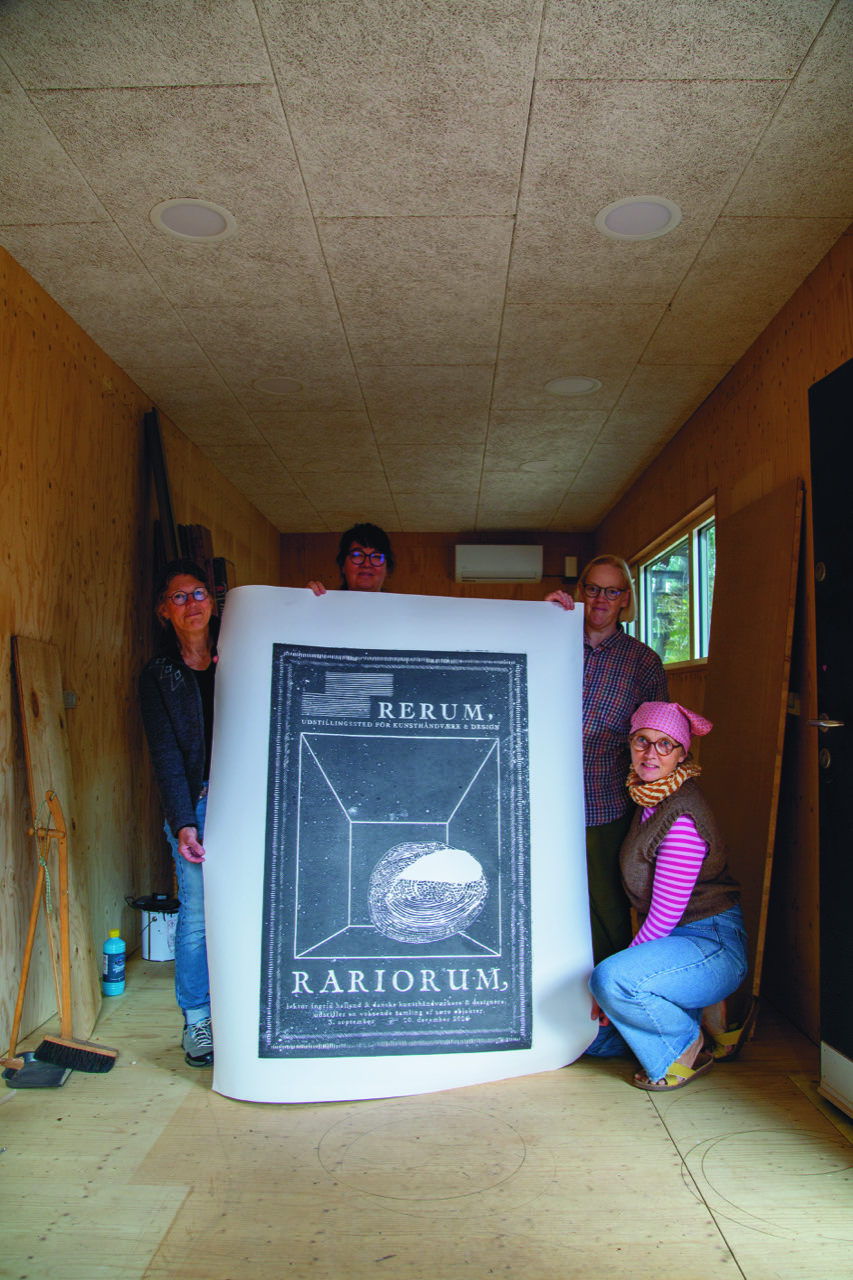
The initiative group consists of the board members of the Central Region: Karina Præstegaard, Gitte Jensen, Mona Kaae, Christine Urfe Bendt, and chairperson Rebecca Uth.
Anna Lena Raab, the research and curatorial assistant who works closely with Associate Professor and Curator Ingrid Halland, met with the group to discuss the idea and process behind RERUM, as well as the venue’s ambitions. The conversation centered, among other things, on experimentation, community, upcycling, and sustainability—as well as on the desire to challenge the existing hierarchies and categories that characterize the fields of crafts and design. The group also shared their vision for RERUM, and the values that form the foundation of the space.
Present at the conversation was Karina Præstegaard, a ceramicist who works with the materiality of clay and the artistic potential of the medium. Gitte Jensen, also a ceramicist, focuses primarily on functional objects. Mona Kaae is trained in both textiles and graphic design and works with textile printing and graphic design, including photogravure. Rebecca Uth is an industrial designer with a background in ceramics and currently works across the fields of graphic design and ceramics.
Anna: How did the idea for RERUM come about, and how have you gone about developing the project?
Karina: Several of us on the board have actually been working on this idea for a couple of years. Along the way, we’ve gained a lot of experience and, among other things, visited various places. We went to visit Dina Vejling in Odense, who runs an arts and crafts exhibition, and in Kolding we visited Galleri Pagter, which specializes in printmaking and ceramics. We’ve talked to them about their experiences, and we’ve also met regularly to discuss the project.
Anna: What made you want to create a space in Aarhus, and what do you feel is missing in the arts and crafts and design scene here?
Rebecca: The association has long had Officinet on Bredgade in Copenhagen. It’s very centrally located within the arts and crafts and design world, but it’s also at one of the most expensive addresses in Copenhagen. Some of us have exhibited there and found that people come from far away to participate. Of course, it’s great that we have that space, but we’ve also thought it would be cool to have something that was more local.
Aarhus is Denmark’s second-largest city and has a vibrant art scene with both galleries and, for example, pottery shops like Lertøj. But we feel there’s a lack of an experimental space for crafts and design. And, of course, it also stems from our own desire to have a place where we can exhibit our work.
Karina: We’ve always talked about wanting to create a space for community. It should be both a venue for experimental exhibitions and a tangible space that belongs to us—both as an association and as a discipline.
X offers a space for the quirky and cozy
Anna: And why did you choose the Institute for X in particular?
Karina: We went around looking at different places, including in Djursland, where we visited Skindergade 5 in Ebeltoft. There, you can eat, see exhibitions, and meet various organizations. That got us talking about how we’d like to create a place where you could walk in, have a cup of coffee, and look at art without necessarily feeling nervous about stepping into a gallery.
So we talked about how we’d really like it to be a cozy little spot like that. And then we were like: What? Are we going to run a coffee shop? Or are we going to find someone to do it? But then we started thinking about this area. If we’re located here, we can collaborate with and support the businesses that are already here. That way, we’d be supporting the person who runs the coffee shop, and it’s like we’re helping them by being here, while they’re also doing something for us by having us here.
I also already had a connection to Huggeormen, which is a workshop space for artists and artisans located right nearby, so I was already somewhat familiar with the area and the place.
Gitte: And then there was also a financial consideration. It can be difficult to finance a space in Aarhus—even a first-floor apartment or a space in a courtyard. It was quite a challenge.
Rebecca: But it’s not just about the practical side of things. It’s also about wanting to get closer to something that’s more grassroots-oriented. You also feel freer here. You don’t necessarily have to live up to the same expectations, and that leaves room for experimentation. It’s also important that this is a pilot project. It’s a place where we can try things out. There’s room here for something a bit crazier.
Anna: The first exhibition, RARIORUM, at RERUM, is about strange and peculiar things and is inspired by Ole Worm’s museum, ‘Museum Wormanium seu Historia Rerum Rariorum’ (1655). What do you mean by ‘strange things’ – both in relation to your own practices and to the venue?
Karina: I think you often fall in love with certain things in your studio that might just be a bit odd. Sometimes they can be exhibited, other times they can’t. They might not, in themselves, be ‘good enough’ to be brought into an exhibition space. But they’re actually some of the things you can be most fond of.
It might be a strange little contraption where you think: ‘Wow, that’s brilliant’. But what would you actually have to do to exhibit it? You might have to stage it in a completely crazy way. That’s why I think it’s brilliant to have this opportunity here.
Rebecca: But there’s also something strange about making things. Especially at a time when we’re so conscious of overconsumption and the environment. You might ask yourself: Why do we keep making more and more and just piling things on top of one another?
At the same time, it’s a fundamental human need to create, collect and make things.
Mona: I think about that too, the whole thing with objects. When you look at an object, it doesn’t necessarily have to serve a function. But it can spark thoughts you hadn’t imagined. That’s exactly what can happen when you visit an exhibition.
Something might not immediately mean anything to you, but you can come back to it. And when you see that same little thing – a piece of paper, a scrap or something else – again, it changes. Every time you return to it, you can see it in a new way.
Karina: It’ll also be exciting to see what others come up with. I imagine that many will probably bring things that are actually exhibition pieces, but it’ll be interesting to see just how varied the contributions turn out to be.
Breaking down boxes, categories and hierarchies
Anna: It could also be drafts or things that aren’t finished. And perhaps the objects take on a different meaning because they are placed in a new context and alongside other objects. In that way, there are no specific criteria for what can be included.
One aim of RERUM is to make more room for experimentation and less room for categorising what an artist, craftsperson or designer is. How is that reflected here?
Rebecca: I see it very much as a place where boundaries are blurred. We might have someone working in performance art, or someone collaborating with musicians or other art forms. That’s precisely what we’ve been talking about: bringing other art forms into play alongside craft.
I hope we’ll see more of that, so we can move a little away from the traditional. At the same time, there’ll be quite a few open calls, so it also depends on what we’re looking for. How open do we dare to be ourselves? And how much can we think outside the box that we all find ourselves in, in one way or another?
Karina: It’s also about giving our members the opportunity to exhibit. There are so few places where you can exhibit, so the venue should ideally be open and inclusive.
Gitte: And especially venues that are specifically for craft and design.
Karina: I also think it’ll be exciting to see if some of those who usually exhibit at large, established venues would like to be here. That could be fun.
Rebecca: Because there are hierarchies within our own field too, after all. Who’s talented? Who gets recognised? It would be great if we could also help break down some of those hierarchies.
Rerum for recycling
Anna: The word ‘Rerum’ is Latin and means ‘things’ – specifically ‘things’ in the genitive plural. Sustainability is also a key consideration for you, which, amongst other things, can be linked to the ‘Re’ in the name. What do sustainability and recycling mean to you and your practice?
Karina: There’s really a lot happening in this area these days. Take clay, for example: you can crush it and fire it very briefly before reusing it. In the past, people might have said that a maximum of 25 per cent recycled clay could be used, but now you can pulverise it so finely that you can actually reuse much more of it. It’s exciting, but of course it’s also a huge task. Several of us are certainly keeping an eye on what’s happening.
Rebecca: We’ve also made specific decisions regarding exhibition equipment. As far as possible, we want to borrow and reuse items rather than buying new ones.
Karina: We’ve actually talked about drawing up a list of what people have in their workshops, so we can borrow from one another. That way, we can reuse the things we already have.
Mona: I also think you can hardly avoid keeping sustainability in mind. It’s always in the back of your mind. When you’re putting on an exhibition, you also think: What do I already have? Can I build on something I already have? Can it be used in a different context?
Karina: And that applies to the space itself, too. We could have built a completely new unit, but we were lucky enough to find something that could almost be used as it was.
Rebecca: At the same time, it’s also a bit complex, because we’re a professional group that’s already used to living and working in a relatively sustainable way. Most craftspeople focus on materials, resources and durability.
Karina: You can also look at your own mistakes. If something doesn’t work out, you can break it up and make something new. You don’t have to fire a ceramic piece if you don’t think it’s interesting.
Gitte: You can try out lots of things before it turns into something that has to be discarded. And then you can reuse the materials.
Rebecca: Most of the objects that are made are also things that people buy because they want craftwork. People buy craftwork with the expectation that it will last for many years – perhaps for several hundred years.
Karina: That’s also part of the care inherent in the craft.
Anna: I’ve previously worked theoretically with the concept of bricolage, which is inspired by Lévi-Strauss (1962), and it’s about creating something new from the materials and resources you already have at your disposal. I think it fits this place well. Because the space is very much about discovery and rediscovery. You might use old or analogue practices and techniques, but at the same time you’re experimenting and discovering something new. How do you see it?
Gitte: I think that’s right. It’s inherent in the space itself. You have to work in an analogue way, and in doing so you can rediscover certain things. How can you do something differently? Can you put on an exhibition in a completely new way? That’s also something I think the space should be used for in the future.
A shared space
Anna: Is RERUM primarily a place for other artists, or is it also intended for a wider community?
Rebecca: It’s difficult to define a target audience. Of course, RERUM, is also for people who are already interested in crafts. But all sorts of people drop by here. We get homeless people, young people, local residents and all sorts of others. I think it’s really healthy for us to be thrown into encounters with a different audience. The people who are already interested in crafts will find us anyway.
Karina: So it’s both about bringing people together within the association and about opening the space up to the city.
Mona: Visitors don’t need any prior knowledge to see what’s here. Sometimes it can be difficult to walk into a gallery because you think you need a certain level of knowledge to understand it. It would be nice to create a place where you don’t have that feeling.
Karina: It’s something our members often ask for – that we can branch out a bit and bring different people into the association. You simply have that opportunity when you have a space of your own.
Anna: And can all members of DKoD apply to exhibit here?
Karina: Open calls will be for members, whilst the curated exhibitions will allow us to broaden the scope further. We’ll continue to organise curated exhibitions once a year. Here, for example, one could imagine inviting artists from abroad. It doesn’t necessarily have to be foreign artists, but it should be an opportunity to shake things up.
Mona: I hope that RERUM, will become a voice in Aarhus’s art scene. We’ve also talked a lot about collaborating with other institutions in the area, and that would be fantastic for Danish Crafts & Design Association. Just as Huggeormen has established itself and gained recognition, I hope that RERUM, can achieve the same significance. That people will want to be part of it.
Further reading
Behold,
Aarhus’s new venue for crafts and design, RERUM, is housed in a recycled shipping container at the Institute for X. In this essay, the Norwegian curator and senior lecturer Ingrid Halland discusses the curatorial approach, the first exhibition and visions for the venue.
