

Contemporary design, crafts and architecture have a strong interest in exploring and developing material properties. This focus is founded in the indisputable need to manage earth’s resources sustainably; a need that plainly and in a multiple ways relates to the major global and ethical question of how we understand and live with each other, other living beings, plants and raw materials.
Design, crafts, architecture, art and literature have the potential to make the big issues tangible, add nuance and promote development through knowledge and creativity while providing us all with an opportunity to achieve understanding through physical, sensory and relational encounters with experiments.
There are many interesting examples of this, from exhibitions at Officinet and major art centres and museums to student projects at the University of Southern Denmark, Aalborg University, the Royal Danish Academy and Kolding School of Design, just to stick to the present Danish context.
This essay discusses how two current exhibition projects performatively highlight our connectedness with other organisms and the sustainable management of resources and materials. Each in their way, the two exhibitions invite visitors to engage physically and conceptually with this major issue.
My purpose with this essay is to reflect on how they do this and what it may mean to be physically embedded and, so to speak, present in the material. Sensation, understanding and action are related.
This idea is also manifested in the new Danish craft residence halls , where materiality and sensuousness are driven by an intention to promote renewed respect for and interest in craft education. We also see it at the Wadden Sea Centre, where the first-hand encounter with the architecture is part of an experiential communication approach.
Facts
The two exhibitions discussed in the article are The Queen’s Cleavage at Munkeruphus in the town of Dronningmølle, which was shown from 13 April to 10 August 2025, and Build of Site at the Venice Biennale of Architecture, which is on display from 10 May to 23 November 2025.
Landscape and organisms
I have encountered the Swedish artist Ingela Ihrman’s works on a couple of occasions. The first time was in her exhibition Frutti di Mare (literally: Fruit of the Sea) at Malmö Konsthall in autumn 2023, where my immediate reaction was a smile and a bubbly feeling of joy at seeing her scaled-up anthropomorphic takes on seaweed, flowers and animals in the form of costumes and soft sculptures (when the costumes were lying on the floor in between Ihrman’s performances).
The title, Frutti di Mare, according to Ihrman, is a slightly tongue-in-cheek suggestion of a yearning for something warm, colourful and dreamlike and – like the Italian dish – something that, in her own Swedish context, goes beyond the humdrum reality of everyday life.
Some of the pieces from the Malmö exhibition were also included in this year’s presentation of The Queen’s Cleavage at Munkeruphus, but here, the display engaged in a dialogue with the landscape context around the art centre: Here, the sea off the North Zealand coast is a constant presence, offering the prospect of a walk through the wood to the beach at the Sound.
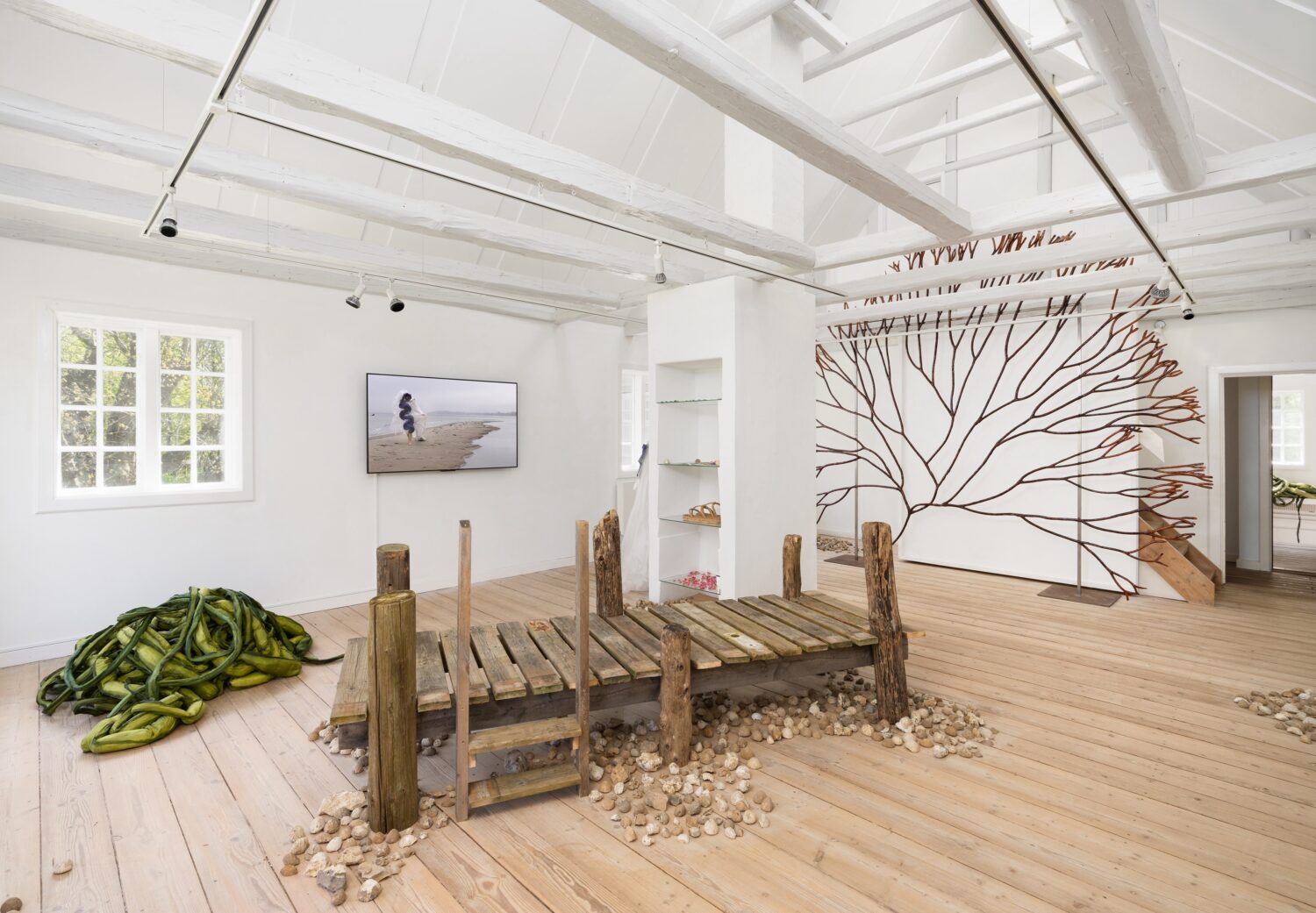
Ihrman’s goal of giving everyday life a twist that goes beyond the commonplace and predictable was also in play here, but it was experientially removed from the playful universe of Malmö Konsthall. Instead, The Queen’s Cleavage was a more closely contextualized comment on the connectedness between sea, nature and land-living organisms, centring on the way in which organisms simultaneously are landscapes and are in landscapes.(3)
The name of the exhibition refers to the Queen’s Gorge, which extends from the Munkeruphus building, through the wood and down towards the beach. As you walk through this area, the movements of your body are folded into the landscape, just as the landscape is folded into your body. In a video installation by Ihrman, Aphrodite is born from the sea foam of the Sound, and her body moves through the landscape and the building and rises up from the foam in the bathtub.
The body in the sea is related to the water in our bodies to the water in the tub – which brings us right back to the dreamlike, humorous and thought-provoking displacement of our everyday world in Ihrman’s work. At Munkeruphus, the video was part of a spatial composition with organisms (costume sculptures) such as Tarmtang (Intestinal Seaweed), The Flower Coral and The Giant Clam as well as an installation of the giant clam’s bathroom cabinet.
A pamphlet from the exhibition includes a story about Aphrodite, in which Ihrman’s artistic focus on capturing connectedness is expressed as follows:
The beach is something in-between. Both sea and land.
The foam is something in-between. Both water and air.
The sand is something in-between. Both liquid and solid.
Is Aphrodite also an in-between? (4)

Gut sense
While Ihrman’s art connects artistic fiction with an existing landscape, the Danish exhibition Build of Site at the 2025 Venice Biennale of Architecture takes a tangible approach in its exploration of the Danish pavilion as architectural body and materiality. The architect Søren Pihlmann curated the exhibition in the Danish pavilion at Giardini della Biennale.
In the book Making Matter What Too Often Does Not Matter, which was published in connection with the biennale, Pihlmann and the poet Adam Dickinson present the ideas behind site-derived architecture that is – sustainably – constructed from the existing materials and material traces found on-site. Materials are on loan to us, as they write, and architecture should be derived from the site by reusing, transforming and exploring the materials available there.
Build of Site is a 1:1 look into an ongoing renovation of the pavilion. The renovation is carried out by Pihlmann’s firm in collaboration with experts from the Technical University of Denmark, among other organizations. Thus, the pavilion has partially broken-up floors and a few missing windows, as the parts of the floors are temporarily used as spatial elements, including as spatially guiding partial walls near the entrance, as exhibits or as the subject of experiments in which material from the pavilion is crushed and mixed with different types of binders with a view to being recycled. A peek into an architectural material lab and an architecture ecology.
This working exhibition is a material manifestation of the pavilion as historical sensorium, where the different layers of the floors appear clearly, along with traces of the Venetian soil conditions, erosion and damage, in part due to recurring flooding of the area and the pavilion.
This sensuous encounter with architecture thus goes beyond creating a particular intended atmosphere through architecture. It is more complex than that, according to Pihlmann and Dickinson, because the historical layers and narratives about material relations in time and place are made accessible to our contemporary experience as well as future architectural treatment.
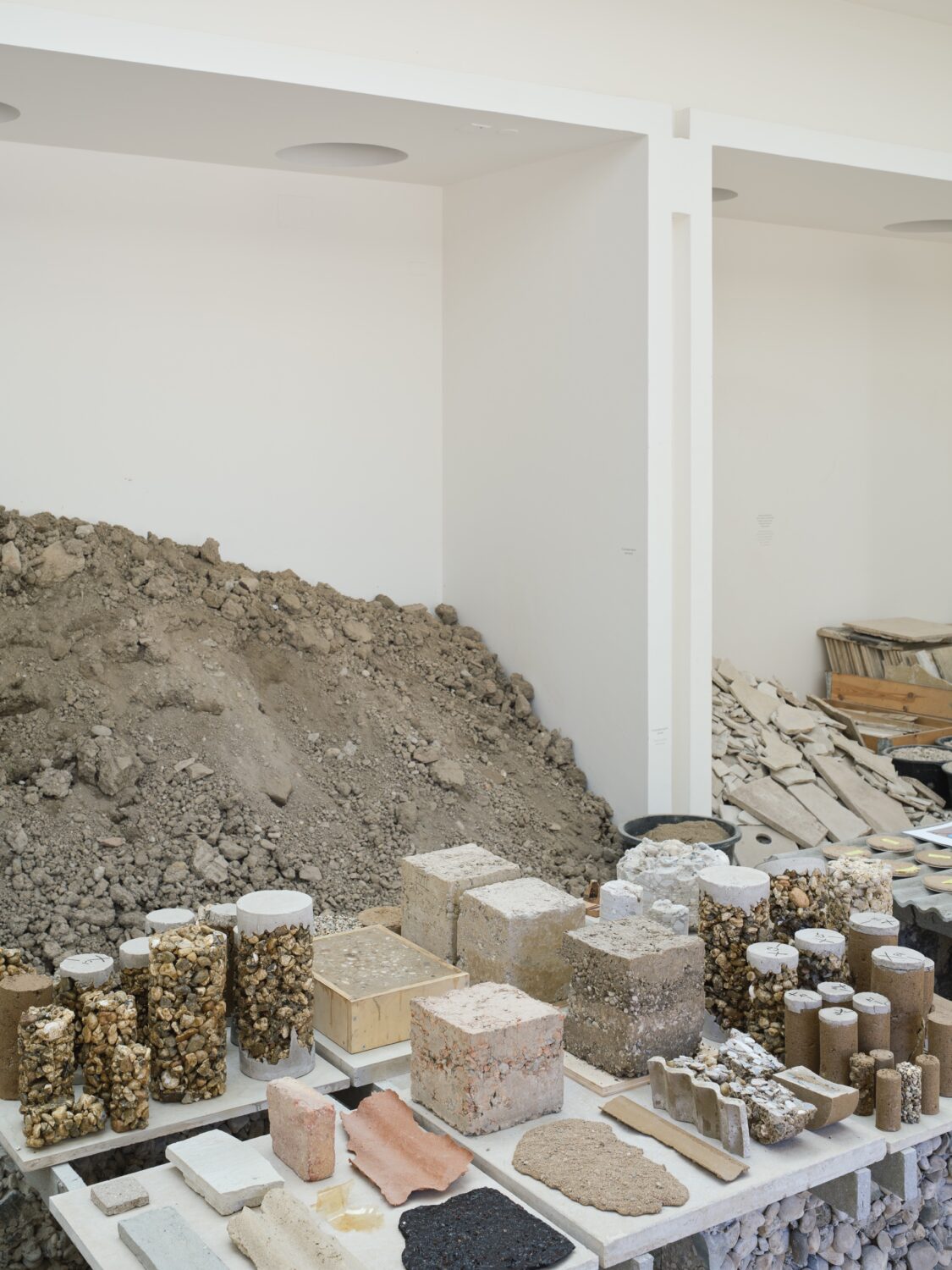
This inspires Dickinson (with reference to Donna Haraway’s book Staying with the Trouble: Making Kin in the Chthulucene) to reintroduce the term interoception about the architectural body: the ability to listen to the inner signals and stimuli of the body of the architecture:
Interoception refers to the capacity of a body to sense its internal signals. It is a form of perception at the conscious and subconscious level integrating information from internal organs and viscera with brain activity and behaviour. Broadly speaking, interoception encompasses the processing of sensory information from internal organs, tissues, and cells.(5)
In this context, the term refers specifically to being attentive to the ‘gut sense’ of the site, with architecture most aptly understood as a collection of nerve paths and an enhancer of material qualities.
Pihlmann, who has practical experience with this building approach from his work with Thoravej 29 in Copenhagen, among other projects, says that, in practice, it can be a challenge to make the materials, traces and properties available on-site connect and make sense in a new architectural treatment of a site. The friction between diverse materials and their properties imposes an obstacle and a challenge, but when everything suddenly comes together to form a new whole, the result may include new unanticipated qualities.
Reflexivity
Laurajane Smith is an internationally acclaimed scholar in the field of Critical Heritage Studies. She criticizes the privileged position that the fields of natural and cultural heritage typically attribute to materiality.
Material features, such as sites, buildings and objects, are often considered to hold intrinsic cultural-historical value, and there is a tendency for conservation discourses and regulations to freeze the identity and value of material elements, both in time and in a particular form. Smith argues that value should instead be attributed to the way in which people use, relate and reflect with material aspects.
From a critical cultural heritage perspective, Smith argues that the significance of sites, buildings and objects depends on how they are used and addressed in actions and discourses and how they represent broader humanist discussions of identity, gender, social conditions and so forth.
Thus, the significance of our material heritage also depends on how it may be said to embody abstract emotions and expressions that are relevant in their time and how it can help drive engagement through reflexivity.
In this context, reflexivity should be understood as the ongoing conversation we carry on with ourselves in our interaction with the world and which mediates how our individual backgrounds and situations influence our way of experiencing, understanding and engaging, for example in an exhibition.(6)
Smith’s perspective invites each of us to consider how our reflexive conversations play out on different levels, for example in our experience of one of the exhibitions I have presented here.
A key argument for increasing our focus on the human aspect in relation to – but not subordinate to – the material aspect is the relevance of considering whether (all) the right questions are being addressed or whether the material aspect might provide access to other, relevant perspectives.
This should be considered, for example, when a building at the Venice Biennale of Architecture is renovated according to the principles of regenerative architecture with a focus on material aspects or when an art project playfully puts the body, the landscape and the connectedness of organisms on the agenda at Munkeruphus.
Smith’s point is that the material aspect (for example a landscape, a building or a biennale pavilion) has its principal significance in the encounter with human reflection and emotions.
Notably, these reflections and emotions are inseparable from current conversations in society. We are not ‘blank canvases’ when we experience an exhibition, for example; on the contrary, we bring experiences and discourses with us into the encounter with materiality.
Build of Site is an almost extreme celebration of the significance of the pavilion (and of architecture) as materiality, all the way into the deeper layers of the ground. At the same time, however, the architectural body has been twisted out of its usual controlled composition and harmony through current discourses and agendas of regenerative construction and sustainability.
Instead, The Queen’s Cleavage taps into joy, variations in significance, interpretations of organisms and physical experiences of the landscape. Both exhibitions have the added strength of a verbal component in the form of a book, a pamphlet and meaningful concepts.
However, the reflections are there, whether you read the book or not. And according to Smith, we should aim to reflect with the material aspects.
Sources
1: https://ffhk.dk/om-fonden-haandvaerkskollegier
2: https://malmokonsthall.se/en/utstallningar/ingela-ihrman/
3: https://munkeruphus.dk/portfolio/dronningens-kloeft-13-04-10-08-2025/
4: Ihrman, I. (2025) Afrodite i udstillingspamfletten fra Dronningens Kløft 2025, uden sidetal. Afrodite er oversat fra Aphrodite af Lise Haurum.
5: Pihlmann, S. og Dickinson, A. (2025), Making Matter What Too Often Does Not Matter. Verlag der Buchhandlung Walther und Franz König & Danish Architectural Press, s. 36
6: Smith, L. (2021), Emotional Heritage. Visitor Engagement at Museums and Heritage Sites. Routledge

Theme: Various Bodies
Crafts and design are closely linked to materiality, sensuousness and the physical – both in the inherent qualities of the works and through the hands that shape them.
In this issue, Formkraft explores corporeality with multiple perspectives on bodies and materiality.