
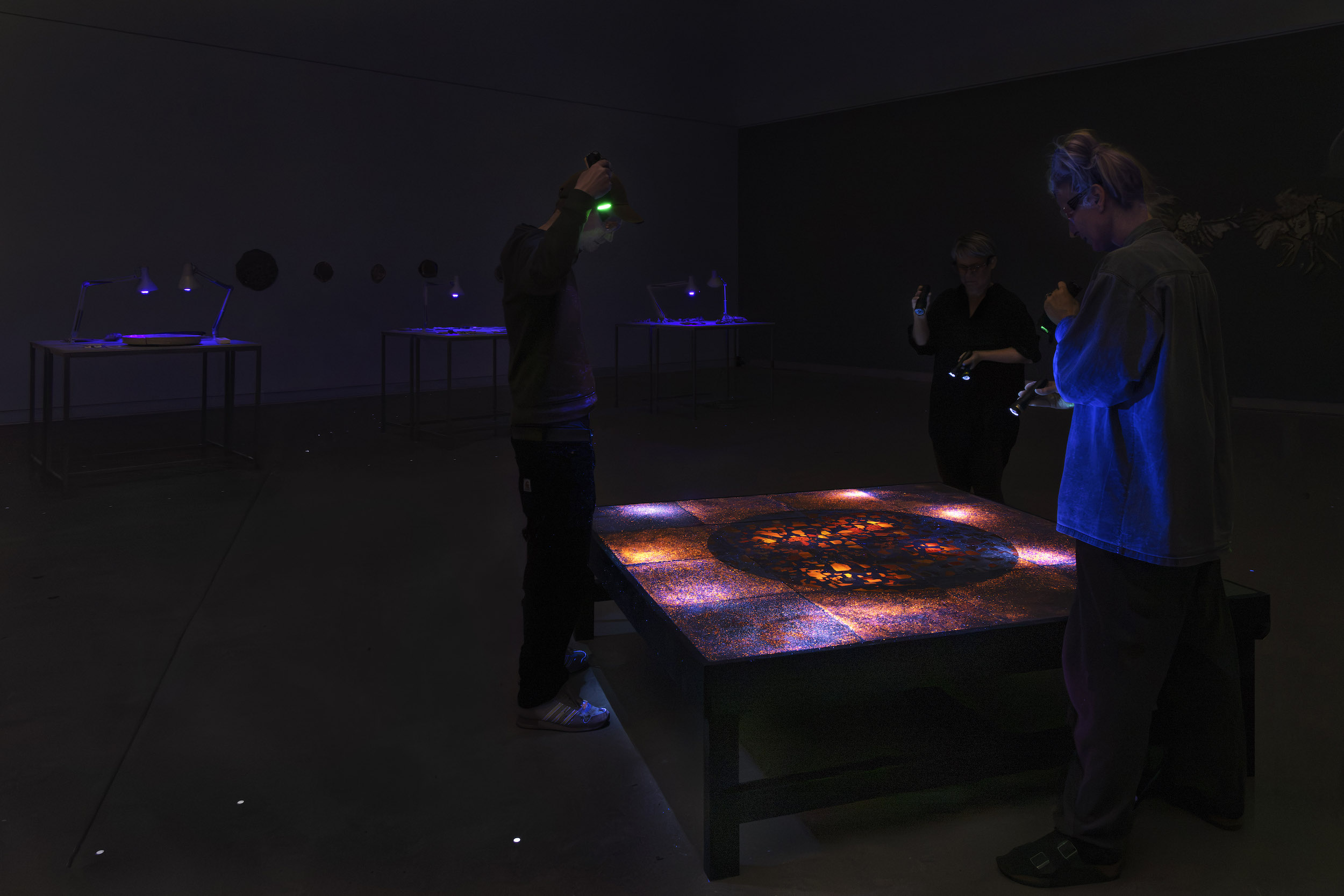
«Nature is just so, SO beautiful!» Nynne Hoe all but shouted. Flowers bursting with colour, autumn leaves in orange, gleaming metals. «But it wasn’t made for us».
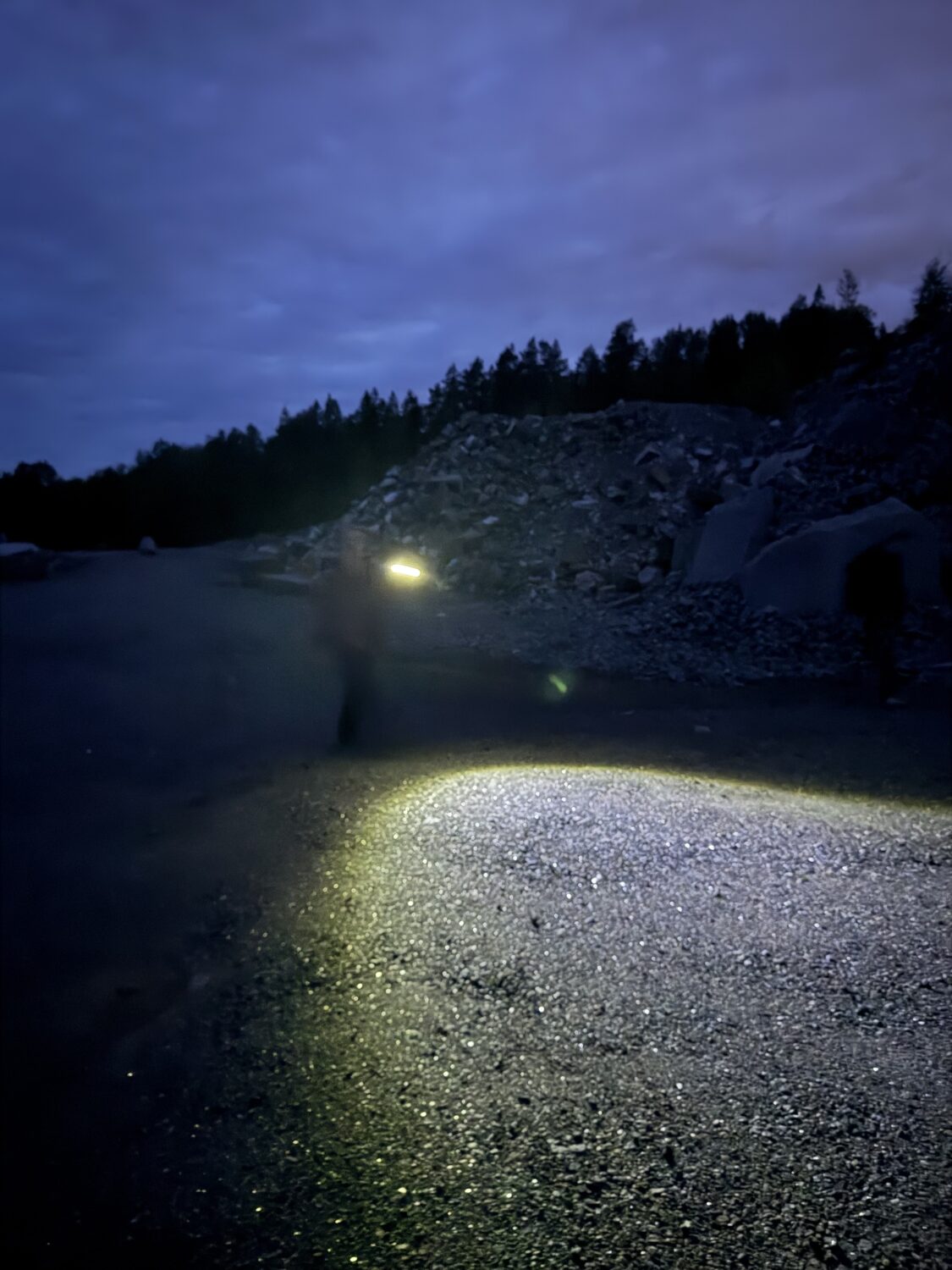
We feel our way through a pit of grey rock outside Porsgrunn, Norway. It is dark enough that the stones have lost their contours. «Look here!» comes from where Thomas Iversen is standing. He holds a grey stone in one hand and the UV flashlight in the other: «This one’s glowing purple!»
What we can see of our surroundings depends on our sensory apparatus. Bees can see ultraviolet light, and certain snakes register infrared radiation.
Fieldwork outside Porsgrunn, Norway. Photo: Kristian Grønevet/Kunsthall Grenland
Human sight gives access to a limited slice of these physical conditions. And what do the stones themselves see, if they could see?
What we can see of our surroundings depends on our sensory apparatus. Bees can see ultraviolet light, and certain snakes register infrared radiation. Human sight gives access to a limited slice of these physical conditions. And what do the stones themselves see, if they could see?
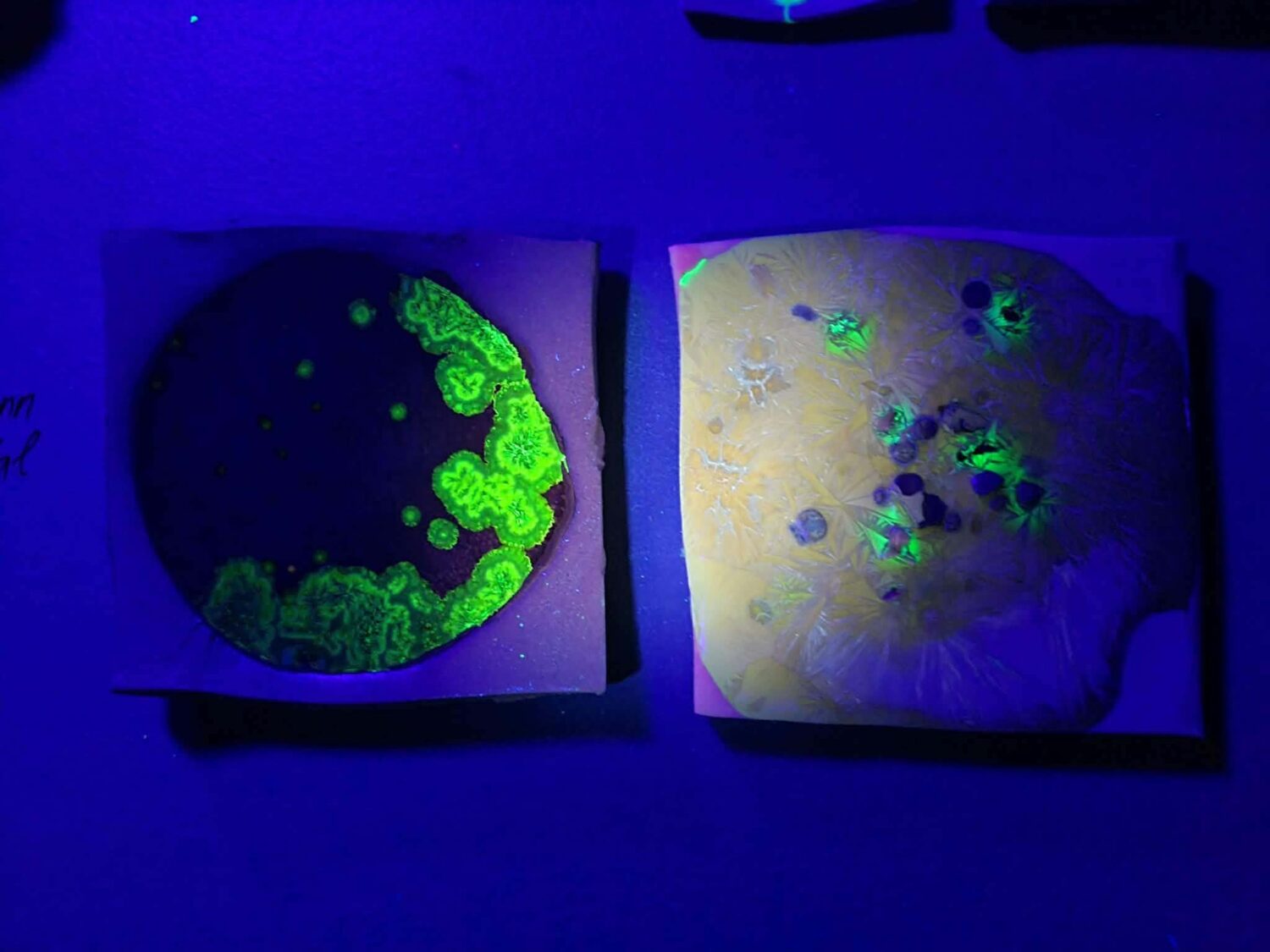
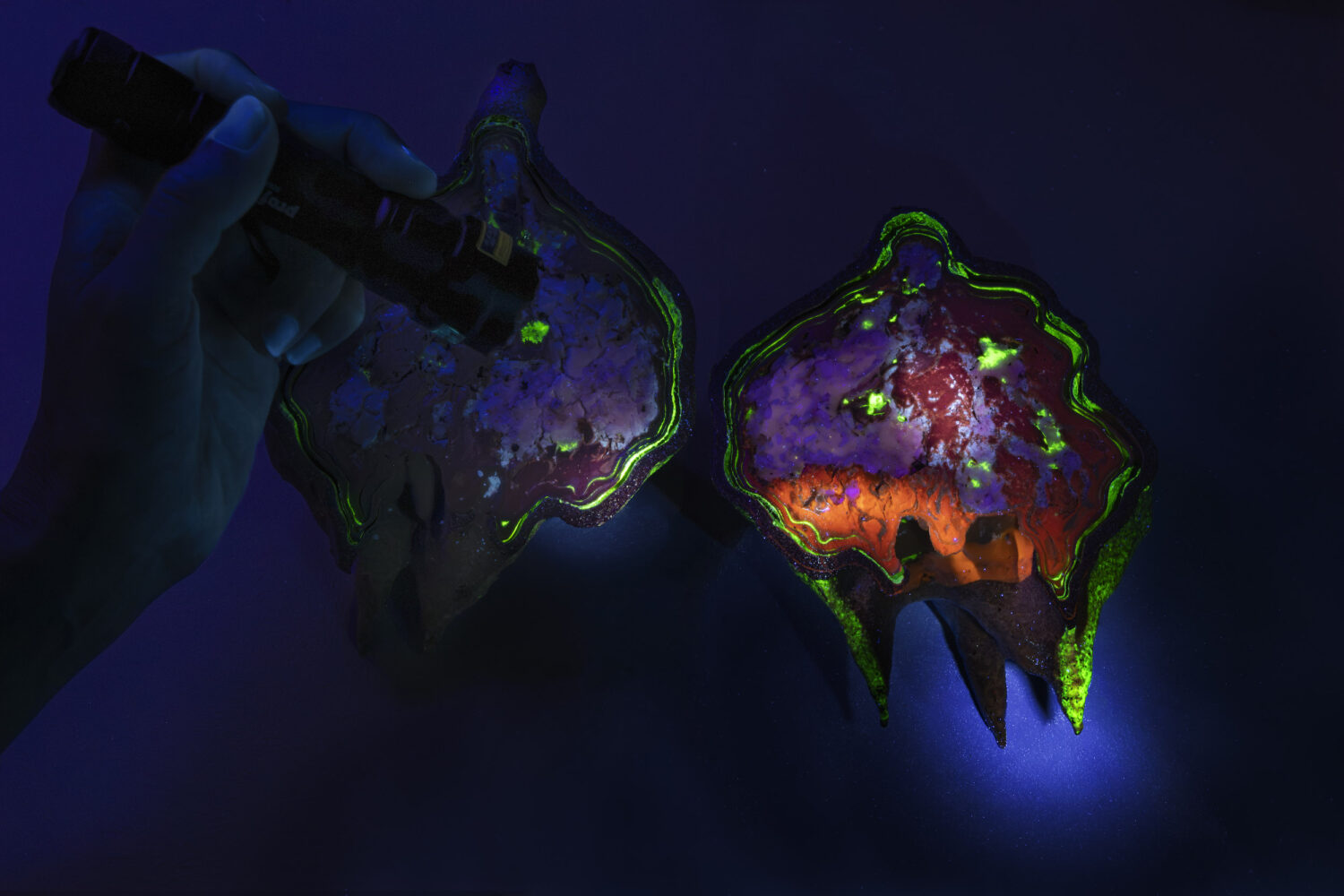
The three artists describe the working process behind the project and the exhibition LYS as almost absurd: three artists crawling around various rock heaps in Norway and Sweden to shine flashlights on stones. For under UV light, minerals in what we call grey rock can emit visible light. Many minerals can be fluorescent, among them sodalite, zircon, willemite, and fluorite. The phenomenon is even named after one of them: fluorite gave us the word fluorescence.
Ane Fabricius Christiansen: It started with Thomas reading an article on fluorescence in the magazine STEIN – Magasin for populærgeologi. We then got in touch with the Danish mineralogist Henrik Friis at the Natural History Museum in Oslo, and we’ve also been in contact with some wildly knowledgeable amateur geologists to learn more.
Thomas Iversen: The whole process has been a bit like when I was a child going on treasure hunts. Found a stick, a stone, a shell. I could feel it boiling inside me: I have to have that one, I have to take it with me.
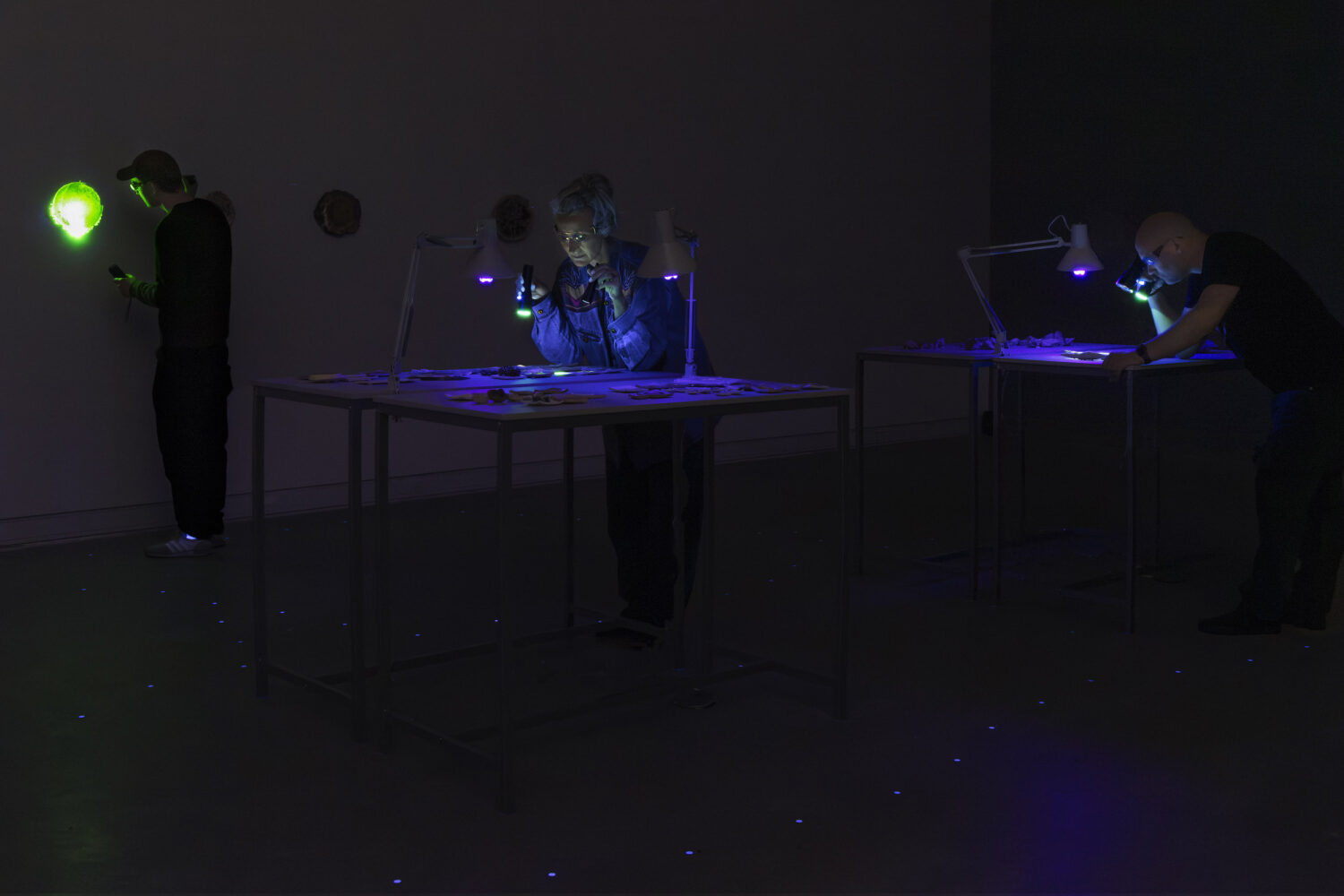
Ane: We’ve brought shortwave and longwave flashlights with us. Then we put on our black capes, over our heads, so that it gets dark. The project requires almost no science beforehand. The process has been a hands-on investigation of something we knew nothing about. But there has been so much that was unknown – it’s as if we’re feeling our way in the dark the whole time.
Fieldwork outside Porsgrunn, Norway. Video: Ingrid Halland
Darkness as Premise
The French philosopher Alain Badiou opens his book on the colour black, Black: The Brilliance of a Non-Color (2015), with the child who is afraid of the dark and of everything it imagines the dark contains. Hidden under the duvet, the child invents what is not in the room. For Badiou, black is bound up with the dream of becoming something else. Darkness makes room for imaginings of dreams and death, ghosts and trolls, and for forbidden desire. In LYS, darkness has a concrete function: the artists shield the materials from ambient light in order to make the fluorescence visible – and so dream their way into another world.
Nynne Hoe: Luminescent minerals open up a magical world that normally isn’t accessible to us, because we can’t see it with our own eyes – and that in turn opens up a colour palette we don’t normally have access to when we work with minerals and clay. So we’re outside the usual gaze, and that’s liberating – and a little childlike – it activates a new kind of approach, or curiosity.
The use of darkness and artificial light has a long history in art. Many prehistoric cave paintings were made far from daylight. They were seen by the light of flaming torches or fat lamps, which could lend the figures an impression of movement. Lighting was thus part of the conditions under which the images appeared.
Ane: LYS takes the viewer straight into our working process. We haven’t known how to work with the materials we’ve found. Fluorite and sodalite glow wonderfully under UV light – until they’re fired. So sometimes you have to go back to the start.
What if life on earth was able to emerge on land precisely because the world is paler – for us? One precondition for biological life developing outside the sea was the membrane that blocks the sun’s UV light.
Thomas: The atmosphere stops UV light from the sun. We get a little UVA, longwave, but UVC – the kind that makes the most minerals glow – is removed. So you can think of the earth as a UV isolate in space. Through the development of new technology, we now know that colour is something entirely different for the majority of the universe. If the ozone layer weren’t there, the real light would have changed our perspective on the earth – and in fact made it fairly uninhabitable.
Nynne: The sea is a membrane like that too. The colours disappear the deeper you go, until none are left. The deepest parts of the ocean lie entirely outside human perception.
In LYS the artists investigate a different connection between lighting and colour: UV radiation makes certain minerals emit visible light. The fluorescence is harder to discern in daylight, which is far stronger. The exhibition turns this difference in lighting conditions into an artistic mode.
«What is missing from both snow and white is the rainbow», Badiou states in Black.[1] He explains that white can be understood as a sum of colours we do not distinguish individually. White light can be split into a visible spectrum, but usually appears as a whole. Darkness, by contrast, is manifold.
The Blind Spot
Giorgio de Chirico’s painting The Seer (1914–15) shows a faceless mannequin contemplating a work of art, seated on a wooden pedestal. The mannequin occupies the viewer’s position, with a human-like body without a face. Among the surrealists, such figures were linked to what Sigmund Freud called ‘the uncanny’: the experience of something familiar appearing strange. André Breton and the surrealists explored how dreams and unconscious processes could challenge the habitual perception of reality.[2]
In LYS, too, a displacement of the familiar takes place. Under UV light the grey rock takes on an appearance that breaks with what we expect of the material. The surrealists sought the unconscious; another reality – a blind spot in reality – which they could never actually reach. What if the blind spot in reality is not an uncanny Other, a mannequin in human form, but ourselves?
Nynne: The UV light makes the grey stones a bit punk – it’s glam, it’s the 80s – and so a completely different narrative possibility opens up. But I’m drawn to this light because I become so curious about what it’s communicating. Why does it exist at all? Who is it communicating with? Clearly not with humans. And that makes me relieved, humble, happy on the earth’s behalf. It reminds me that we are not at the centre, because we don’t understand it at all. This light isn’t for us; we can’t see it without developing technologies that translate the language.
Although the artists can control the lighting, they do not always know how the minerals will respond until they try. The experiments thus yield results that can alter the premises for the work that follows. In his major work Being and Event (1988), Alain Badiou uses the term ‘event’ for a rupture with a situation’s established order and knowledge.
Ane: It exploded inside the kiln – because I didn’t know in advance how the minerals would behave in the firing.
Outside the Human
Badiou points out that the English expression «to be lost in the dark» links darkness with a lack of knowledge. Light – as a symbol of knowledge – has a long history in Western thought. This connection also offers a way into Michel Foucault’s concept of ‘the unthought’: when Foucault set out to describe the distinctive features of the modern epoch, he asked after the unthought. Which places and conceptions are regarded as inaccessible to thought? What lies outside the illuminated?
Nynne: I think it’s been wildly weird to make a work that is meant to stand in darkness. So what aesthetic criteria – or what criteria at all – am I supposed to rely on to feel that the work has succeeded? (Ceramics is probably known for being brown and beige, in earthy tones. But shine UV light on the same glazes, and they take on orange or pink tones, in a way.)
If one can locate the places, forms or conceptions of the unthought in a given epoch, one will, according to Foucault, find the essence of that epoch’s thinking. The form the unthought assumes in Western thought from the nineteenth century onwards Foucault calls a ‘double’, and he describes it as an ‘Other’ or a shadow.[3]
When man entered the modern epoch – which Foucault defines as a ‘field of knowledge’ – this shadow appeared as well. «The Other that is not only a brother but a twin, born, not of man, nor in man, but beside him and at the same time, in an identical newness»,[4] Foucault writes.
The unthought is «the shadow cast by man as he emerged in the field of knowledge; [it is] the blind spot by which it is possible to know him».[5] The shadow is near but foreign, and the task of thought is «to come as close to itself as possible».[6]
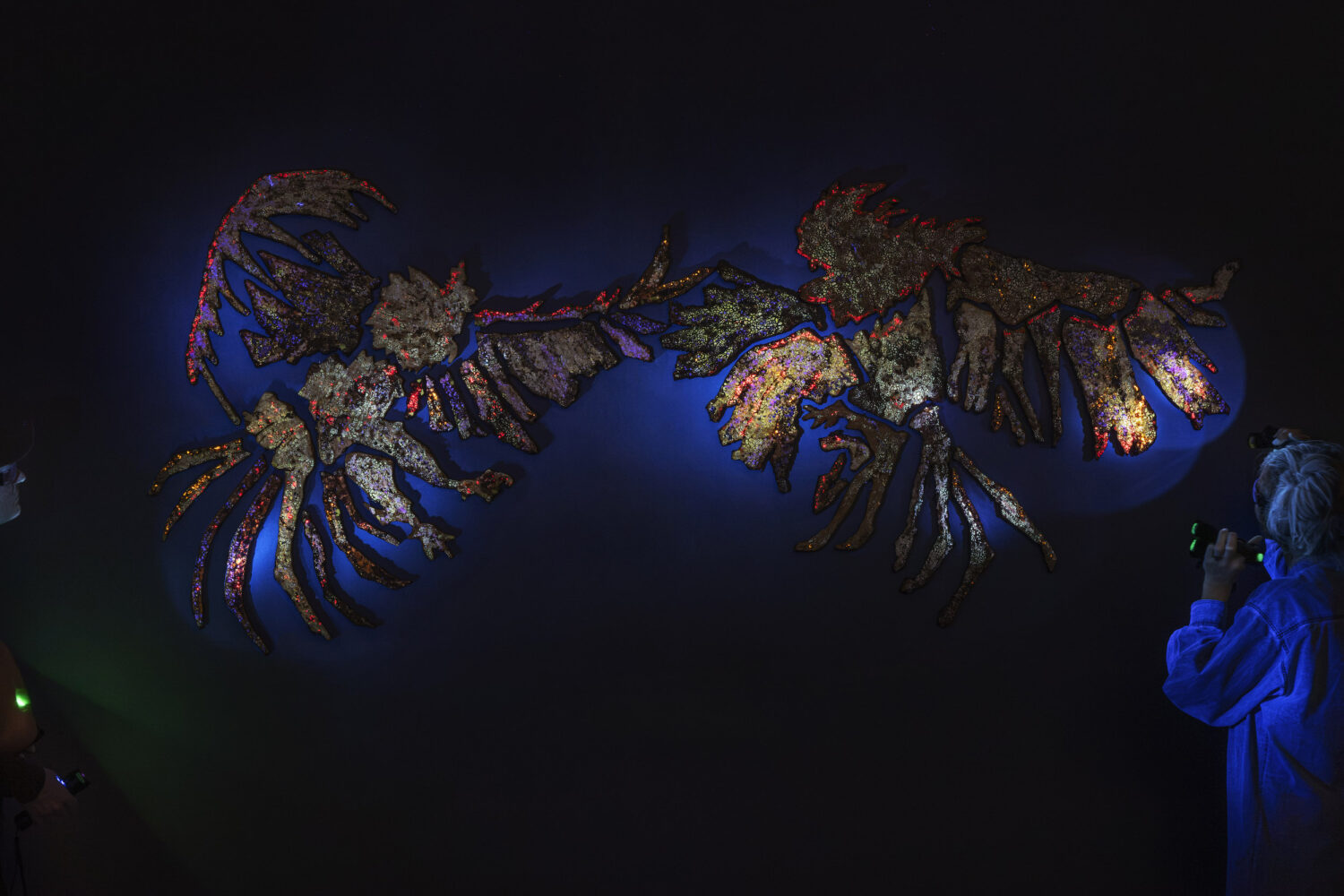
In LYS, the unthought and the Other are brought into an uncanny connection. But the kinship is no longer bound to the subject. The minerals belong outside us, side by side with us, in a sphere that neither mirrors us nor needs us. For us to see them clearly – to come as close as possible – specific conditions must be established: UV lighting, sufficient darkness, and materials that respond to the radiation. In this way LYS offers a concrete starting point for examining the limitations of our own gaze.
For we humans cannot cope with the blind spot. It is human to seek light; it is human to desire the unattainable. Yet, «man is an invention of recent date» Foucault asserted at the end of The Order of Things, before he added, «and one perhaps nearing its end».[7]
Thomas: UV light may have been a precondition for life arising – some believe it was UV radiation that set off the chemistry of the first life. But this light is also used to kill bacteria, so UV light can end biological life as well.
Ane: For me there’s an immediacy here, because it glows. It’s like looking at a fire; you’re naturally drawn to it. But this material also has something beyond aesthetic desire and curiosity. It stirs something to do with trying to grasp what it is and what it does, because there’s something ordinarily unnatural about it. It draws threads down into the earth’s interior and out to the cosmic. In these materials we have both our origin and everything that lies outside us.
Ethics and Aesthetics
For Badiou, darkness sets the imagination to work. «Black is, above all else, the colourless colour of fetishes»,[8] he writes. When it becomes difficult to make out one’s surroundings, imaginings and desire can shape what we perceive. In LYS, darkness forms part of a controlled lighting that alters both the appearance of the materials and the criteria by which the artists judge them.
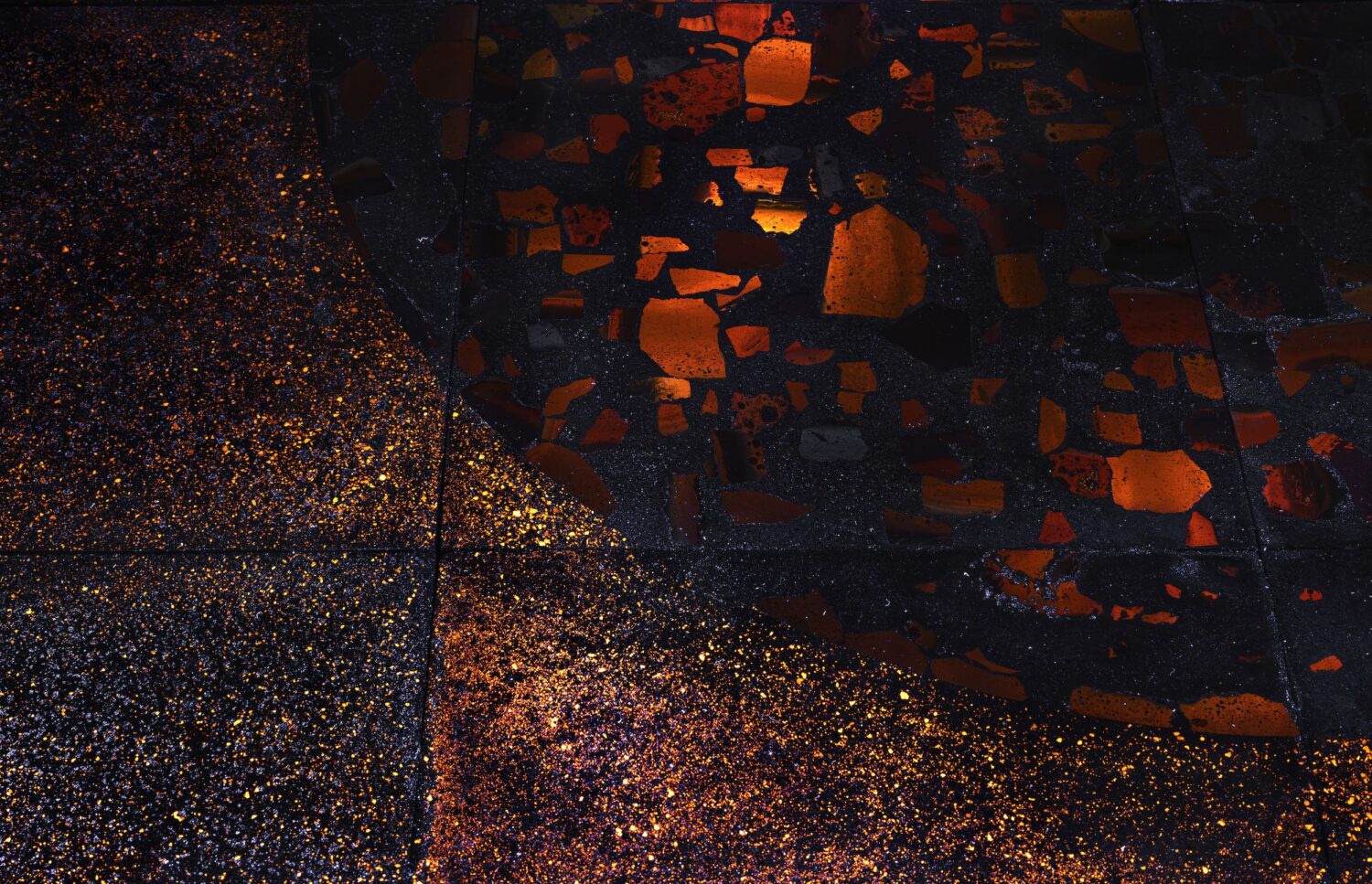
Nynne: But it’s not only the colours that lie in the light. It’s the light that is the form-giving element. That has been an entirely new way of thinking.
So far, the project LYS has been marked by trial, error, and new discoveries. But as a thread running through the project, the three artists have insisted on working methods that underscore the ethics of aesthetics.
Thomas: In my ceramic practice I control the process of producing my materials, and absolutely everything I use is made on a very small scale. When we stand in a mine and see the consequences of global mass consumption, or when I extract materials that are no longer commercially available – or never were – I get a different perspective on consequences and on my own role.
Nynne: The project LYS is an investigation into connecting us with our materials, with our planet, with one another in some kind of new understanding, because we’re standing in a time of change – in our thinking and our identity, too. One way or another, we have to attach ourselves to our surroundings anew.
Thomas: In the classic ‘trolley problem’ in ethics, three people lie on one track and one on the other, and you have to choose who is to be saved. There’s no time to brake; you’re forced to choose. But the track doesn’t end with those who are tied down – there may be more people further ahead. That’s why we have to slow down. We’re constantly placed in situations where we feel we have to choose, but there are always more possibilities than the ones we’re presented with.
Here attention shifts from a choice between given outcomes to the possibility of changing the conditions of the choice. In crafts, tempo and scale of production can be such conditions. The three artists stress that tempo is something one chooses, and that the choice has material consequences.
Nynne: In the time we’re living in now, humans have become stewards of the planet and of our life here. We have imperialized the world, and we’re left holding the responsibility. But to be able to look after our world, we have to catch sight of it – shift perspective, or shift our position in the narrative (and in the naming of the world). The earth just keeps turning regardless of what we do. And at some point it’ll go dark here, because the sun burns out, or whatever.
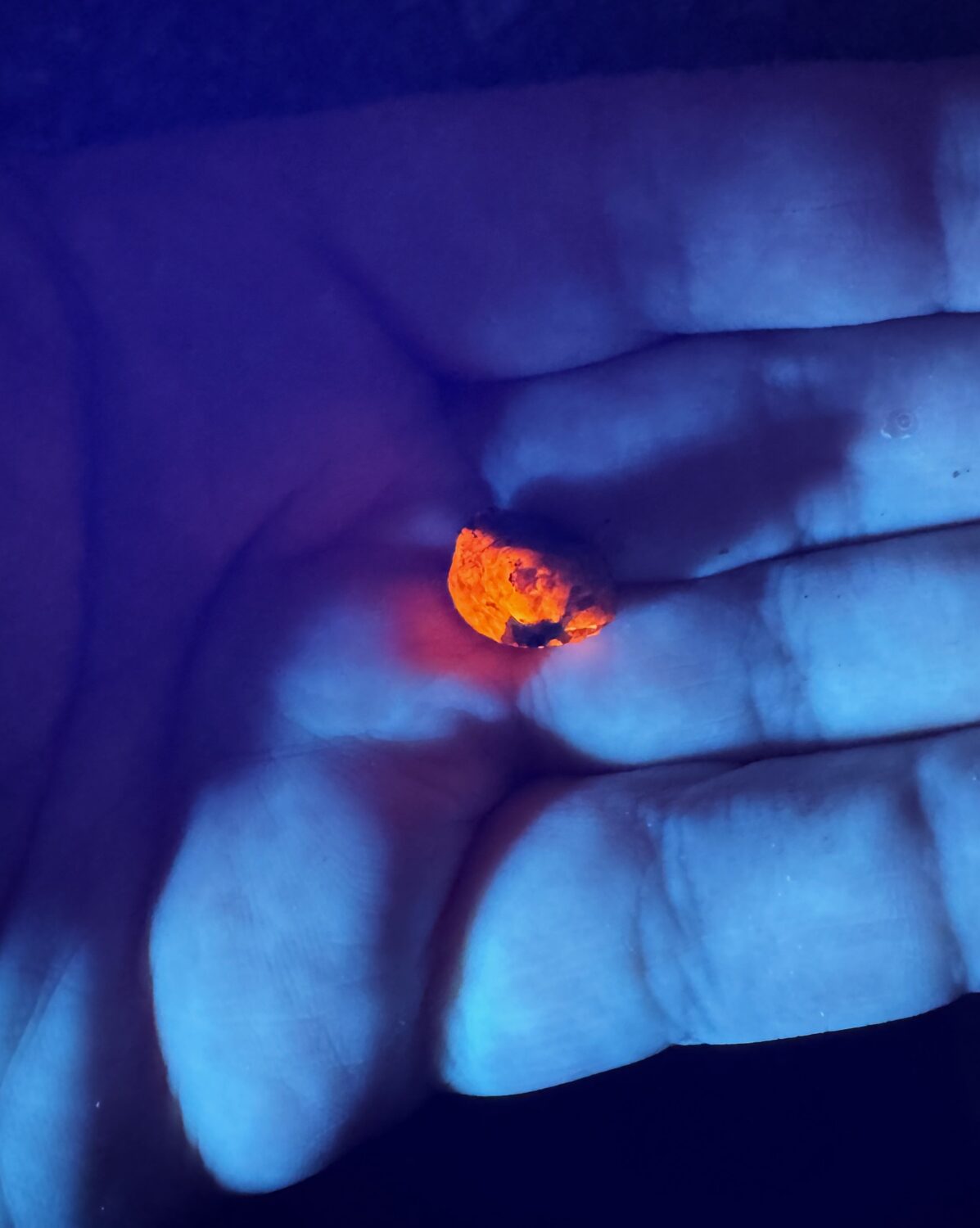
The stone Thomas held in his hand fluoresced orange under the UV flashlight. The property belongs to the mineral; perhaps it is a piece of the world that has never needed our gaze.
But the lighting makes it visible to us.
In LYS, this difference is the starting point for the artistic work.
Facts
The project: LYS: Fluorescent Nordic minerals
The exhibition: LYS at Kunsthall Grenland, Norway, from 26 September to 1 November 2026.
The project will be further developed and presented in a new version at the Observatoriebeholderen in Aarhus in September 2027.
Footnotes
[1] Alan Badieu, Black: The Brilliance of a Non-Color, oversatt av Susan Spitzer (Cambridge: Polity Press, 2017)[2015], 35.
[2] André Breton, Manifestoes of Surrealism (Chicago: University of Michigan Press, 1969), 16.
[3] Michel Foucault, The Order of Things: An Archaeology of the Human Sciences (London: Routledge, 1989), 326.
[4] Ibid.
[5] Ibid.
[6] Ibid., 327.
[7] Ibid., 387.
[8] Alan Badieu, Black: The Brilliance of a Non-Color, translated by Susan Spitzer (Cambridge: Polity Press, 2017)[2015], 30.
Sources
Alan Badieu, Black: The Brilliance of a Non-Color, translated by Susan Spitzer (Cambridge: Polity Press, 2017)[2015].
André Breton, Manifestoes of Surrealism (Chicago: University of Michigan Press, 1969).
Michel Foucault, The Order of Things: An Archaeology of the Human Sciences (London: Routledge, 1989).
Theme: Places and Materials
In this theme, Formkraft explores how craft and design can help shape our environments: from materials and architectural details to landscapes, raw materials and global power structures. What unites them is an interest in how materials, design and craft can forge connections between people and their surroundings.