Look, don’t touch.
That’s usually how it is when you walk into an exhibition space.
But in the spring, when Laura Astrup Larsen debuted her first solo exhibition at Officinet, that norm was turned on its head. With “Hudsult” (Skin Hunger), which was the title of the exhibition, she wanted to celebrate tactile experiences. So she filled the exhibition space with organic shapes and colourful glazes.
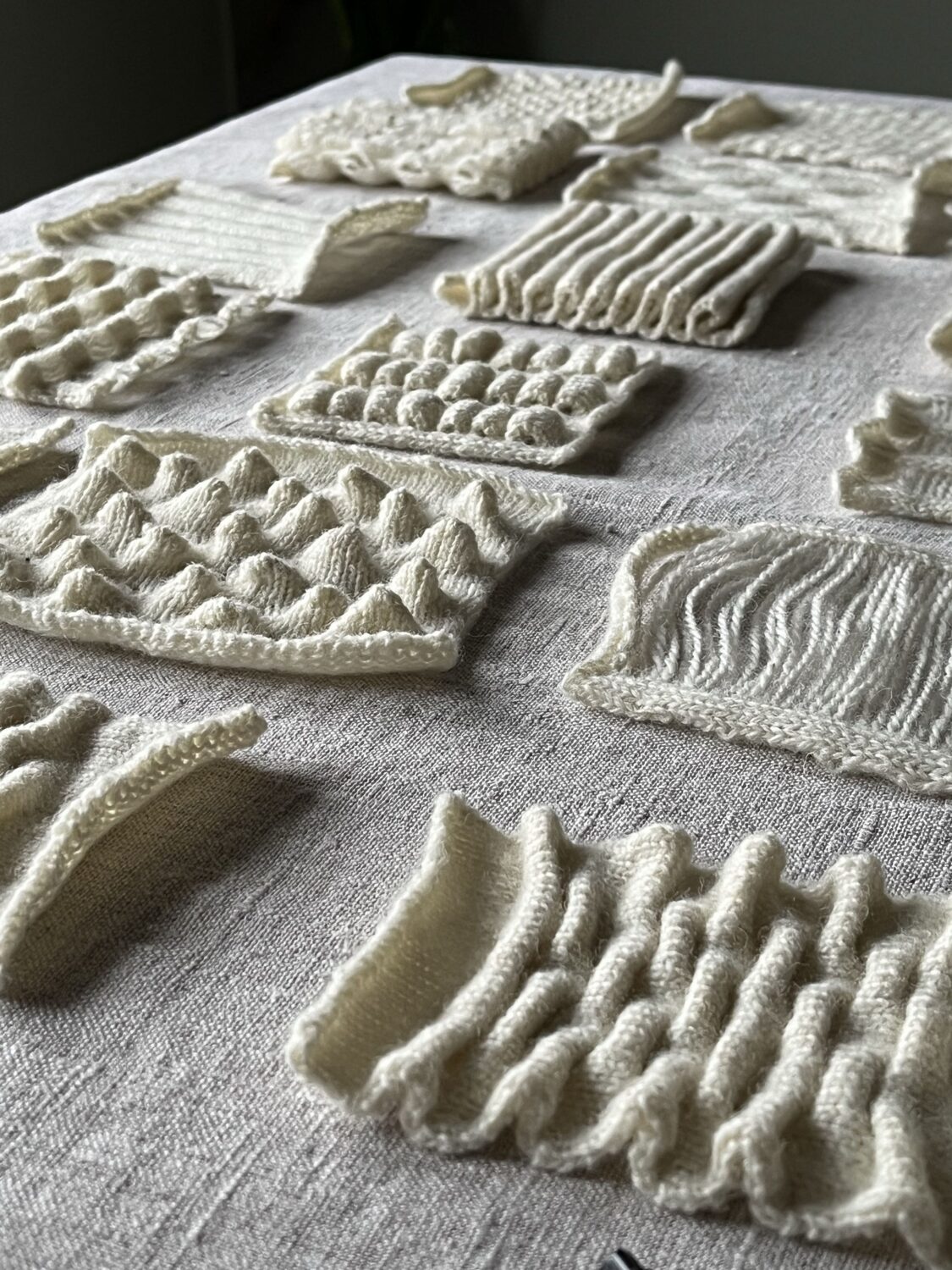
In Officinet, the Danish craftswoman had laid out a bunch of glaze samples on a table. Like little cookies with weird glaze.
As people walked past them in the exhibition space, they reached out, stretched their fingers, and then stopped themselves mid-motion. As if they suddenly became self-conscious and had to consider: Am I allowed to do this?
With Hudsult, Laura Astrup Larsen wanted to awaken the senses of a target group that she believes is too rarely addressed – us adults. At the exhibition in Officinet, everything had to be touched and felt.
‘It’s as if, as we get older, all our senses are cut off. And that’s a deprivation,’ she says when we meet in her studio in central Copenhagen to talk about arts and crafts that stimulate the senses.
And how, with works ranging from ceramics to glass and textiles, she wants to bring us into contact with the childlike curiosity that we all know so well. But which we, as well-behaved adults, have learned to hide away.

Bring out your fiddling fingers
Throughout the day, we experience countless sensations. There is the cup that fits comfortably in our hand, or the rug that is pleasant to walk on.
With her works, Laura Astrup Larsen encourages us to consider the impact materials have on us and to understand the importance of tactile experiences.
‘Sensory perception is so important because it gives us knowledge and understanding that we would otherwise not have access to,’ says Laura Astrup Larsen. She loves it when materials bear the marks of people and reveal their inclinations and habits.
Like a bronze statue that has become lighter in colour on the more private parts of the body, or a stair step that has become most worn in the middle because that is where most people have walked.
As long as you just look at things, your brain connects them to experiences you have already had. That way, you cannot experience anything new solely through sight, she explains.
‘And that’s why it’s so much fun when you experience a sensation that is different from what you expected.’
She believes in the value of small, sensory disturbances in everyday life. Like when opening a door feels different than usual. Or when you are allowed to touch all the works at an art exhibition.
‘It’s really exciting to see what happens when you’re actually allowed to touch things,’ says Laura Astrup Larsen.
‘You just have cooler conversations when you can pick up the works and talk about how they feel.’
Pleasure and disgust
Laura Astrup Larsen creates works that deceive the eye.
They look hard, but turn out to be soft, or they are completely rigid, even though they look as if they are about to float away.
This is entirely deliberate.
In this way, she highlights how much information we receive when our skin comes into contact with objects.
Just think about wearing a silk shirt or a cotton sweatshirt. The sensation is completely different.
That is why she has always prioritised including many different physical sensations into her works. There must be something to explore. With your fingers.

‘My intention has never been to create objects that are just meant to be looked at,’ she says.
If things are just pretty, we quickly lose interest in them.
‘I don’t want to just make pretty objects to hang on the wall.’
That’s why she doesn’t only work with sensations that evoke pleasure and comfort. She also works with disgust and revulsion.
‘These are fun techniques to work with because we can’t quite look away,’ she explains.
‘I think many of us are familiar with this: you’re on Instagram, and then some gross video pops up. It’s disgusting, but it’s also enjoyable.’
And without being able to fully explain why, it has captured your attention.
Childlike enthusiasm
Laura Astrup Larsen studied ceramics and glass at Konstfack in Stockholm, and she also has a bachelor’s degree in industrial design from Design School Kolding and Willem De Kooning Academy in the Netherlands.
During her bachelor’s degree in particular, a lot of the work was done on the computer.
‘Digital technology played an incredibly important role. Sketching and modelling were often done on the computer. As a very sensory person, I felt almost deprived of something.’
Her process often starts with a collage, where she cuts out different shapes. Especially from underwater books – ‘they are simply the best!’
But something happens when she actually gets her hands on the material.
‘The sketch is a good safety net for me. Because then I know that my ideas have potential. But the really exciting part is when I finally get my hands on the materials. That’s when I start putting things together in completely different ways than I had first imagined.’
When the body is involved in the process, small, happy accidents can occur.
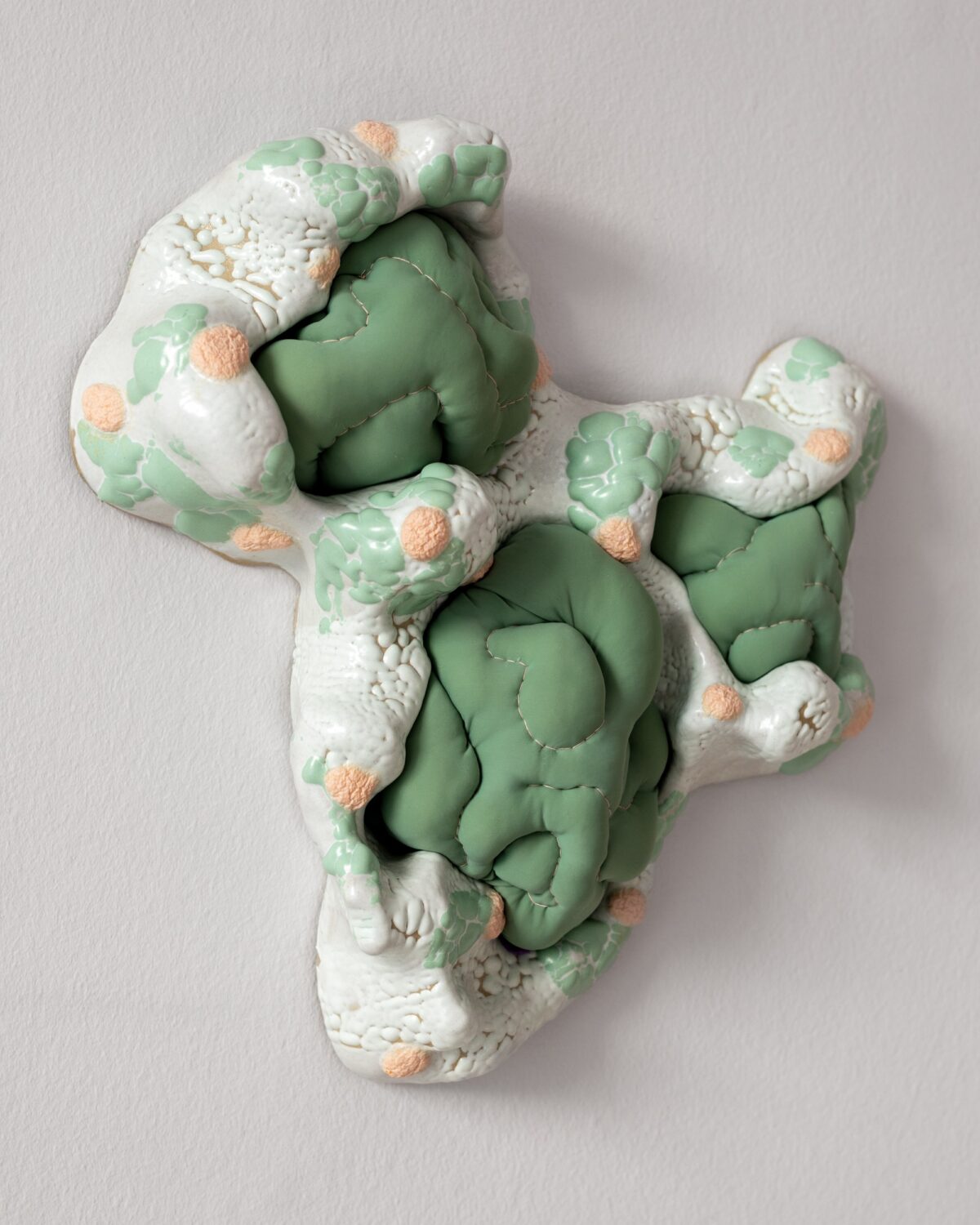
In her works, Laura Astrup Larsen likes to take qualities from one material and transfer them to another.
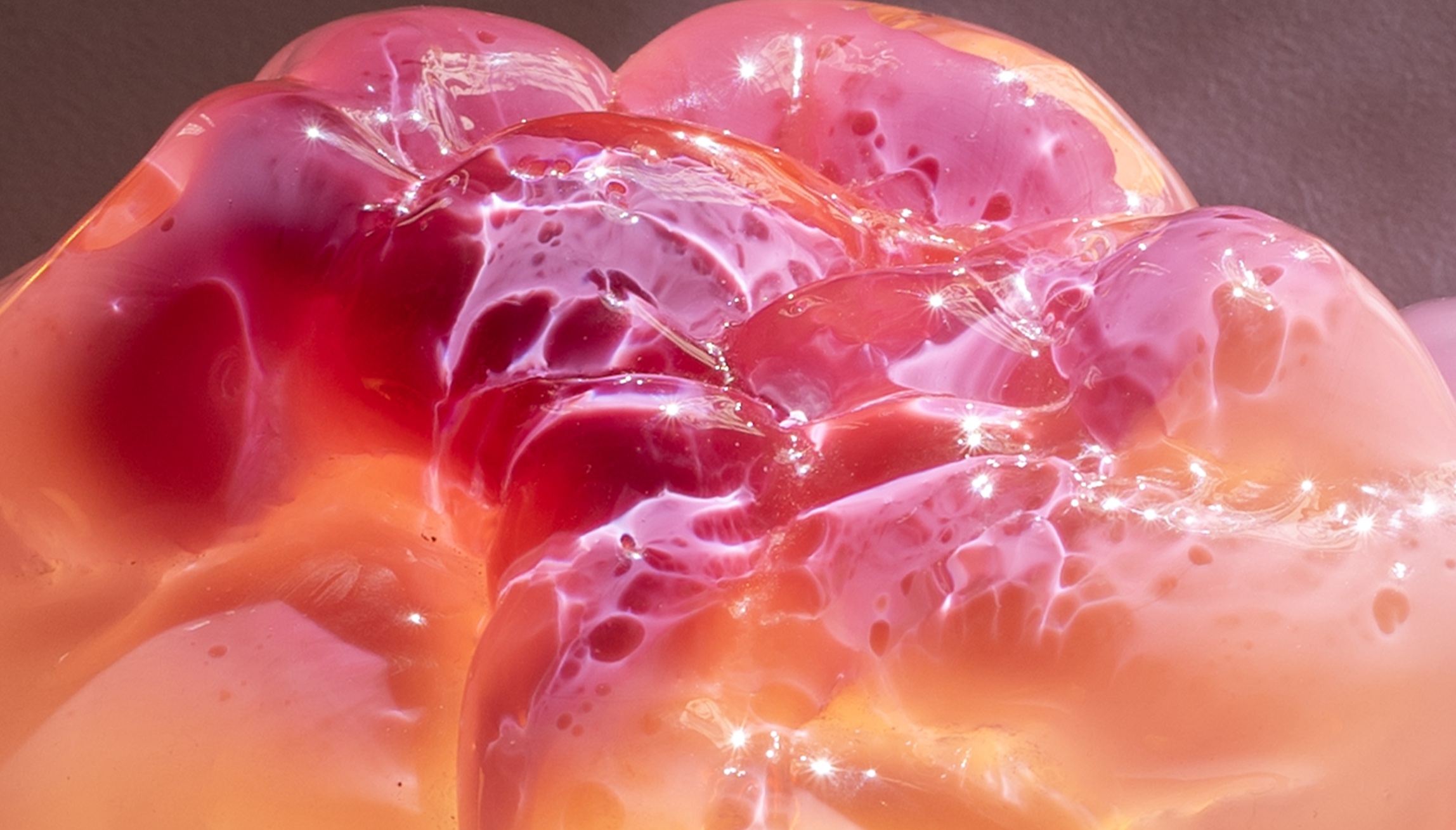
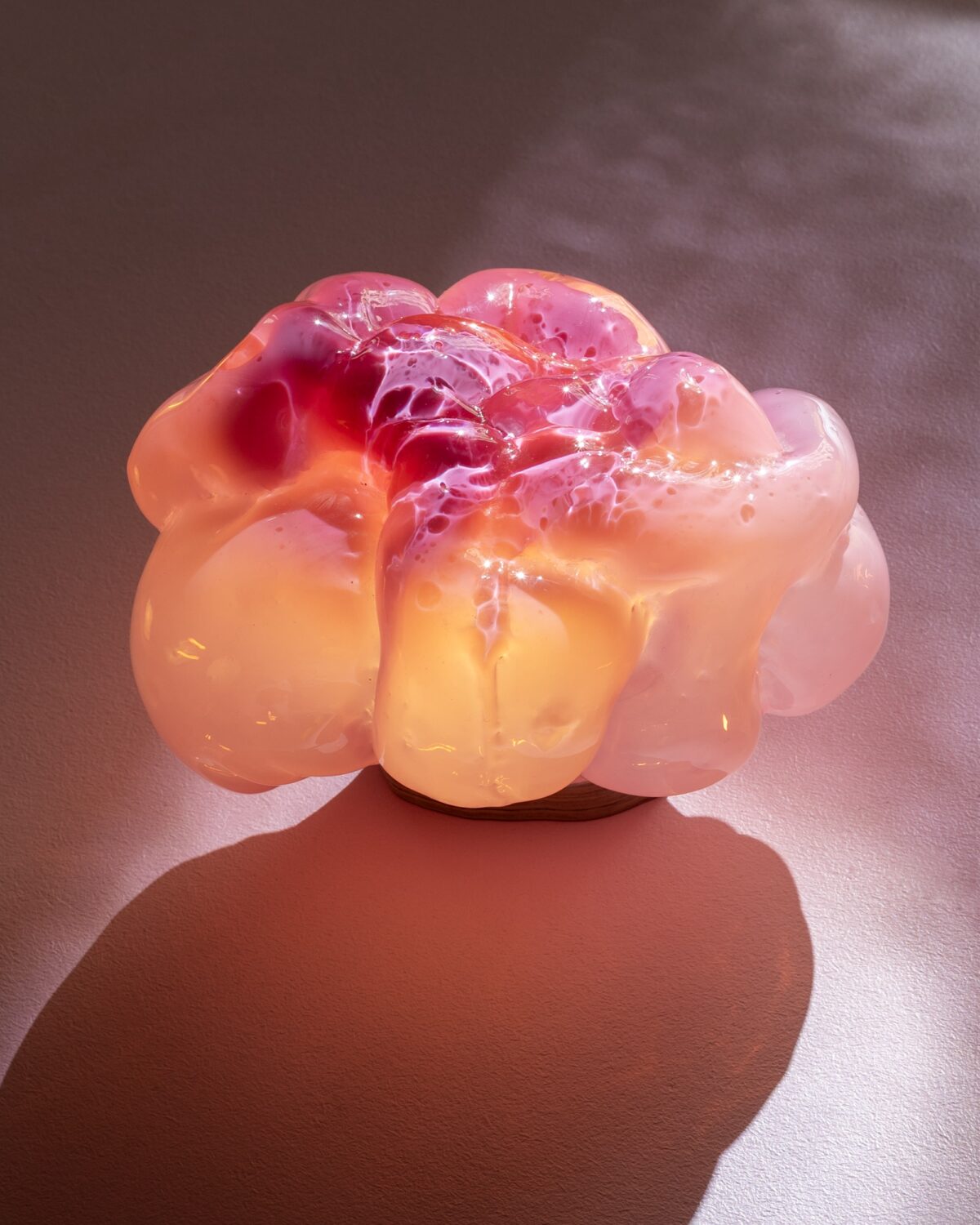
She mouth-blows glass into a cast of a textile object. She lets a piece of glass melt over a colourful frame created in ceramics. She embroiders on Lycra, which bubbles out of an organic form in stoneware.
‘I really like combining different materials that speak the same language but have completely different qualities.’
At Officinet, Laura Astrup Larsen exhibited a work that contained a dented mirror. ‘Organism on Wall. White with red underglaze,’ was the title of the work, which sent distorted mirror images back to those who looked at it.
It sparked great excitement. People began to play.
Actually, it’s a rather banal device, Laura Astrup Larsen reasons.
‘But it’s quite fun to have. We so often pack away the sensuality that comes with our childlike curiosity.’
‘I understand why you’re not allowed to touch most exhibitions. But I think it’s a real shame!’
About Laura Astrup
Laura Astrup Larsen was born in 1996 and lives in Copenhagen.
She holds a master’s degree in CRAFT! Ceramics and Glass from Konstfack in Stockholm and a bachelor’s degree in industrial design from Design School Kolding.
Laura Astrup Larsen has received several awards and recognitions, including from Ung Svensk Form, Kvadrat and Svensk Färgcentrum.
In the spring, her first solo exhibition, “Hudsult”, was on display as part of NYE TALENTER 2025 (New Talents 2025) in the exhibition space of Danish Crafts & Design Association, Officinet.
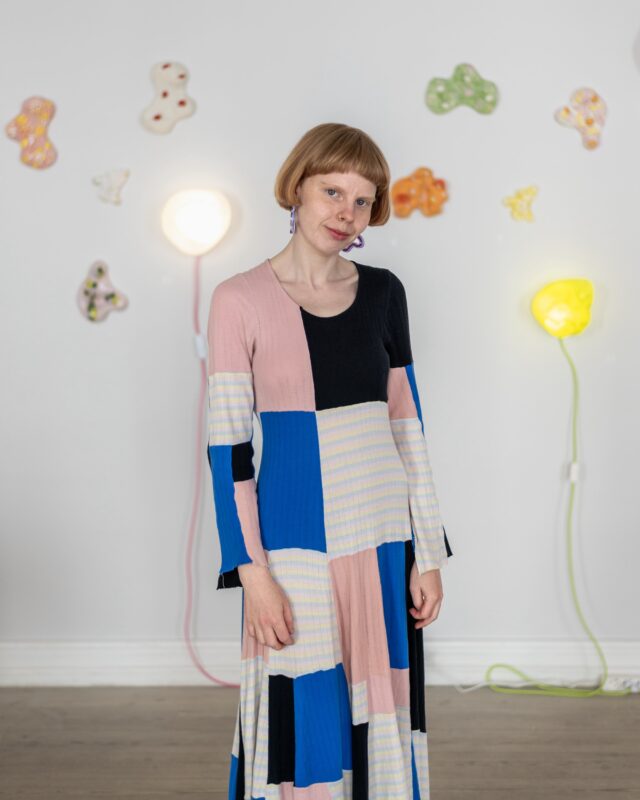
Portræt af Laura Astrup Larsen. Fotograf: Malthe Emanuel.
Theme: Various Bodies
Crafts and design are closely linked to materiality, sensuousness and the physical – both in the inherent qualities of the works and through the hands that shape them. As a counter-movement to digital technologies, which are developing at the same speed as a Japanese high-speed train, we are seeing a growing interest in crafts, materials and techniques.
Further reading..
Sustainable future through sensory revolution!
Can a sensory approach to the world be a way to create care for what surrounds us? Textile design student Signe Rødkjær Griffin explores how sensory experiences and bodily knowledge of materiality can create a foundation for a more sustainable future.
Published: 27-05-2024