
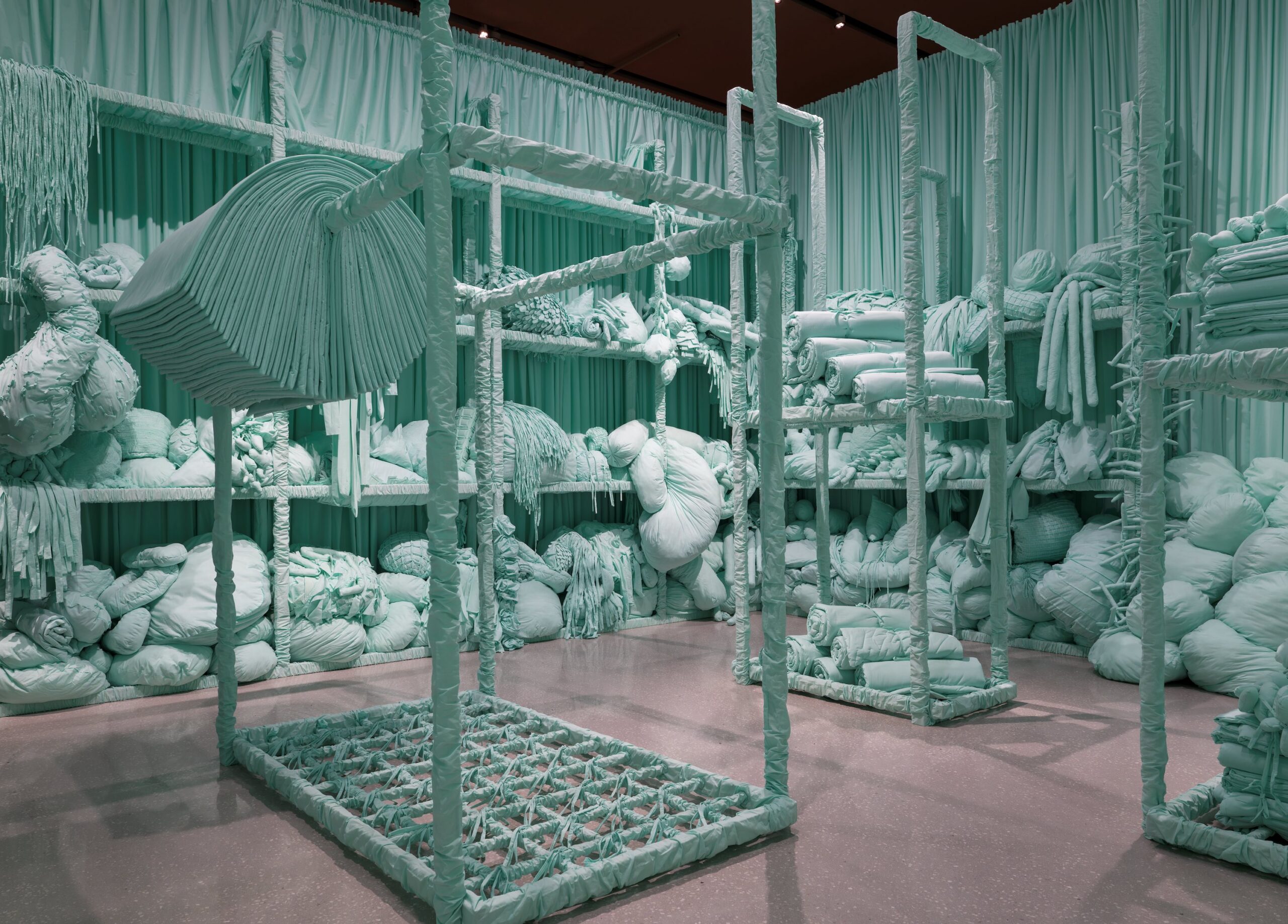
What are we talking about when we talk about crafts? That was the title of a seminar at the National Museum in Oslo, which I attended a few weeks ago. The seminar was based on the museum’s major exhibition on arts and crafts entitled Kunst-Hånd-Værk (Art-Hand-Work), which presented more than 100 works from the permanent collections of the National Museum, Kode and Trondheim Art Museum, spread over 700 square metres.
The exhibition was magnificent and grandiose in all its almost unbelievable reality: that one of Norway’s largest and most prominent museums dedicated so much space to crafts.
Part of the works on display fell under the category of visual arts, and the title of the seminar invited discussion on whether disciplinary boundaries still make sense, now that everything falls under the slightly larger umbrella of material-based art.
My immediate reaction is that, of course, it matters whether it is craft or visual art. The frames of reference are not the same. The history is not the same. The traditions are not the same. And in Denmark, the educational programmes do not share the same address, so the professional environments are separated from conception, so to speak – in contrast to Norway. If we do not actively use the term ‘kunsthåndværk’ (crafts), the professional, academic and political basis for strengthening the field will crumble.
The Intelligent Craft
I often discuss the concept of the intelligent craft. In my view, this term embodies the very best and strongest aspects of craftsmanship: knowledge of materials, technique, method, attention to detail, aesthetics and, not least, experience.
At its best, craftsmanship is the epitome of sublime material understanding and equilibrium, when you have more than the 10,000 hours under your belt that the Japanese say it takes to master a material. When practitioners reach 20-30,000 hours, it’s paradise. By then, they are so skilled they can push their material, their design language and their mission to where the angels sing.
Here is an important and, in my opinion, overlooked point. When the craftsperson manages to master their material to such a magnificent level that it sings and even says something about the world – as an intellectual statement that springs from the work of their hands – craftsmanship is far stronger and more “bad ass” than visual art.

The strength of opposites
Crafts have always been the little brother of visual arts. Perhaps because they are rounded off by domestic crafts and objects that are created with the hands for a functional purpose. When crafts are perceived as visual art, they can be invited into museums. And precisely because the hierarchy has always placed visual art above crafts, the field is eager to be elevated into the hallowed halls. Here, crafts can be seen, heard and understood in a new discourse. With new glasses that lift them out of the associations with amateur crafts and into the neat and sometimes polished, but always cool, prestigious and marketable stronghold of art. Crafts deserve to be regarded, marketed and articulated as artistic statements with weight and relevance in the world. As a field that has diversity embedded in its DNA.
Do we need to categorise craftsmanship? Maintain it? Force it into a specific framework?
The answer is both yes and no. Yes, because, as mentioned earlier, there are some general characteristics that are common despite the diversity of disciplines and expressions. A narrative that draws on history, tradition, customs and practices, and the practitioners who have worked within it. No, because it is important that the field is not held back, but constantly evolving.
Talk, write, communicate
When crafts are exhibited in museums, information about methods, tradition and ideas is needed so that the audience can understand the work behind them. Understand the tradition that the work is trying to mimic or play against. The technique that shows new ways or breaks with history. All these layers need to be brought into play so that the audience can form a bigger and more coherent picture of the craft. They can be trained to see the many layers and the message behind them.
The craft exhibitions I was lucky enough to see in Norway were all in art museums. They all had strict museum-style descriptions in their accompanying texts, with the name of the artist, the title of the work, the year it was made, and the materials used. It was too rigid, too truncated, and created a missing link between sender and receiver. The descriptions did not open any doors. In fact, they were completely closed.
Museums have an obvious opportunity to educate the public and communicate the essence and messages of crafts. If a short text had been added to the descriptions, explaining, for example, the low firing point of clay and why it is important in the particular project, we would open people’s eyes and give them an insight into the complexity (climate considerations, references or aesthetics?). I am convinced that if the public gains insight into the technical difficulties of the craft, the characteristics of the material and the interplay and contrast between traditions, they will understand why craft differs from visual art and where it sometimes overlaps. The more museums, art halls, and galleries communicate and convey information on multiple levels, the better the audience will understand what they are seeing.
Preserve crafts as its own unique art form
The question of whether ‘kunsthåndværk’ (crafts) can be classified as material-based art is open, although I hope that it cannot. The unique nature and historical impact of crafts must never be discarded in order to fit into the epistemology and cycle of visual art. Because then it ends up being something it is not. For me, the epistemology of crafts is about its ability to do both: the craftsmanship, the useful – in form or reference – and the artistic. This is precisely the strength that visual art does not embrace in the same way.
If the categories fall away, then let them fall away, but without resorting to being squeezed into new boxes that may be larger and have room for everything. Isn’t the box labelled “material-based art” just a way of shifting the problems? A box of hot air that cannot properly warm the craft, and which will therefore end up empty?
John K. Raustein on defining oneself
I trained at the Bergen Academy of Art and Design, specialising in textile art. I define myself first and foremost as a textile artist, with one foot in the visual arts and one in crafts.
For me, the material and textile techniques are fundamental, but the works are conceptually rooted and developed in dialogue with the field of contemporary art.
I therefore do not experience the distinction between art and craft as an either/or, but as a productive field of tension in/between which I consciously work.

John K. Raustein, Tilrettelagte sannheter (den nye verden)» Arranged truths (the new world) (2022) Photo: Charlotte Jul