

You have to bend down to enter the circular oven vault that forms the setting for the Craft and Tool exhibition, and as I step inside with the bright late summer sun on my retina, my eyes have to adjust to the darkness inside. The room opens up into a wide, rounded corridor, and in the middle stand the works, dramatically illuminated by golden spotlights.
The exhibition is structured in such a way that you first encounter the finished work and then move on to a podium where you gain insight into the process: material studies, sketches, moulds or tools. The works are curated by the design duo ArkForma, consisting of architect Sara Saur and designer Mathilde Østengaard-Sejersen, who are also exhibiting themselves.
The selection has been made with the desire to highlight the broad use of materials in recent design and craftsmanship and to take into account the unique exhibition venue.

Yes, in fact, the fascinating old ring kiln from 1870 was the starting point for the composition of the exhibition, because it was as if the design duo were given a common thread when they found this unique place, they tell me. Some of the works were even created for the exhibition based on the shape and textures of the ring kiln, such as Sia Hurtigkarl’s woven ‘Circle and Bricks’ and Esben Kaldahl’s ceramic work ‘Ru’ & ‘Ca’.
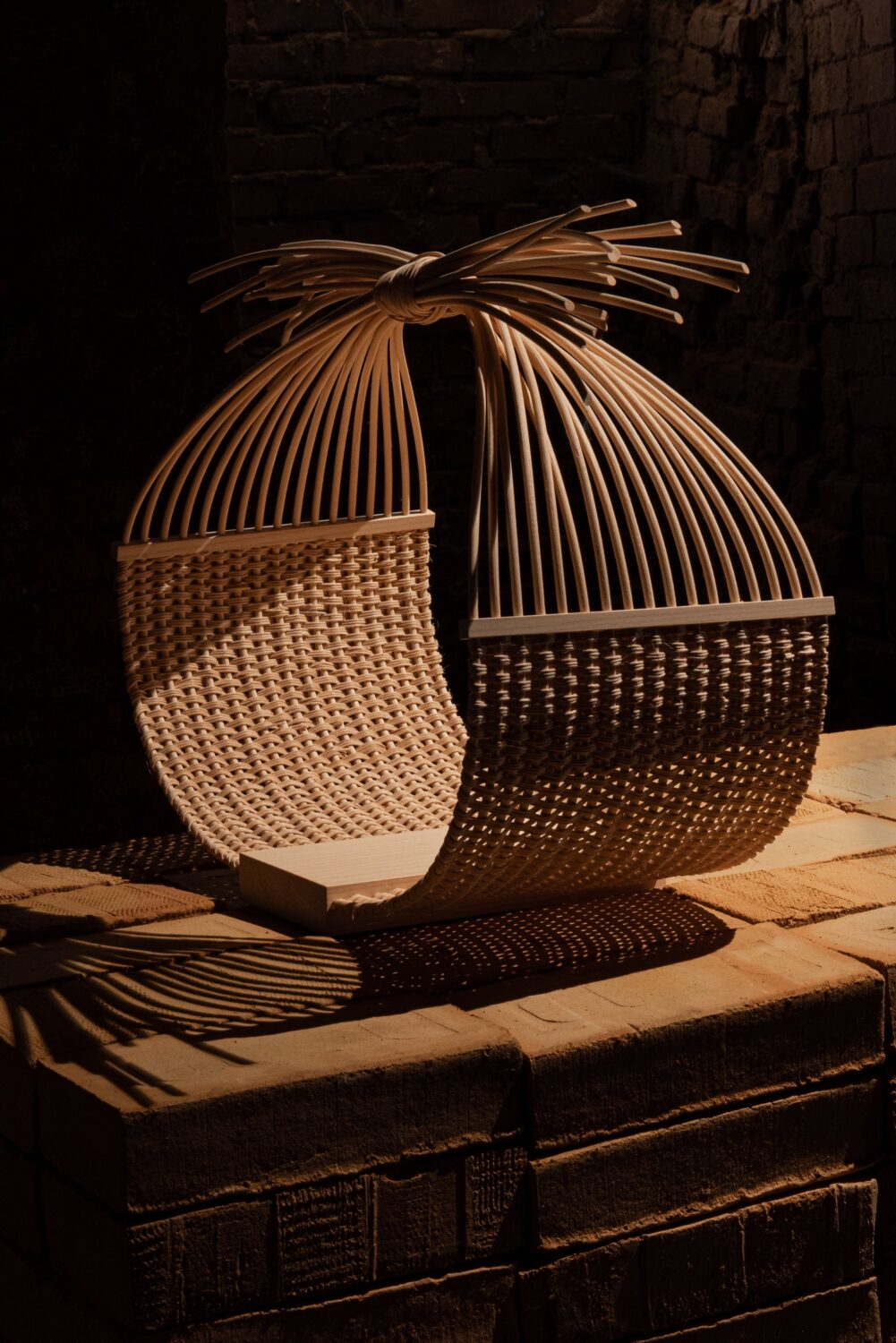
The walls of the oven vault are raw and unpolished, and the drying loft, or hayloft as it is also called, where the second part of the exhibition is located, with its rustic wooden frame, forms an airy counterpart to the more massive lower floor. The contrast between heaviness and lightness is also reflected in the distribution of the 19 works: the works on the lower floor appear with a different solidity than the more ethereal ones in the drying loft on the first floor.
It is like two sides of the same coin; heavy and light material exercises that, as a whole, showcase a wide range of craft techniques and aesthetic approaches. In other words, the building is the perfect setting to showcase the beauty of the “imperfect”. Imperfect in quotation marks, as this does not mean that the works are not aesthetically nourishing.
They certainly are, but they all contain a rawness. And that is precisely one of the elements the exhibitors want to convey: the distinctive, raw beauty that emerges when things are created from the material or slowly shaped by hand, forming a nourishing antithesis to the speed and digitalisation of our time.
For many of the designers, the design process is based on material research. Wood, textiles, clay and steel are all present in the works in the exhibition – and even a mixture of pig’s blood and sawdust in Paulina Delhaes-Heinz’s cutlery set “Sang durci”, which sends my thoughts in the direction of Dadaist explorations of what art and everyday objects are, can be and should be.
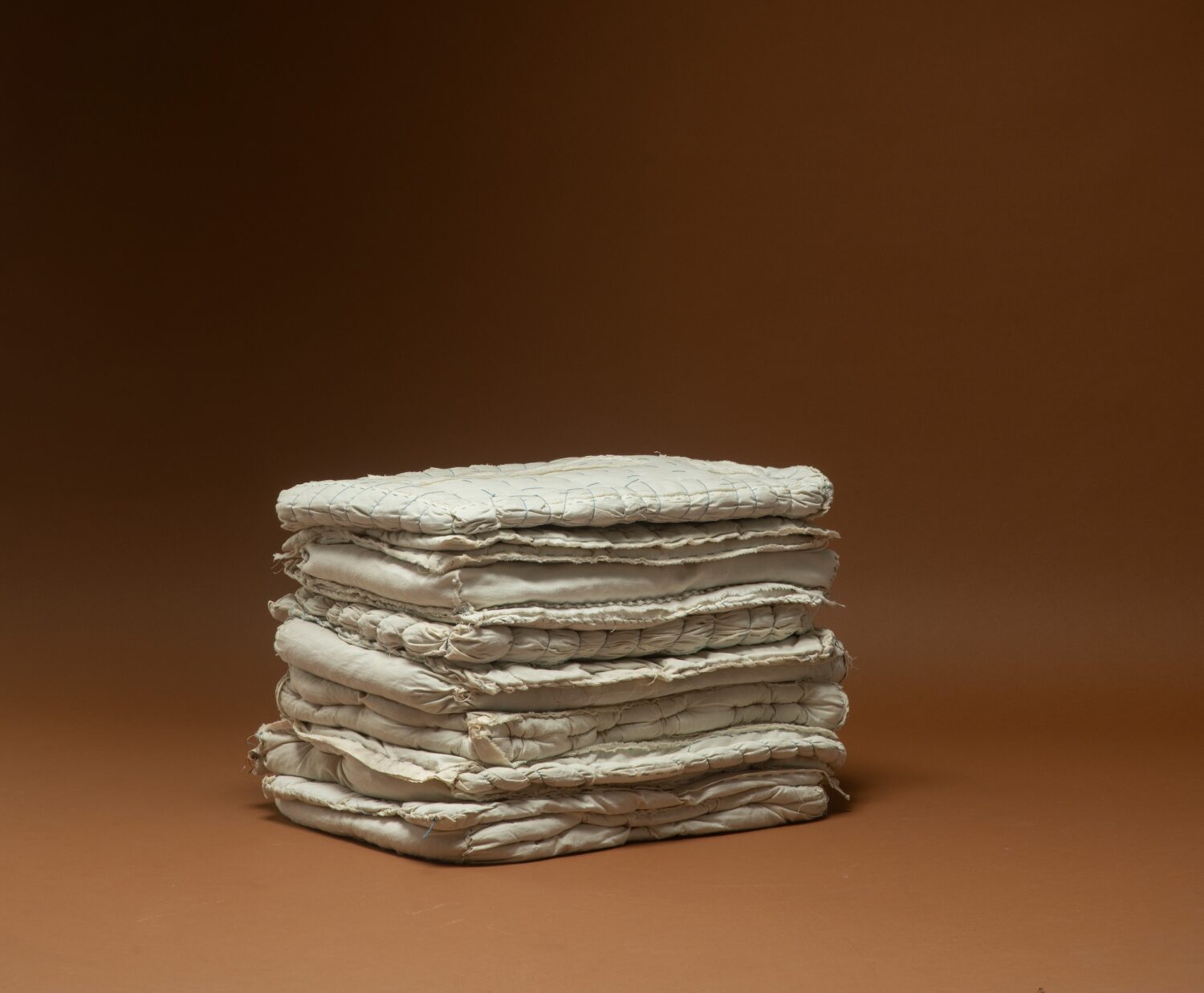
In some of the works, the ‘hands behind’ are particularly evident – for example, in Nikoline Oda’s ‘Ella,’ where tactility is the focus and the clearly hand-sewn stitches almost appear as the designer’s fingerprints.
‘Do not touch,“ says the sign next to the name and title, and I understand that, of course – but it makes me want to touch it all the more. Standing in front of ‘Ella”, I can hardly contain myself; I am told that the cushions are filled with eelgrass, which provides a very special tactile experience.
The last work in the lower floor of the ring kiln is a small group of ceramic seating objects entitled ‘Shadows of Possibilities’ by Dutch ceramicist Min Say. Again, I have to restrain myself from touching – or sitting down – because can you really sit on the bubbles that seem to shoot up from the ground? How would it feel?
I leave the oven vault, step out into the sunlight and climb the external staircase to the upper floor – the drying loft of the ring kiln.
Here, textile weaving, wickerwork and ceramic works dominate the exhibition, and the first thing that meets my eye is the design trio Plain Weavers’ room divider, woven in paper yarn, through which the light from the skylights flows freely, creating a faint checkered pattern on the floor and thus emphasizing the lightness of the room.
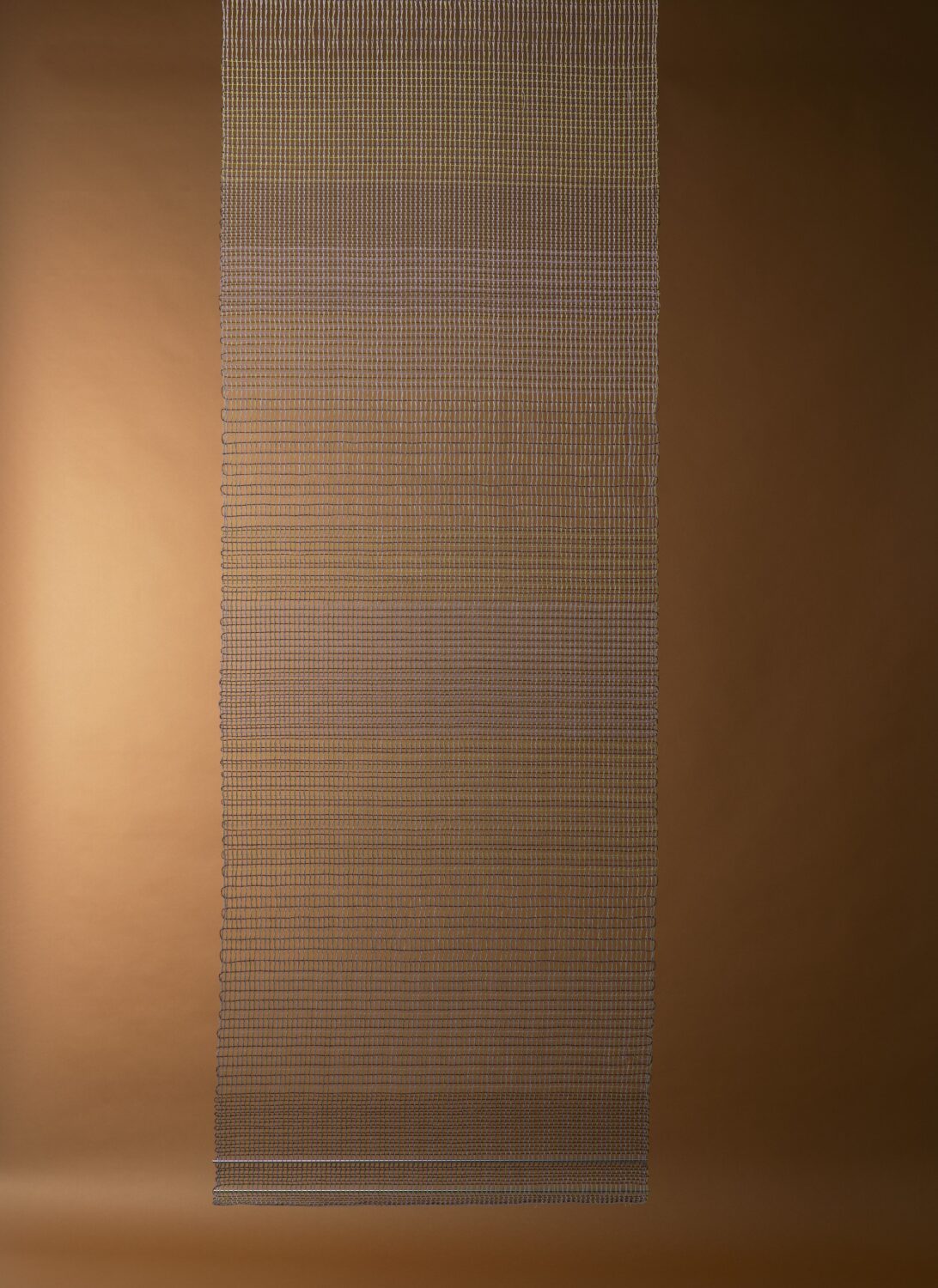
In the drying loft, I find several woven works, including the ikat-woven (Indonesian weaving, ed.) ‘One more thread, one more knot’ by Anna Bruun Kristiansen, which is woven from leftover materials from the clothing industry, thus focusing on the (probably only) materials we have in abundance in our time, namely waste materials.
The beauty lies in the raw and the open. This common thread emerges without being spelled out, as there are no explanatory wall texts, only podiums with sketches and tools and a title.
The decoding is largely left to the viewer, and thus the exhibition insists on slowness; on taking the time to experience the works for what they are: objects in space.
There is an openness to interpretation here that matches the theme well. In other words, as a viewer, you have to think for yourself, and I like that, but if you want more context, you can read about the works and designers and see process images on Arkforma’s Instagram account.
Facts
Craft and Tool: 6 – 28 September 2025.
Open every weekend (Saturday-Sunday) from 10 a.m. to 3 p.m. at Nivaagaard Teglværks Ringovn.
Read more
You may also find these articles interesting
Vibrant, living materials: Can we develop heightened awareness of the life of materials?
How do we change our relationship with the materials around us to become more aware of their life and development? The EU’s new legislation on sustainable production is a step in the right direction, but it’s far from enough.
Masters of materials
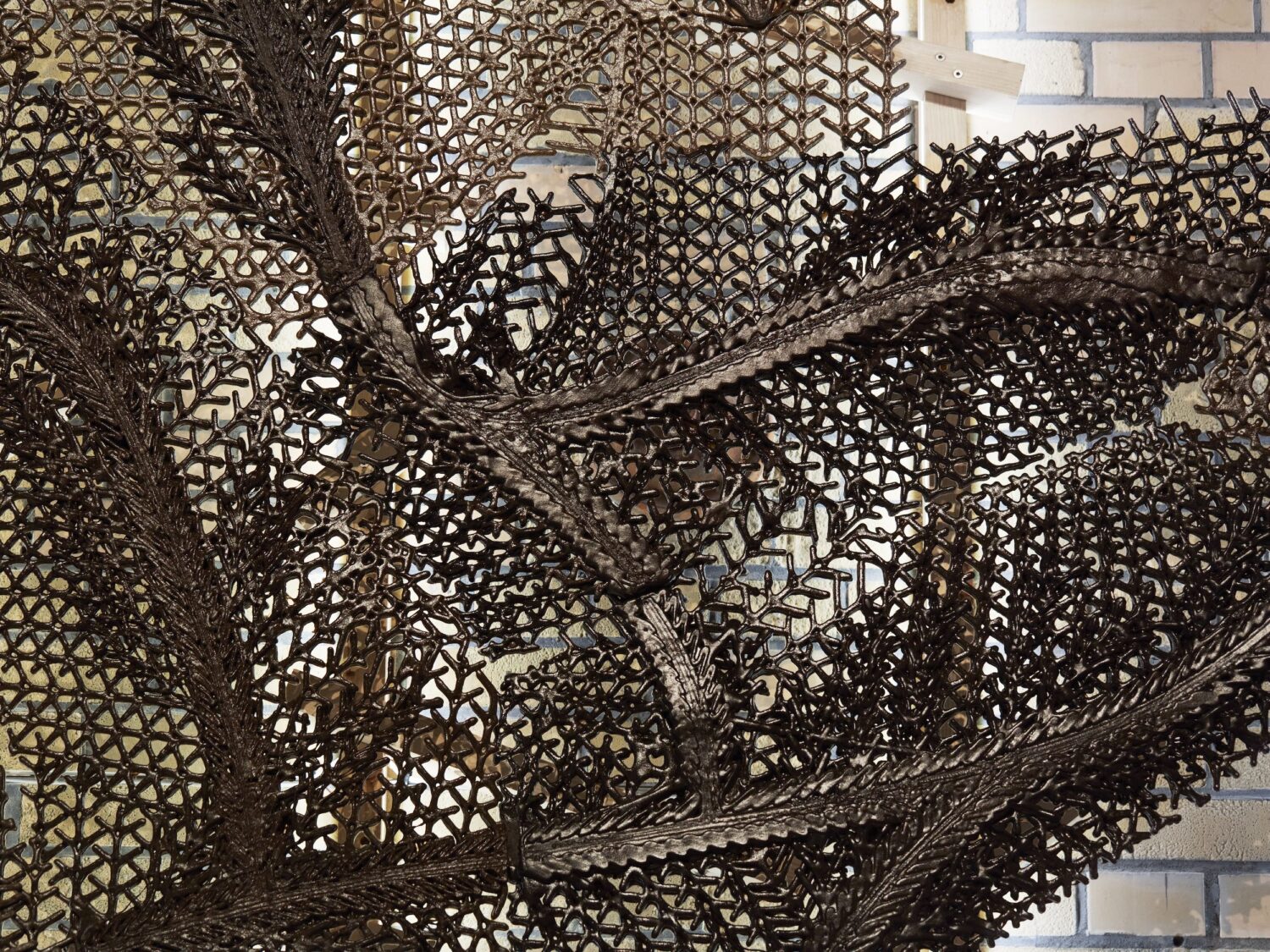
Craft makers and designers have a unique advantage when it comes to decorative projects, installations and building-integrated art in the public space: an in-depth grasp and knowledge of materials.
Glass artist and Maria Sparre-Petersen, teaching associate professor at the Royal Danish Academy, sees new possibilities in an elastic field spanning from classic decorative projects to the virtual space that everyone now carries in their back pocket.
