
Along the Little Belt, where nature, town and infrastructure converge in a striking coastal landscape, Middelfart Municipality has set a new direction for art in public spaces. With its first comprehensive art strategy, adopted in December 2025, the municipality seeks not merely more works of art, but a more coherent, site-specific and interdisciplinary approach, in which craft and design also play a central role. And here, just six months after the strategy saw the light of day, it has manifested itself in the urban space in the form of a striking work within what might almost be called the town’s signature craft: ceramics.
A clear artistic direction for the town — enriching everyday life for its residents
This is the first time Middelfart Municipality has adopted an art strategy. This is according to Steen Møller, Head of Culture and Leisure at Middelfart Municipality – and also a member of the steering group responsible for developing the art strategy. The background to the strategy is that Middelfart Municipality has a ‘five-per-thousand’ scheme, which means that five per thousand of the budgets for construction projects must be dedicated to art. And in recent years, there had been a desire not just to approve individual projects – but to look more broadly at what an art project could do for the city’s overall offering.
‘The idea for an art strategy emerged from a collaboration between the municipality’s visual arts council, the culture and leisure department, and the climate, technology and environment administration. The common denominator was the desire for new art in public spaces, including as part of some new footpaths, and this called for a joint, rigorous approach to achieve our shared ambitions, embodied in a strategy,’ he explains.
Positive experiences with public engagement
This marked the start of a comprehensive process, led by Kamilla Uttrup, the municipality’s cultural consultant. One of the measures taken was to apply for funding from the Danish Arts Foundation to hire art consultant Stenka Hellfach to lead some of the processes. And here, one of the town’s previous projects in the field of crafts and design was to play a key role.
‘We placed great emphasis on running participatory processes, both in relation to the political committees and to the public,” explains Kamilla Uttrup. “And it was really interesting to hold workshops around the city – at the town hall, at KulturØen and at the cultural venue Lillebælt Værftet – where local stakeholders and residents shared their wishes for art in public spaces. It’s important to get residents on board – that was one of the things we learnt from our project with Nærhospitalet.’

Crafts and design make the difficult waiting process more bearable
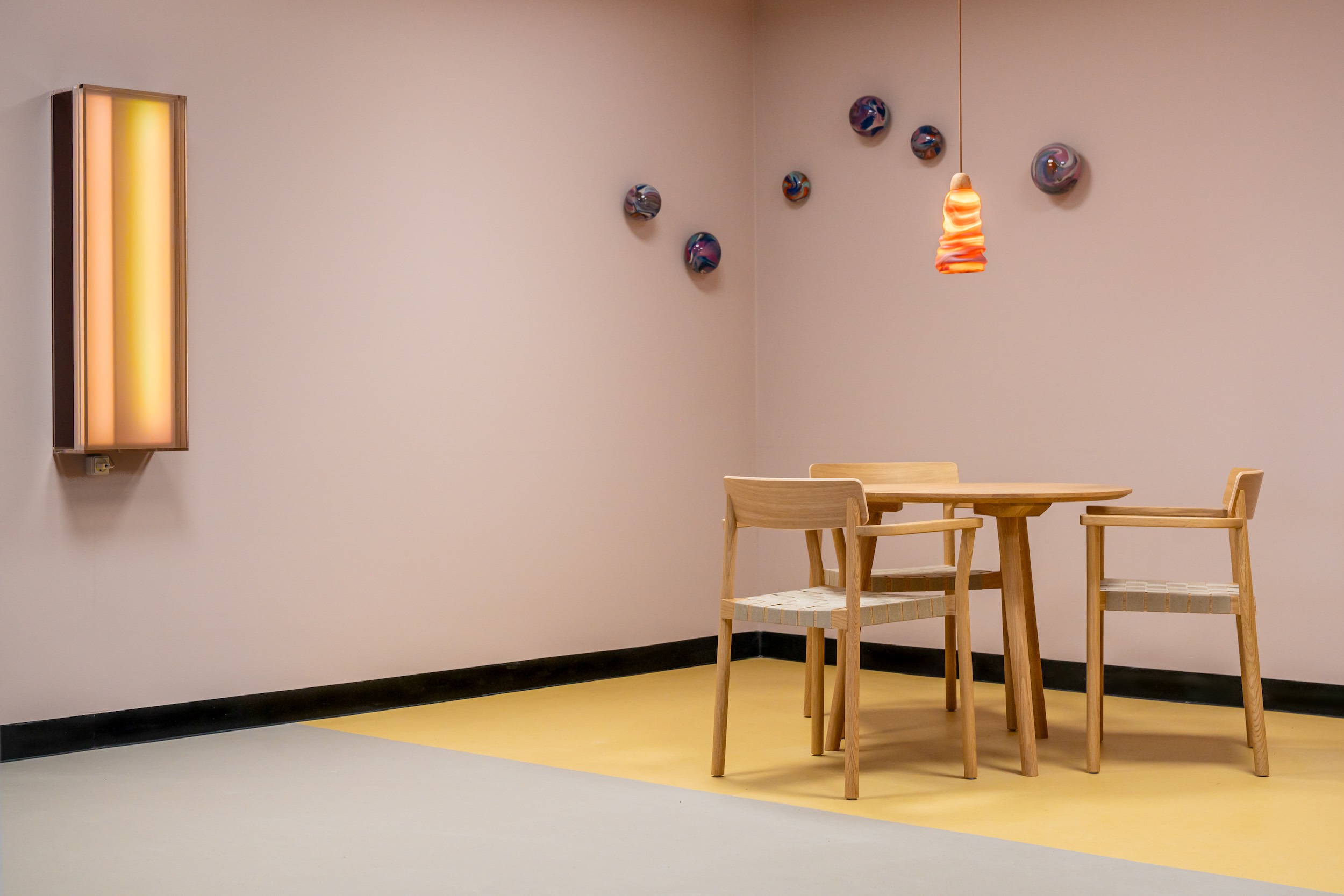
The project Kamilla refers to is a major decorative project linked to the opening of Denmark’s first local hospital in 2025 – in Middelfart Municipality. Here, local residents, including a group of vulnerable young people, were involved early on in the process, and it turned out that there was a desire for a waiting area – ‘one that didn’t make you feel any sicker sitting in, but was actually a space you wanted to be in,’ as Steen Møller explains.
The Danish Arts Foundation supported the art project, which resulted in a space featuring art, craft and furniture design, created by light artist Christina Augustsen, glassblower Marie Retpen and designer Rune Fjord. The result is a sensory space with a focus on colour and a wealth of visual experiences to distract from what might be a difficult medical consultation. In fact, Nærhospitalet has been such a success that the project was included as a model in the process surrounding the art strategy.
(Read also: A waiting area you actually want to be in)
A symbiosis of art, urban development and the surrounding environment
‘The result is an art strategy based on four themes: Quality in art, with Nærhospitalet highlighted as an example; Art for all, which focuses particularly on children and young people; Art that connects; and Site-specific art,’ explains Kamilla Uttrup.
‘In our process, we were very concerned with site-specificity, and this is generally the case in Middelfart – that is, our attractions, our urban development and the surroundings must complement one another, and it was important that this became an element of the art strategy,’ explains Steen Møller. The Middelfartkrukken is an example of this.
Crafts as a visible identity in the urban space
The strategy has already begun to take physical shape in the town. One of the most striking examples is the so-called Middelfart pots – a series of 20 unique ceramic works designed by Per Ahlmann and developed in collaboration with Clay Keramikmuseum Danmark.
‘At the end of March, we unveiled the first concrete example of the strategy’s implementation: the Middelfart pot. Together with Clay, we invited Per Ahlmann to design the pot, which was then produced at Tommerup Ceramic Workshop. The intention behind the pot is that it should mark the new, distinctive locations that will emerge in the town over time.
So when we had the official opening of our major marina project, a Middelfart Pot was installed as part of the project, just as pots have also been installed at the new diving club and in some new pocket parks around the town. “The pot is being produced in a series of 20 unique pieces, several of which will also be placed along the ceramics trail,’ he explains.
The Ceramics Trail is a 2.3-kilometre circular walking route that takes walkers on an audio-guided tour from Clay, past a wide array of ceramic works installed in the urban landscape, and through the town’s maritime environment. (Read also: A city told in clay)
‘I think it shows how we’ve taken the artistic element and used it as a tool in urban development. When something new happens in the city, the pots help to bring it to life. So far, eight have been installed in public spaces and at Clay,’ says Steen Møller.
Kamilla Uttrup adds: ‘The pots are designed to be easily movable, which is clearly evident in their design language. They are mobile, and each pot features different glazes and texts, so it is clear that they are designed for maritime themes or other well-known locations in the city. This emphasises their site-specific nature. It’s been less than a month since we unveiled the pots, but we hope that in time they will become part of the town’s visual identity.’
The reception has already been very positive, she says. ‘We had an incredibly positive experience at the project’s launch. We unveiled the Middelfart pot at Clay and the Diving Centre, where the pot’s creator, Per Ahlmann, spoke about the project – and it was absolutely packed with people.’

Art City or not?
The art strategy has five years to make its mark on the municipality. ‘We have set up a working group which is now drawing up an action plan to bring the strategy to life. The Middelfart pots project is the first and a good example, but we need to have defined at least ten concrete art ideas that our politicians can choose to work on. The art strategy should be felt throughout the municipality within the next five years, not just in Middelfart town,’ says Steen Møller.
It seems that, partly through public engagement, there has been a successful effort to connect residents with the town’s art and crafts. Steen Møller comments: ‘We feel a sense of pride in what we have in Middelfart, for example Clay and the Ceramics Route, but we do not have an ambition to become an art city. People are welcome to think we are – but that is not the driving force behind what we do.’
Theme: Crafts and design policy
Denmark needs a new design policy, but what should it include to support independent craftspeople and designers?
Formkraft explores this question through case studies, interviews, articles and debates.